

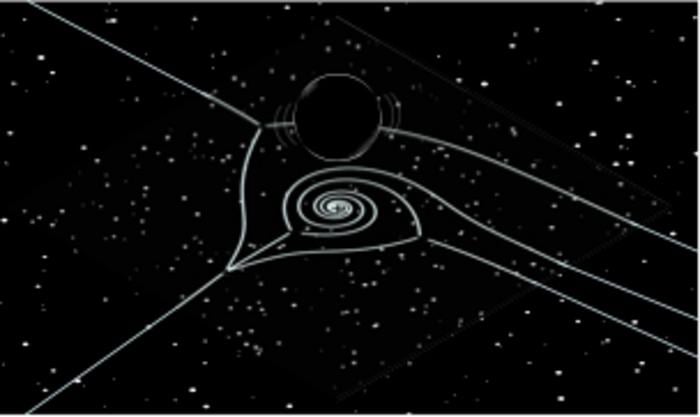
A new study from Kyoto University has unveiled a precise method for calculating the faint vibrations that ripple out from black holes after they are disturbed. These patterns, known as quasinormal modes, form complex spirals in spacetime and are key to understanding the structure of the universe through gravitational waves. Using a long-established mathematical technique called exact Wentzel-Kramers-Brillouin (WKB) analysis, the researchers tracked these waveforms with unprecedented detail.
A Familiar Method, Newly Applied
The exact WKB method has its roots in quantum mechanics but was significantly developed by Japanese mathematicians. Lead author Taiga Miyachi noted that this intellectual legacy made the work feel both culturally and scientifically resonant.
“This method is intellectually and culturally familiar as a Japanese researcher,” Miyachi said.
By applying the technique to black hole physics, the team could calculate wave behavior in regions where conventional models fail. The method allowed them to trace how gravitational waves evolve as they spiral outward from the event horizon.
Following the Spirals Through Complex Space
To achieve this, the scientists turned to complex number domains—mathematical spaces where real and imaginary numbers coexist. Within these domains, they identified what are known as Stokes curves. These curves map how the wave nature of black hole vibrations changes rapidly and, crucially, where the waves split or branch.
Previous methods often missed these spiraling branches, especially as the waves weaken. But with exact WKB analysis, the Kyoto team captured the fine details of these fading frequencies. This not only improves the match between theoretical predictions and gravitational wave observations, but also opens a path to more accurate black hole modeling.
Key Findings from the Study
– Used exact WKB analysis to calculate black hole quasinormal modes
– Detected Stokes curves and spiral wave branching not seen before
– Applied method to regions where other models break down
– Captured the frequency structure of rapidly weakening vibrations
– Linked predictions more closely to observational gravitational wave data
Why It Matters
Gravitational wave astronomy is still in its early stages, but each new technique helps extract more information from cosmic signals. The ability to detect faint, spiraling waveforms deepens our understanding of how black holes form, merge, and settle.
“It’s surprising how much complexity and beauty emerge from these equations,” said Miyachi, reflecting on the elegance of the patterns uncovered.
This research strengthens the bridge between mathematics and observational astrophysics, proving once again that old tools can uncover new truths when applied with precision.
Journal Reference
Published in Progress of Theoretical and Experimental Physics
DOI: https://doi.org/10.1093/ptep/ptae084