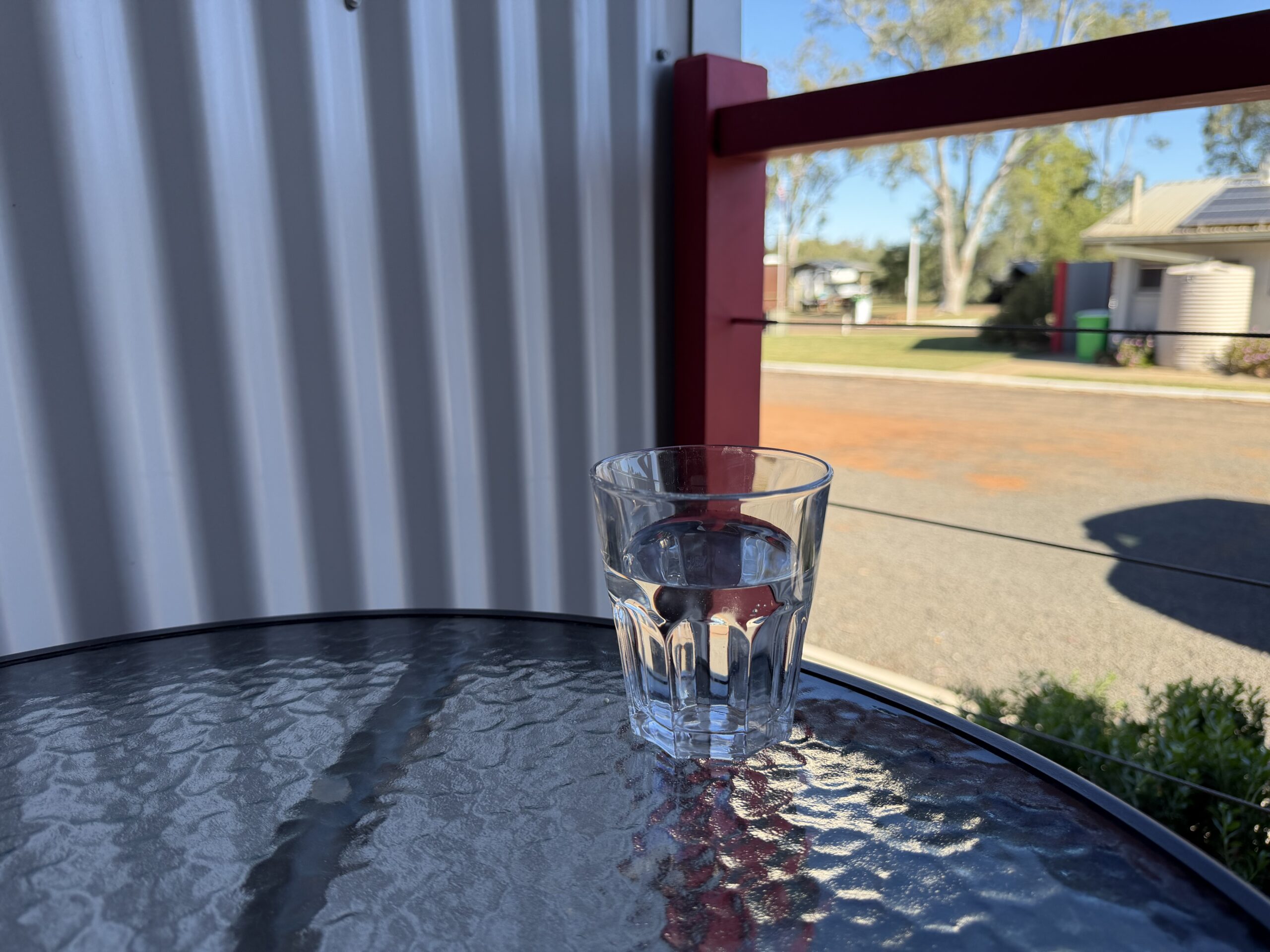
We’re travelling around Queensland at the moment, and one of the things I love about travelling this way is that you never quite know what is going to make you curious.
Sometimes it’s the landscape. Sometimes it’s a person you meet. And sometimes, apparently, it’s the water coming out of the bathroom tap.
We’re currently in Cunnamulla, a small outback town in south-west Queensland. I turned on the tap and immediately noticed something different.
The water had a smell.
Not necessarily an alarming smell. Just one that made me hesitate for a moment and wonder: Is this actually okay to drink?
Then I noticed a sign explaining Cunnamulla’s water supply.
It said the town’s water comes from deep beneath the ground, from the Great Artesian Basin. According to the sign, it is pumped from roughly 500 metres underground before being cooled and distributed around town.
That sent me down one of those wonderful travelling rabbit holes.
Because the more I discovered about what was happening beneath my feet, the less interested I became in the smell — and the more fascinated I became by the extraordinary hidden world underneath much of Australia.
There is an enormous body of water beneath Australia
The Great Artesian Basin is difficult to comprehend because we can’t see it.
We can stand beside a river and watch it flow. We can look across a lake or reservoir and understand, at least visually, where our water is coming from.
But groundwater is different.
The Great Artesian Basin stretches beneath approximately 1.7 million square kilometres of Australia — more than one-fifth of the continent — extending beneath parts of Queensland, New South Wales, South Australia and the Northern Territory.
The Australian Government describes it as Australia’s largest groundwater basin and one of the largest underground freshwater resources in the world. It contains an estimated 65 million gigalitres of groundwater.
That figure is so enormous that it almost becomes meaningless. The Department of Climate Change, Energy, the Environment and Water puts it another way: enough water to fill Sydney Harbour about 130,000 times.
And here we were, brushing our teeth with it.
There was something about that thought I found extraordinary.
The water coming from our tap has been on quite a journey
I initially pictured the Great Artesian Basin as a gigantic underground lake.
It isn’t.
The water is held within layers of permeable rock — aquifers — separated in places by less permeable geological layers. Rainfall enters or “recharges” parts of the system, particularly around the margins of the Basin, and groundwater then moves through these geological formations.
In Queensland, much of the recharge occurs along the western slopes of the Great Dividing Range, where rainfall and water from streams infiltrate the ground.
And this is not necessarily a quick journey.
Some water within the Great Artesian Basin is extraordinarily old. The Australian Government notes that in some parts of the system groundwater can be more than one million years old.
That stopped me.
Obviously, that doesn’t mean the particular glass of water sitting beside me in Cunnamulla is a million years old. Groundwater age varies enormously depending on where it is in the Basin and how it has moved through the system.
But it does change the way you look at a tap.
We tend to think of water as something immediate. Turn the handle. Fill the kettle. Have a shower. Brush your teeth.
Yet groundwater reminds us that some of the natural systems supporting our very modern lives operate on timescales almost impossible for us to imagine.
In Cunnamulla, the water really does come from hundreds of metres below us
The sign in our accommodation says the water is pumped from roughly 500 metres underground.
I wanted to check that, because tourist signs — delightful though they can be — aren’t always where I would choose to end my scientific investigation.
It turns out that the figure is remarkably close.
A drinking-water management document from Paroo Shire Council reports that Cunnamulla’s water supply comes entirely from artesian bores drawing from the Great Artesian Basin at depths of approximately 550 to 650 metres.
Think about that for a moment.
More than half a kilometre beneath the place where you’re standing is water contained within ancient geological formations, and that water is being brought to the surface to supply a small Queensland town.
Suddenly my slightly funny-smelling shower seemed considerably more interesting.
So why does Cunnamulla’s water smell different?
This was, of course, the question that started the whole thing.
The sign explains that Cunnamulla’s artesian water has a distinctive mineral composition, mentioning sodium carbonate as well as chloride and sulphate.
That basic idea makes sense: groundwater chemistry is influenced by the rocks and sediments through which water travels.
As water spends time underground, interactions between the water and surrounding geological materials can change its chemistry. And across something as vast as the Great Artesian Basin, water chemistry isn’t uniform. Geoscience Australia actually maps variations in water chemistry across its major aquifers.
Paroo Shire Council’s own water-quality documentation describes Cunnamulla’s supply as soft and high in pH. It also reports that the artesian bores are the source of the town’s water supply.
So if you’re accustomed to drinking treated surface water in a major city, artesian water can be a sensory surprise.
And smell is remarkably good at attracting our attention.
You don’t stand in a hotel bathroom contemplating hydrogeology when the water smells exactly as expected.
Perhaps we should be grateful for the smell.
I became a little more sceptical when I reached the health claims
The sign didn’t stop at geology.
It also suggested that the mineral-rich water could help with everything from skin hydration and muscle relaxation to circulation, sleep, hair health and “detoxifying” the lymphatic system.
This is where my curiosity changed gear.
I have been interested in health, wellbeing and self-development for more than 20 years, and increasingly I’ve become interested in the evidence behind the claims we make.
There is an important distinction between saying water contains particular minerals and saying drinking or bathing in that water will produce specific health effects.
Those are two very different claims.
The sources I found support the fascinating story of the Great Artesian Basin, its mineral-rich groundwater, its geology and its enormous importance to inland Australia. I did not find comparably strong evidence to justify treating the long list of health and beauty benefits on the sign as established effects of Cunnamulla’s tap water.
That doesn’t mean every possible benefit is impossible. It simply means I wouldn’t turn a charming local sign into medical advice.
And I rather like that distinction.
Being curious doesn’t require us to believe everything we read. In fact, curiosity becomes much more interesting when we ask the second question:
How do we know?
The bigger story isn’t really about the smell at all
The more I read, the more I realised that the truly important thing about this water isn’t whether visitors like its taste.
It’s what it makes possible.
The Great Artesian Basin is a critical source of water across some of the driest parts of the country. The Australian Government says it supports around 120 towns, as well as thousands of businesses and communities across inland Australia.
Its significance stretches back far beyond modern bores and plumbing. Aboriginal and Torres Strait Islander peoples have depended upon Basin water in Australia’s arid interior for tens of thousands of years, with deep cultural, social and spiritual connections to its springs and landscapes.
It also supports extraordinary ecosystems.
Natural artesian springs can occur where groundwater finds its way to the surface through geological structures. Some of these isolated spring environments support species found nowhere else.
And because this resource is so vast, it would be easy to imagine it is limitless.
It isn’t.
Groundwater pressure, extraction, leaking bores and inefficient open bore drains have all mattered historically. Governments and communities have spent years capping uncontrolled bores and replacing open drains with pipes to reduce water losses. Recent basin-wide assessment is encouraging: groundwater pressure has improved, extraction has declined over the past decade, and water quality has remained broadly stable over the past five years.
That seems to me a much more important story than whether artesian water makes your hair shiny.
Travel has a wonderful way of reminding us how much we don’t notice
This is one of the things I’m enjoying most about travelling through Queensland.
Travel makes ordinary things unfamiliar again.
At home, I can turn on a tap without giving the water a second thought. I don’t wonder about the rock it has passed through, the landscape where it entered the ground or the enormous systems required to deliver it to me.
Here in Cunnamulla, I did.
And perhaps that’s one of the underrated gifts of travel as we get older.
We often think travel needs to involve spectacular destinations and bucket-list experiences. I’ve certainly thought that way myself. But increasingly I’m finding that some of the best moments are much smaller.
You notice something.
You ask a question.
You discover something you didn’t know yesterday.
And suddenly an ordinary morning becomes interesting.
This morning, I turned on a tap because I wanted some water.
Instead, I found myself thinking about rain falling somewhere on the Australian landscape, water slowly entering layers of rock, an immense groundwater system stretching beneath more than one-fifth of the continent, and a little outback town that depends upon it.
The water still smells rather strange to me.
But tonight, when I turn on that tap, I suspect I’ll appreciate it a little more.