

An eminent Russian biochemist has been working fifteen years to get the cell’s most active anti-oxidant into the mitochondria, which is the locus of its action. Called “SkQ” for short, his designer drug administered in food, has been shown to make mice live longer; and topically it can induce regression of eye diseases in rodents, dogs and horses. While the long process of US FDA review has just begun, an eye drop containing SkQ has been approved for sale in Russia, and can now be purchased in Moscow drug stores.
Biochemical background: Ubiquinol in Mitochondria
Mitochondria are “organelles”, hundreds of independent energy factories floating within the cells of all higher life forms. Sugar is “burned” in the mitochondria, and the energy generated is stashed as molecules of ATP, which act like a battery that the rest of the cell can use. Muscle and nerve cells are large consumers of energy, and their function can be limited when mitochondria in aging cells begin to wane. Mitochondria have another role as well: they serve as executioners for diseased or damaged cells. It is the mitochondria that emit peroxides, which trigger a cascade of signals, culminating in cell suicide, or apoptosis. (This story is told colorfully and creatively in a book I highly recommend, called Power, Sex and Suicide by Nick Lane.)
Ubiquinone was named as the enzyme that is “found everywhere”. Every cell needs energy, and every cell relies on mitochondria to supply that energy, and every mitochondrion uses ubiquinone, both to create the energetic molecules of ATP that are exported for use in the cell’s primary functions, and also to clean up the mitochondria’s effluent of peroxides. Peroxides are an example of reactive oxygen species (ROS). ROS are toxic waste that corrodes the body’s delicate chemistry. At higher concentrations, peroxides constitute also a distress signal which can trigger cell suicide and even export a suicide message to neighboring cells.
As we age, we have less ubiquinone and there are dire consequences: less energy in our muscles and nerves; more toxic waste that damages and poisons more delicate chemicals; and over-active cell suicide that destroys healthy cells in our muscles and brains. We lose strength, sensitivity and mental acuity. Ubiquinone is sold as CoQ10, a nutritional supplement that some people take for heart health and oft-imputed anti-aging benefits. But no animal study has ever succeeded in extending life span with CoQ10. Perhaps its value is limited by bioavailability. Only a small portion of ingested CoQ10 makes its way from the stomach into the bloodstream, and a much tinier portion actually reaches the mitochondria where it is needed. This is the issue that Skulachev has addressed in such an innovative way with his molecule, which his friends and students have affectionately dubbed SkQ.
The molecule and how it works
Skuklachev’s molecule is designed like a tugboat pulling a barge on a chain. The barge on the left is a molecule like ubiquinone. The 10-carbon chain is a simple hydrocarbon. And the tugboat on the right consists of a positively charged phosphorus atom, surrounded by ligand residues that delocalize and shield the charge. This works because mitochondria, in nature’s design, are the only parts of a cell to carry a consistent electrical charge. They are continuously pumping protons out through their membranes, maintaining a negative electrical potential within the mitochondria.
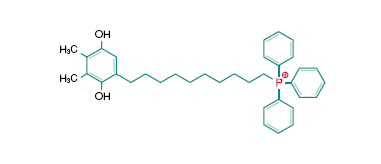
The electrostatic attraction is a powerful lure, drawing the positively-charged tugboat into the mitochondria, and dragging the barge in behind. The effect is to concentrate SkQ a million-fold inside, compared to outside the mitochondria. This means that very tiny amounts can be effective antioxidants. SkQ is a very practical drug, inexpensive and non-toxic because it is administered in tiny doses.
Curiously, the “barge” on the left is not the version of CoQ that is used by mammals, but the plant version, called plastoquinone, which is an even more effective anti-oxidant. After comparing plastoquinone to ubiquinone in animal experiments, Skulachev switched to plastoquinone several years ago.
Anti-oxidant or signal molecule?
Readers of this column must be aware that I have been skeptical about anti-oxidants for life extension. It appears that SkQ may be an exception because it is so precisely targeted to mitochondria. There is some precedent for the exception, in that genetic interventions that are targeted to the mitochondria have also been found to extend life span in mice. This study arranges for extra copies of the anti-oxidant called catalase in the mitochondria only. Perhaps the reason for the exception is that to the mitochondria, peroxides not only cause molecular damage, but also can signal cell suicide. This is the theory that Skulachev has promoted.
He should know. In earlier days, Skulachev was responsible for elucidating the electrochemistry of mitochondria in relation to energy generation and programmed cell death.
Life extension in animals
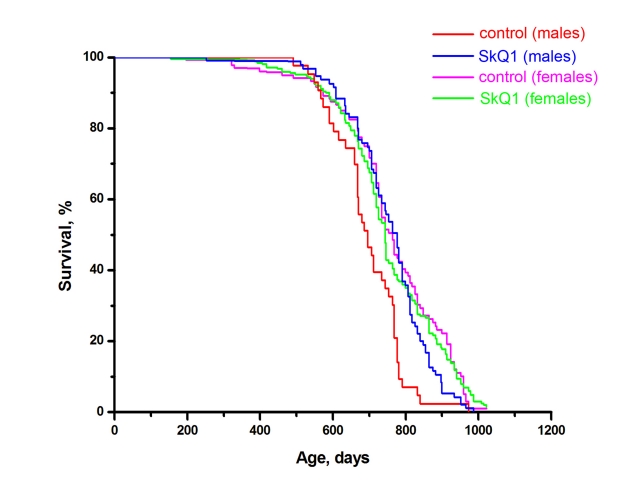
Since 2007, Skulachev’s lab at Moscow State University has been publishing studies which demonstrate life extension, first in flies and other invertebrates then in a variety of different rodents. SkQ has also been shown to delay all the common diseases of aging in rats. The effect on life span is easily discerned, and is large under some circumstances:
Administered as eye drops, the effect has been more dramatic. Rabbits have been cured of glaucoma. Macular degeneration has regressed in horses and dogs. Experimenting on himself, Skulachev reports that his age-related presbyopia has regressed to the point where he can see without glasses for the first time in many years.
Present and future
SkQ has cleared the Russian equivalent of FDA approval. Clinical trials have begun for SkQ, and preliminary results indicate that 80% of people who were given the drops for cataracts experience an improvement in visual acuity within half a year (unpublished). As of last summer, SkQ eye drops have become available for sale in Moscow and environs through a partnership with a company named Mitotech, under the brand name Bизомитин, or Visomitin in a more familiar script. Sales are brisk because Skuklachev is something of a legend in his own country. There is no present timetable for marketing Visomitin in America.
Discussion
28 reader comments
Imported threads are marked Archive. New comments are welcome and moderated for spam.
I used visomitin drops, 3x per day, for 6 weeks.
It did not help my dry eyes, however is absolutely helped my presbyopia. I’ve just ordered 8 bottles and hope to continue using it, as 13 weeks is the point at which it should also help my dry eyes.
For about 9 months I‘be been treating my mothers AMD with it. Her vision stopped deteriorating since she starting taking it. Yesterday she called me to tell me that she had a slight subjective improvement (can read signs that she couldn’t read one year ago), and her doctor actually detected a slight objective improvement, something like going from 3% vision in one eye to 8%. Sorry for the lack of details, that’s just what she remembers from her doctors visit.
Hello Josh Mitteldorf,
How and where can I buy these SkQ products?
Last mail on this question was June 2016.
Has something changed for Europe?
I looked also at your blog on MitoQ. Today April 23 sciencedailycom had news about it. Which seemed to me too commercial. So, I started searching for critical info and found your blog. Thank you.
P_ter
I imported this for my optic neuritis and this cured but I ran out blindness came back.
This study may put the brakes on the enthusiasm for Mitotech. I know that Skulachev comments here from time to time and would love to have him discuss this study.
http://www.nature.com/articles/srep33944
I'm fascinated - this needs follow up. Did anybody try this online pharmacy rupharmacy.com/VISOMITIN? Is it the real product? Are there any links to information on the human trials? Did Sabra St.Germain experience any improvement?
If “Mature lens fibers have no organelles or nuclei” (https://en.wikipedia.org/wiki/Lens_(anatomy)#Lens_fibers), and in cataracts “Clouding of the lens occurs due to changes in the proteins and lens fibers.” (http://www.aoa.org/patients-and-public/eye-and-vision-problems/glossary-of-eye-and-vision-conditions/cataract?sso=y), how can “80% of people who were given the drops for cataracts experience an improvement in visual acuity” as a result of a drug that targets mitochondria?
did anybody try this online pharmacy rupharmacy.com/VISOMITIN?fake or real product?
I haven't tried their product but I am using mitoQ and seeing great improvements in my vision and reduction of cataract symptoms. My understanding is that cataracts result from the binding of adjacent proteins with glucose. Perhaps it is somehow reversing that binding. All I know is street lamps no longer have star effects, stars are now a point source of light in the sky again instead of a fuzzy blob. I don't see any visible haze looking across the room.
I used rupharmacy, however it took about 2.5 - 3 weeks to arrive. Recently ordered from nootropicspot, they are hoping to arrive in about a week (according to tracking) and it’s about half the cost.
Now it is impossible to buy it on ebay. I take it here
rupharmacy.com/VISOMITIN
I bought the Visomitin eye drops on ebay. instructions all in Russian but I could see a 2-8 degrees Celsius on the packages so it must need to be refrigerated. The drops did not arrive in a cold pack however, and took about two and a half weeks to arrive from Russia so if you plan to use them please count on the delivery time to re-up if you need another bottle. The drops make my eyes feel great. Been using them about a week but see no vision changes yet. Per the blog Dr. S said he used them about half a year before he got results. I am putting one drop in each eye three times a day. Today is 8-13-15. I will see what happens by February. I would really like to put away my glasses or at least use them less.
any updates on eyes improvement by Visomitin, me and a friend are seeing good chances on nicotinamide riboside starting after few weeks but we are both just a couple of months using it.now we require reading glasses only and we both can read newspaper without glasses but only under a very strong light or under the sun, if light is not strong presbiopia is still present but for me it is really great i only need glasses for small writing as newspaper or cellphone.just thinking of adding visomitin to hopefully get rid of glasses complitely
wow.
but how do you get the SKq drops? without going to Moscow? do you have to buy the solid and mix with nasty nasty DMSO? I dont want to taste that garlic taste and I really am not sure about putting dmso in my eyes.
To my knowledge, SkQ is not yet available in the US.
If anyone is planning a trip to Russia, let me know and maybe we can arrange a group purchase.
- Josh
It looks as though Sk-Q is available from Eby
http://www.ebay.com/itm/VISOMITIN-R-cataract-eye-drops-SKQ-1-Skulachev-Anti-Ageing-Ions-/321781446698?pt=LH_DefaultDomain_0&hash=item4aebab382a
i have a friend whose wife is russian and he goes to russia from time to time, and i also have a friend in canada and US who has a company connected with many scientists and universities in canada and Los angeles, they mainly study cirrhosis/fibrosis reversal (but not achieved what i did, cirrhotic nodules clearance) so very interested in all our antiaging stuff since it is all connected to health, he will visit italy soon
so i can ask if we can get SkQ from russia and give it also to my friend in canada
does it worth to go to russia for it, me and my friend have zero financial issues but very busy jobs, if this really worths we can go get it.do you want some of it?is SkQ more interesting than telomerase activators like ta65?can it reverse mild presbyopia (me and the russian friend are already reversing it by NR).i ll also check if there are ways to get it shipped in EU.thank you
SkQ Visomitin is for sale for research by special order from medkoo.com
It comes as a solid; but is soluble in DMSO. Must be kept refrigerated if used within a few days, or frozen if stored for up to 2 years.
I am suspicious of my mitochondria. They are really just symbiotic bacteria with their own DNA. Inside their regular cellular membrane, they have their own bacterial membrane. How do I know they are even on my side in the battle for life? They are responsible for apoptosis (cell suicide). I also suspect they are responsible for aging. All they have to do is dial down ATP production, and the lack of energy could be the basic cause of all aging and chronic diseases.
Well that is to suggest that people with ADHD live longer lives I doubt that's ever been proven in a study
How is it possible to get such a relatively large molecule a) into a cell b) into the mitochondria? Just how leaky are the mitochondrial membranes? Also, is there any research on whether the molecule is able to avoid hydrolysis in the GI-tract? And whether it is absorbed to the bloodstream as a whole molecule? Seems kind of unbelievable that it would. I hope to be proven wrong.
"Large molecule" is a relative thing. In biochemistry, the word usually refers to a protein with hundreds or even thousands of amino acids strung together in a chain, then folded precisely to form a functioning molecular machine.
It's true that it requires a lot of energy to pull a molecule into the mitochondria. But this energy is already being supplied incidentally by the mitochondria themselves. In supplying electrochemical energy to the cell, the mitochondria are constantly pumping protons out into the cell cytoplasm, leaving behind a net negative charge. SkQ makes use of this negative charge by attaching a positive charge to the plastiquinone molecule, so that the mitochondria's own energy is harnessed to suck SkQ inside.
You are right that absorption of SkQ through the digestive tract is a big issue, and most of it is lost. I'm not aware of studies that measure the absorption quantitatively. In the first clinical trials of SkQ, delivery is in the form of eye drops.
could the eye drops be used sublingually?my guess is absorption should be better than the digestive tract, and how much to use sublingually?
Marco, clinical trials for SKQ1 (plastomitin) through oral administration is already being conducted. I think you are better off, waiting for it to become commercially available, when the exact dosage, possible side effects etc. are established.
Here are some details that I learned from Dr Skulachev recently:
- Several years ago his lab switched from SkQ based on ubiquinone to a very similar molecule based on plastiquinone. Ubiquinone is found in animals, and plastiquinone in plants. The plastiquinone version was found to be much more effective. More important, the margin for error was also much higher for plastiquinone. Ubiquinone can be a pro-oxidant and do more harm than good if concentrations get too high. But plastiquinone is beneficial in a very wide range of concentrations.
- In tests on mice, SkQ had a much larger effect on life span when the mice were raised in a normal, germy environment rather than a sterile lab environment. Dr Skulachev interprets this as evidence that one primary benefit of SkQ is to slow the aging of the immune system.
Is ubiquinol toxic above certain quantities?
Max 200mg/day?
I think that Dr Skulachev was referring to extremely high concentrations of ubiquinol in mitochondria, such as can only be obtained by targeted therapies such as SkQ. I have never heard that there is a max safe dose of ubiquinol or ubiquinone, and in fact getting enough into the mitochondria is not possible in practice, after a certain age.