

CoQ10 plays a crucial role both in energy production and in detox. Our bodies make less of it as we age, and we function less well for that. For more than 30 years, supplementation with CoQ10 has been identified as a promising anti-aging strategy and preventive for diseases of the heart and the brain. But in extensive animal studies and dozens of clinical trials, CoQ10 has shown modest benefit, or none at all. Part of the problem is that, when CoQ10 is taken into the digestive system, very little of it gets to the site where it can work. Where CoQ10 belongs is in the cellular energy factories, the organelles called mitochondria. Very recently, a mitochondria-targeted form of CoQ10 has become commercially available. Preliminary experiments with MitoQ in animals and humans are very promising.
How much is enough?
At the Second SENS conference in 2004, I sidled up to an expert whom I respected and asked, “What’s the optimal dose of CoQ10?” He laughed and asked, in reply, “How much can you afford?”*
Mitochondria are “organelles”, hundreds of them in every cell, that provide the energy that is used for everything from thinking to fleeing Sabre-tooth tigers. We have less mitochondria as we age, and the mitochondria we do have function less efficiently. This fact contribuetes to diverse aspects of aging. The high-energy redox chemistry of the mitohondria is also the primary source of free radicals that cause oxidative damage associated with age.
Another role played by mitochondria is that they are the designated hit-men when a cell outlives its usefulness, or becomes cancerous or diseased, or needs to be eliminated for any reason. Apoptosis is the process by which an individual cell is programmed to commit suicide for the sake of the larger organism, and the mitochondria orchestrate the killing, emitting the chemicals that do the dirty work. In older animals (and people), apoptosis becomes over-active, and we lose perfectly good nerve and muscle cells to cell suicide.
Coenzyme Q, a.k.a. ubiquinone, is a small molecule, a key chemical component in the working of the mitochondria and also the first-line anti-oxidant that prevents the generation of free radicals in the course of energy generation. As we age, each mitochondrion has less ubiquinone than it needs to function well. Long-lived species have more CoQ, pound for pound, than short-lived species. Hence CoQ has been recognized as an anti-aging compound for twenty years. Today it is routinely prescribed by many cardiologists, because statin therapy depletes CoQ.
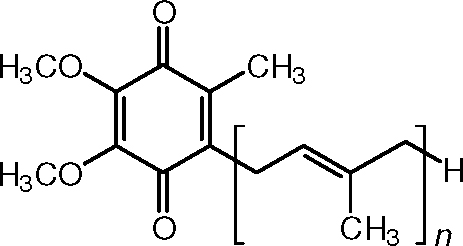
But eating ubiquinone doesn’t work very well. It is poorly absorbed in the digestive tract (the molecular variant called ubiquinol is supposed to mitigate this problem), little of it makes it into the blood stream, less into the cells, and a pittance to the mitochondria where it is needed.
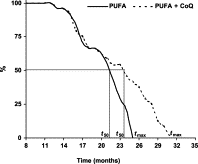
This may be one reason CoQ supplementation has failed to live up to its potential. A Spanish Study (2004) found that CoQ could increase the mean and maximum life spans** of rats on a diet rich in polyunsaturates. (Polyunsaturated fats are prone to oxidation.) Doses were modest, equivalent to daily 50mg capsules for humans. But this result was exceptional. More typical are these studies (Ref Ref Ref Ref), which begin with great enthusiasm, but report no benefit for life span or mortality in mice and rats.
Provenance of Mito-targeted CoQ
In the 1990s, Michael Murphy and Robin Smith, two New Zealand biochemists, had an idea to get ubiquinone more efficiently into the cells’ mitochondria – the only place where it is useful. It happens that part of the mitochondria’s electrochemical activity is to continuously pump protons out through their membranes. Hence they maintain a negative electric potential relative to the rest of the cell. Anything with a positive charge is drawn into the mitochondria, and if it’s not a proton, it won’t be pumped right back out again. Murphy and Smith were inspired to create a molecule that combined ubiquinone at one end with a chemical tugboat at the other, a positive ion that is “chelated”, meaning that the positive charge is spread over a large number of atoms so that there is less tendency for it to simply pair up with a negative ion and be permanently neutralized. The chemical “tugboat”, called TPP for tri-phenyl phosphonium, had been developed 25 years earlier in the Moscow State University lab of Vladimir Skulachev (Grinius et al, 1970). Connecting the tugboat to the ubiquinone is a simple carbon chain that prevents interference between the chemical properties of the two ends (Smith and Murhpy, 1999)
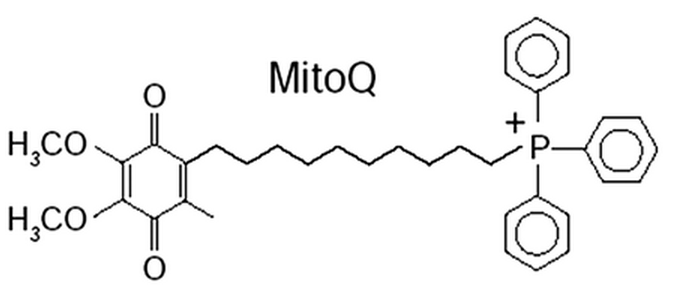
The next step was to synthesize this molecule in the lab – a task requiring a lot of ingenuity and lab experience, but Smith was up to it. Then came years of testing the substance, first in cell cultures, then in animals, with various applications. Targeting worked amazingly well, with virtually all of the Mito-Q molecules finding their way to the mitochondria. This means that very low doses can result in very high effectiveness.
Skulachev, who had pioneered the early work on the right-hand part of the molecule, picked up this thread early on, and has sponsored much of the research that has demonstrated the rejuvenating potential of the molecule. The molecular tugboat is known as a “Skulachev ion”, and a similar molecule*** to MitoQ has been dubbed “SkQ” and explored in Russian experiments.
Last year, a New Zealand company completed licensing requirements and created a manufacturing facility, and MitoQ is now available by order on the Internet for delivery worldwide. The product was first announced at the A4M annual showcase meeting in November. A year earlier, Skulachev’s company had begun to sell SkQ as eyedrops, available thus far only in Russia. Skulachev’s group has long-term plans to develop the product for other uses as well, and to obtain licensing in Europe and America.
Some of the reason for enthusiasm about MitoQ is theoretical, and hence tentative. We know that apoptosis is on a hair trigger as we get older, and not just diseased cells but many useful, healthy cells are eliminating themselves. Apoptosis has been linked to muscle wasting (sarcopenia) [Ref] and loss of neurons associated dementia [Ref]. It is found in cell cultures that MitoQ strongly inhibits apoptosis, not surprising since peroxides in the mitochondria are a signal that brings on apoptosis, and MitoQ eats peroxide for breakfast. There are also theoretical reasons to believe MitoQ might be effective in curbing loss of insulin sensitivity [Ref].
Evidence for effectiveness of MitoQ
But the most convincing evidence comes from studies in animals and humans. Rats were demonstrated to be resistant to a variety of insults, from ischemia (oxygen deprivation) to toxins to carcinogens to high blood pressure, after administering MitoQ to rats in their drinking water. In a novel experment in mice, MitoQ was shown to protect against insulin resistance. All these studies were reviewed in a 2011 paper by Smith and Murphy. Historically, there is a strong correlation of life extension drugs and the ability to enhance stress resistance. “Together these findings show that MitoQ is protective against pathological changes in a number of animal models of mitochondrial oxidative damage that are relevant to human diseases.”
A lot more animal research was performed in Russia***. In a rat model of Alzheimer’s disease, SkQ reversed neuronal damage in a few weeks. SkQ fed to rodents led to more rapid healing of skin wounds, especially in old age. The same paper reports that, applied topically, SkQ was able to reverse scarring. Most interesting, the Russian team reports small increases in the mean life span of a variety of animals, including mice and fruitflies. The authors claim without supporting data that there were dramatic life span increases of mice outside of standard (sterile) lab conditions, in which they were exposed to disease and infection. In another paper by Skulachev (2007) a large number of animal studies are summarized, with impressive benefits for a broad range of aging diseases, including kidney damage and macular degeneration. Many of the original papers behind this work are available in English through Springer from the journal Biochemistry Moscow.
There is very limited data thus far in humans. Safety and toxicity tests were concluded with a year-long trial at 80mg/day. In one study, MitoQ failed to improve the condition of advanced Parkinson’s patients, and in a second study MitoQ showed significant benefit for protecting against liver damage from Hepatitis C. Dr Skulachev reports that he personally has improved his vision using Sk-Q eye drops.
Caveat
All this study was carried out under direction of people who have an interest in the success of the compound. You don’t have to think that scientists are congenitally dishonest to believe it is a good idea to protect them from incentives that might subtly bias their thinking or reporting. Science Magazine a few weeks ago reported on the failure of mouse studies to translate into human benefit. Studies conducted by drug companies are notorious.
A Subjective Bottom Line
I’ve known Dr Skulachev as a friend and colleague for more than a decade. I trust that his work is solid and honest. I had known that he was planning a campaign to commercialize SkQ, beginning with eye drops that began selling last year in Western Russia. I was surprised and delighted to see that MitoQ is available as a commercial product, 10 years before I had expected. It’s my belief that MitoQ is a promising new anti-aging strategy, and I’m signed on to be an early adopter.
——————-
* Long-term supplementation with high-dose CoQ10 is being studied as a treatment for and Parkinson’s disease and other neurological diseases of aging. “High” is up to 3,600 mg/day, though one study found no further increase in bioavailable CoQ above 2,400 mg. The best price I was able to find for CoQ on line worked out to about $4/g, so 2,400 mg per day would cost over $3,500 /yr.
** For those who follow details of rodent studies, the survival curve of this one stands out. Most interventions that extend life span work mostly to prevent early deaths (“squaring the curve”). Often the mean life span is increased, but the max life span in the group benefits much less, or not at all. In this study, there is no benefit at all until nearly half the rats have already died of old age. Then the death rate for the remaining rats is much lower. Max life span is extended 24%, even as average life span is extended only 11%.
*** In the Russian work, Skulachev is using a variant of the Mito-Q molecule based on plastoquinone rather than ubiquinone. Plastoquinone is the equivalent of ubiquinone in green plants, and Skulachev reports that there is a wider range of effective dosage for plastoquinone compared to ubiquinone. Scientists at MitoQ disagree that plastoquinone is better.
Discussion
58 reader comments
Imported threads are marked Archive. New comments are welcome and moderated for spam.
of course i still need glasses for PC and iphone i can t slow down so much to concentrate and read word by word
under strong light by the sun i can read everything, newspaper and very samll writings too.newspaper is still a little blurry and small writing are very blurry but i can read them
Can you direct us as to where someone can purchase Visomitin to be shipped into the USA
no, we went to buy it in moscow and carried in thermo controlled suicase.
as you probably know it needs temps between 4-8° and it is not suitable for shipping/customs
i was also thinking to try it by sulingual delivery, one drop is 1.3 mcg and studies on mice 0.13-0.7mcg/kg/day to translate to human can i just use this equation 0.13 (mcg) x bodyweight (kg)?what do you think?
https://mitoblue.com/products/coming-soon-skq1-bromide-solution-10ml
i found this website that ships from uk but its not the one produced in russia, ingredients are not the same (visomitin from russia has 6 ingredients) and there is no mntion about temperature for storage on this uk website.not expensive but it doesn t look exactly the same
i got my hands finally on visomitin, i used it for 6 days, 3 drops per day and my vision is improving day by day
basline, reading glasses 2.5 grade for Presbyopia.i can t focus close and i was starting to have issues also on distance vision
vision is blurry but i can read anything now word by word also on PC and iphone, distance vision no isssues already
Has anyone tried the Visomitin Drops(SkQ1) If so can you report any positives or negatives Also where can someone in the USA purchase
I have been taking Mitoq for over a year, for my prostate cancer. I cannot say if it has helped since I take other supplements, including apricots seeds 50 a day) and b-17 extract. I brought my psa down from .7 to .48 with this regimen (plus vegan diet).
I was taking 10 a day and 10 of B-17.
Recently, with my PSA stuck at .48 for 3 straight months, I reduced my intake to 4 a day and 4 of B-17,while also eliminating fruit Juice (but not fruit) and not cooking above 250 degrees (which creates carcinogenic acrylamide). I added Graviola (very inexpensive)
My last PSA test was down 10% to .433 with the reduced intake so I wonder if it is the mitoq at all!
l plan to use up all the mitoq I have (it's expensive) and the B-17 (also expensive) and use continue with my vegan diet and apricot seeds (cost 80 cents a day!) and graviola to see if it is actually the apricot seeds doing the work in reducing my cancer.
I will keep you updated.
In looking at the research on Visomitin it says that they were found to be as safe as regular tears. I cannot imagine that when used as eyedrops it would reach the mitochondria of all the cells in the body. Since they are as safe as real tears would I get a whole-body effect if I put the drop under my tongue instead of in the eye? Any help and advice is appreciated.
coming from a purely non scientific person who has purchased and used mitoQ for almost 2 months now, at the sustained 2 capsule daily dose i can say that the long term sustained energy and drive to actually initiate work/exercise has increased. Sustained sleep has increased however this may be a side effect of the increased physical activity.
As for negative side effects i have noticed a tendancy to heightened mood/uncharacteristic behavior, and strangely less appetite.
There are a few other effects i will not mention at this stage as it would be too early to tell if this was the mitoq. I will update at 6 month intervals on my status and other postive/negative changes.
Oh and i have not noticed any skin/anti aging effects ;)
thanks Craig, do you have any more results you would like to share? I am considering MitoQ and would really like to hear about it's effects from a 'real' user, thanks
Comments on this new study?
http://www.nature.com/articles/srep33944
Age-related loss of skeletal muscle mass and function is a major contributor to morbidity and has a profound effect on the quality of life of older people. The potential role of age-dependent mitochondrial dysfunction and cumulative oxidative stress as the underlying cause of muscle aging remains a controversial topic. Here we show that the pharmacological attenuation of age-related mitochondrial redox changes in muscle with SS31 is associated with some improvements in oxidative damage and mitophagy in muscles of old mice. However, this treatment failed to rescue the age-related muscle fiber atrophy associated with muscle atrophy and weakness. Collectively, these data imply that the muscle mitochondrial redox environment is not a key regulator of muscle fiber atrophy during sarcopenia but may play a key role in the decline of mitochondrial organelle integrity that occurs with muscle aging.
Just because 80mg didn't kill them, it doesn't necessarily mean that it didn't cause them any harm. It is a well established fact that mitoquinone acts as a pro-oxidant at larger doses. I haven't been able to get the manufacturer to tell me, what the maximum dose (mg/kg) should be. As long as they just say "up the dose, if you don't notice any benefits", I err on the side of caution.
Well looking at the full text of that paper, the only significant AE was nausea and vomiting and only an issue in the 80mg group. Those on 40 had the same rate of AEs and discontinuation as the placebo group. Like I said, cost will limit almost everyone going over 40mg/day. If you don't get any benefit from a dose that high I wouldn't bother continuing. It doesn't help everyone but it does help a lot of people
The problem with MitoQ is that the window between anti- and prooxidant activity is very small, making it ineffcient at low doses and harmfull at larger doses. I once asked the manufacturer of MitoQ, if I could up the dose to 20 or 40 mg a day, since I didn't feel any increase in energy levels and they answered that, if I didn't feel any positive effect, I could take 20 or even 40 mg a day. This trial and error approach isn't very appealing. I'm betting on SKQ1 instead.
People were administered up to 80mg/day for a year with minimal to no side effects in the Parkinson's trial of MitoQ. Other cohorts in trials have received 10, 20 and 40 mg daily doses with an excellent tolerability profile. Cost is the issue...
OK so hypothetically speaking what would be a human dose for the SKQ1? I am hearing arounf 1 to 2mg.
MitoQ contains 5mg per capsule, and they recommend 2 per day.
I don't think there is human data to support a dosage, so this is just a guess.
There is one important question asked in the article ... how much is enough? It would be very interesting for me to get a hint on how much on a daily basis of MitoQ is considered enough (and no too much) to show the wanted results. As long as SkQ1 isn't available we have to stick to MitoQ ... As mentioned before MitoQ ist marketed as 5 mg pills and the recommended daily dosage is 10 mg.
Clinical trials for systemic use of SKQ1 (Plastomitin) are now finally taking place:
http://www.mitotechpharma.com/news/Mitotech-SA-to%20initiate-its-first-clinical-study-of-a-systemic-formulation-of-SkQ1%20