

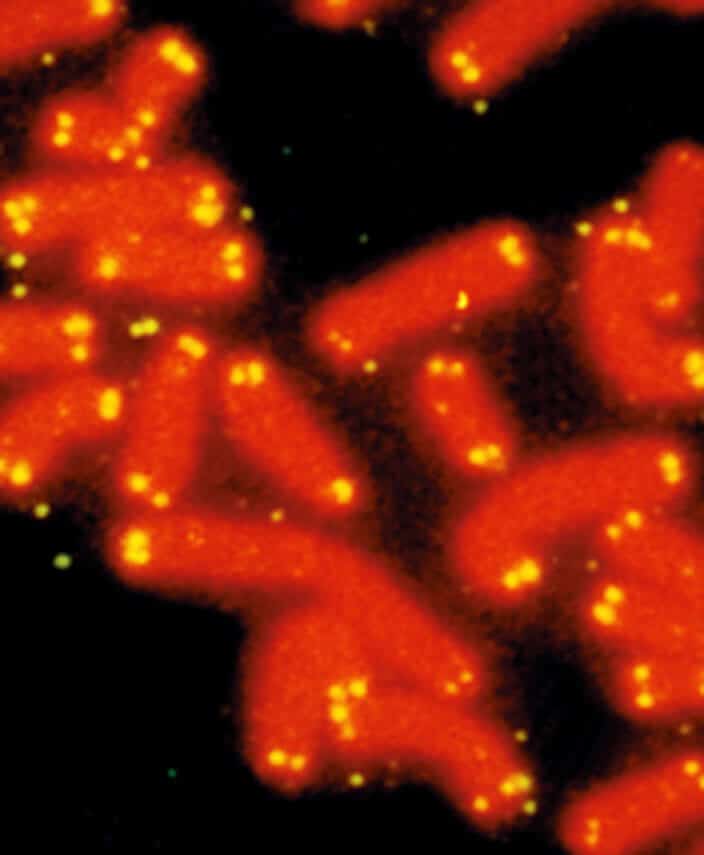
Since 2003, I’ve been saying that long telomeres are a path to long life. The opposing view says that nature allows our telomeres to shorten to protect us against cancer. Up until this spring, there has been little evidentiary support for the cancer theory. Now, a major new study uses genetics to argue that longer telomeres increase risk of cancer as much as five-fold. The study contains many statistical checks, but I’m going out on a limb to say I think the experts have made a conceptual error.
Up until now, epidemiological studies in humans and lab studies in animals have shown consistently that shorter telomeres increase risks for all the diseases of old age. People’s telomere length tends to decline with age, but among people of the same age, those with shorter telomeres tend to die sooner.
The new study finds a very different conclusion: that shorter telomere length leads to much lower risk of cancer, while longer telomere length leads to slightly lower risk of heart disease. Put these two together, and you predict pretty much the same life expectancy for people with long telomeres and short telomeres.
The new studies are based on genetics and account for telomere length only indirectly. Nevertheless, it is claimed, they are more reliable than the old studies (based on direct observation) because they are able to eliminate a statistical anomaly that (they claim) is super-important.
I believe the new study is actually less reliable, and that we should believe the more direct studies like the ones I have reported here in the past. My reasons are that
- The previous studies are straightforward, direct correlations. Methodology in the new study relies on very small differences in telomere length, tiny differences that are lost in the noise and very difficult to detect.
- The new studies require very large implicit extrapolation that is not necessary in the old studies. The 50 to 1 extrapolation is very speculative, and it magnifies the noise along with the signal.
- It is likely what these new studies are seeing are actually direct effects of genetics on cancer risk. Even very small (direct) effects of genotype on cancer would appear in their methodology as though they were huge (indirect) effects of telomere length. This is what I believe is happening, and why I don’t trust their results.
I may be wrong about this. I’m questioning seasoned experts in the field based on my general knowledge of statistics.
Two years ago, I reported on a Danish study linking short telomeres to higher mortality, especially heart disease (CV). I took this as clear proof that telomere length was not just a marker of aging but a cause. The implication is that you can live longer by adopting lifestyles and taking supplements that extend your telomeres.
The core of my argument, based on the the Danish study, was this:
- Impact of telomere length on mortality, raw data: 3.38 (meaning that the 10% of people with the shortest telomeres were dying at a rate 3.38 as high as the 10% with the longest telomeres)
- Same calculation, corrected for age: 1.54
- Same calculation, corrected for age and all other hazard variables: 1.40
Conclusion: This demonstrates that age is the biggest factor in mortality, and telomere length is second, with a strong effect, independent of age. All the health variables together have only minor effect compared to age and telomere length.
The Danish study did a multivariate analysis, also called ANOVA. This is a statistical technique designed to separate out the factors that contribute to an outcome (in this case, mortality) and assign percentages of causality. What their analysis revealed was that the strongest cause of increased mortality is age itself, and that telomere length comes second. Everything else, from smoking to depression to a history of infections, is much less important than age and telomere length. I interpret this to say that short telomeres are probably a direct cause of increased disease risk.
A popular theory is that the association of short telomeres with higher mortality is only incidental. Stresses, infections, smoking, etc. cause both shorter telomeres and higher mortality. But these are separate pathways. It is not the shorter telomeres that are causing higher mortality, but short telomeres happen to be associated with higher mortality because both are caused by various stressors in a person’s past. If this is true, you can’t improve your odds of living longer just by extending your telomeres.
But I believe that the Danish study disproves this theory. If the stressor theory were correct, then the Danish analysis would have found that the relationship between stressors and mortality was stronger than the relationship between telomere length and mortality. In fact, they found the opposite.
The New Genetic Study
The result reported by the new study is that longer telomeres creates a very much higher risk of several common cancers. On the other hand, longer LTL (=leucocyte telomere length) protects against heart disease. The protective effect for heart disease is much smaller, but many more people die of heart disease than of these particular cancers. The result is a wash. Longer LTL is neither a net benefit to health nor is it a net risk. People with longer and shorter LTLs have similar overall mortality risk, about the same life expectancy.
| Disease | Odds Ratio |
| Glioma | 5.27 |
| Ovarian cancer | 4.35 |
| Lung cancer | 3.19 |
| Neuroblastoma | 2.98 |
| Bladder | 2.19 |
| melanoma | 1.87 |
| Testicular | 1.76 |
| Kidney | 1.55 |
| Endometrial | 1.31 |
| Basal cell skin | 1.22 |
| Breast Cancer | 1.06 |
| Heart disease | 0.78 |
“Odds ratio” refers to a person’s probability of contracting the corresponding disease. For example, the first line means that people whose telomere length is one standard deviation (1 sigma) longer than average have a risk of glioma 5 times greater than people who have average telomere length.
This result gains credibility because it is exactly what the theory would predict. Nature has optimized LTL by compromising between two risks. If the average LTL for our species were longer, then we’d get more cancer. If it were shorter, we’d get more heart disease. The reason there is so much variation among the population, people with much longer and much shorter telomere length, is that it doesn’t matter very much.
So here is agreement between experiment and theory, a tidy situation that scientists like to see. What is more, there is a widely-held belief that the methodology of the new study is more reliable than studies in the past that are more direct and simpler. Nevertheless, I’m about to offer my opinion that the previous studies were right, the theory is wrong, and, in fact the design of the new study is seriously flawed.
This was the latest and far the largest in a series of GWAS studies going back four years [ref, ref, ref]. GWAS stands for Genome-Wide Association Study. The idea is to work around life experience variables that might create a correlation without a causal connection. In the present case, the target is to detect any causal relationship between leucocyte telomere length (LTL) and various diseases, while filtering out associations between LTL and disease risk that might be incidental, as described above. The researchers looked for small genetic differences (called SNPs) that are linked to telomere length. These vary from one individual to the next, and they persist through a lifetime. The next step is to compare numbers of people with a particular SNP variant among those who have the disease and those who don’t have the disease. Are people who have the SNP associated with longer telomeres more or less likely to develop the disease? From the answer to this question, they infer a causal relationship, not between SNP and the disease but between telomere length and the disease.
Observational studies look for a direct relationship between LTL and disease. GWAS studies look for an indirect relationship between SNP and LTL, SNP and disease. The indirect study is widely considered to be a more reliable indicator of causal connection than the direct study. Why?
“Mendelian randomization studies are less susceptible to confounding in comparison to observational studies…Given the random distribution of genotypes in the general population with respect to lifestyle and other environmental factors, as well as the fixed nature of germline genotypes, these results should be less susceptible to confounding and reverse causation than those generated by observational studies.”
The reasoning is that people have their genomes for their entire lives, independent of how they live, what they do, what they are exposed to. By working with the genome, the statisticians can be sure to eliminate the standard objection that (for example):
- Stress directly decreases LTL
- Stress directly increases risk of disease
- Therefore, short LTL will appear to be linked with disease, even though short LTL doesn’t cause disease.
Problems with GWAS studies
But the GWAS methodology also introduces new problems of its own. The main problem is that the statistical sensitivity of the study is seriously reduced. This is because the relationship between SNP and LTL is very weak. All sixteen SNPs together constitute a very small factor among many larger ones that create difference in LTL between one person and the next.
“The selected SNPs correspond to 10 independent genomic regions that collectively account for 2% to 3% of the variance in leukocyte telomere length”
And of course, very few people have all 16 SNPs going in the same direction. The study is forced to work with people who have, for example 10 positive SNPs out of 16 compared to others who may have 5 positive SNPs out of 16.
Their LTL is really quite close together. To compensate for this, the statisticians divide by a small number to extrapolate outwards. For example, the difference between typical people in the study is about 1/20 sigma*. And the difference between risk of glioma (brain cancer) for these people is only about 0.08** . But the difference is reported as “what would have been the risk of brain cancer if the difference had been not 1/20th but one full sigma. They extrapolate exponentially, so the conclusion comes out quite startling: They claim that people with 1 sigma of extra LTL have 5 times greater chance of getting brain cancer.
| What they find: people with 0.05 sigma extra LTL have 1.08 times the risk of getting brain cancer.
What they report: people with 1 sigma extra LTL would have (by extrapolation) 5 times the risk of getting brain cancer. |
They conclude that there is a large effect of telomere length on cancer, but they do this by the following reasoning:
- There is a small effect of these genetic variations on telomere length.
- There is a small effect of these genetic variations on cancer risk.
- Dividing the small by the small, they conclude: if the mechanism for these genetic variations affecting cancer is mediated by their effect on telomere length, then the effect of telomere length on cancer must be quite large.
I’m sorry to belabor this, but it’s important, and it’s hidden in the methodology. People who do these studies know that an odds ratio (OR) of 1.08 means nothing. The state of the art in epidemiology is rarely able to attach meaning to odds ratio that is close to 1. It is lost in the nosie. But an OR of 5 is something easy to see. It stands out from the noise and is easy to detect.
The description of the methodology in this study hides the fact that they are working with ORs less than 1.08 and extrapolating exponentially outward to make the ORs look very large and significant.
What I think is really going on
The study finds a large and consistent result that demands some explanation. I’m claiming that the explanation they offer (in terms of telomere length) is wrong. So why do I think they get the results that they did?
A few of the sixteen SNPs that are considered in the study correspond to slight variations on the form of the telomerase molecule. I’m guessing that these mutated forms of telomerase cause an increased risk of cancer. The increased risk doesn’t have to be large. As in my example above, the increased risk for brain cancer would have to be just 8%, and the increased risk for lung cancer (more important because it is more common) only 6%. Because of the extrapolation by an exponent of 20 that is implicit in their methodology, these small effects would be reported as though they were odds ratios of 5 (for brain cancer) and 3 (for lung cancer).
Another possibility is that one or more of the SNPs happen to be more common in a segment of the population that is prone to cancer, for whatever reason. It may be that a particular SNP is more common in an ethnic group that has high smoking rates, or that is prone to melanoma because of lighter skin, or has a diet and lifestyle that leads to a slightly greater risk of cancer. For example, it is known that people of African extraction have SNPs associated with longer telomere length, and they also have higher risks for many cancers, including lung and [ref]. (Africans have lower risk of glioma, so the correlation goes in the wrong direction for this particular example.) At the risk of beating a dead horse, I emphasize again that even a small increased risk would be magnified by the extrapolation that is implicit in the methodology of the GWAS, and appear very large and scary when misinterpreted as an effect of telomere length.
GWAS is also referred to as “Mendelian randomization studies” because they depend very much on the assumption that different SNPs are randomly distributed in the population. Of course, this assumption is not literally satisfied. How significant is the deviation from random distribution? I will be investigating this question, and I’ll let you know what I find.
The Bottom Line
There is a sharp conflict between the new GWAS results [Haycock, 2017] and the observational results [Rode, 2015] reported two years ago. They can’t both be right. If the GWAS results are as Haycock claims, there would have been glaring increases in cancer risk that Rode could not have missed. If Rode is correct, then the methodology of Haycock must be flawed.
The reasoning in GWAS studies depends on a huge extrapolation. I am saying it is more likely that the effect of genetic variations on cancer risk is direct, not (as per Haycock’s assumption) mediated by telomere length. It could be that a very small direct effect of one of these SNPs is reported as though it were a large indirect effect, working via telomere length.
For now, I’m sticking with my previous counsel: Lengthening telomeres is a viable strategy for improving health and longevity. If you take supplements that promote telomerase, you are not adding to your cancer risk. Because of the large net benefit, lengthening of telomeres should be a major target for medical research.
But as I said at the outset, I am criticizing the new study from the outside, and it is quite possible that I have misunderstood the methodology. I have sided with the direct observational studies and I have been skeptical of the GWAS studies, but it may be that the consensus in the field is correct, and that GWAS studies really are more reliable indicators of causality.
I intend to get to the bottom of this, and will report my findings in future columns.
__________
* Sigma is a standard deviation of telomere length in the population at large. If you know what that means, that’s great; if you don’t it doesn’t matter to the logic of what I’m saying.
** Disease risk is typically reported as an odds ratio. In this case, 0.08 would mean that, in their raw data, people in the study with the longer LTLs had a risk of 1.08 times as great as people with shorter LTLs. You get to 1.08 not by adding 1 but by raising e to the power 0.08.
Discussion
301 reader comments
Imported threads are marked Archive. New comments are welcome and moderated for spam.
As we get older epigenetic repression of SHMT 2 leads to reduction in one carbons needed for cell energy and function on many levels // re repertory dysfunction especially complex 1 and partly complex 3 purines, methionine cycle, ect it is the root cause of ageing phenotypes so take glycine!!!! and enjoy your happy cells Glycine is highly effective!!!( it is the most effective ageing intervention to date) but the dose is high looking at 4 heaping table spoons per day / can be reduced after long term dosing and last but not least longer telomere length as you now have the carbons to make them :-) it is so simple I just don't understand why people don't get it /
Good point about glycine, but make sure you get all of the amino acids (especially tryptophan), in order to avoid too low levels of serotonin.
https://www.youtube.com/watch?v=cXro_8804fg
What positive effects have you seen, John; have you had your telomeres measured?
Have you seen this? A pleiotropic role of TERT.
GWAS of epigenetic ageing rates in blood reveals a critical role for TERT
https://www.biorxiv.org/content/early/2017/06/30/157776
Dear Dr Mitteldorf Is any good enzyme that can help to regenerate the functions of DNA without the risk of getting cancer that can be one time treatment that can be affordable to everybody?This kind of treatment can really help to reduce the cost of health everywhere and make life of the people much more productive.The money can be spend in something else,like to help economies in poor land.I think regenerative medicine could help also to rejuvenate the people and what about the antioxidant that are so powerful and use for neurodegenerative diseases?When are supposed to be on the market?As the vatiquinone for example?Now is only for experiments and cost more than diamonds.This is not ok! Arent this people afraid that soon all those drugs from the 80s of older that they have there are going to get old and something better will get over and conquer the market?I think many are working to put other things and then who will pay?
Hi Clinton,
Thanks for your input and posting the link to Micheal Rae' s regimen.
We have two things in common. We are both engineers with limited background in biology (at least for me) and have both lots of respect in Micheal Rae's opinion.
The link you have posted contain lots of useful practical information.
The only thing that looks weird to me is that Micheal mention that rapamycin and acarbose are both very promising as life extending drugs but does not seem to take either. Maybe I am missing something.
Aldebaran,
I wouldn't be surprised if some items in this regimen aren't 100% accurate as to what Michael Rae is doing (even though it notes being updated per Aug 22 2017). I'm skeptical because he didn't update his 'diet' to being vegan but still states it as lacto-ovo vegetarian which I thought he'd changed (to vegan).
I really respect his perspective on things; I personally have been in addition to a very solid diet been taking the LEF 2 per day multi-vitamin which according to Michael is absolutely not helpful (and quite likely harmful), although a decent B-complex ought to be acceptable - not sure if anyone here would comment on basic vitamins that they take? I've been reluctant to scrap the MVM since it also contains some zinc and selenium that I think is good to take.
He also takes phosphatidylcholine which Vince Giuliano scrapped due to it's upregulation of NfKb and possible choline effects on cholesterol and cvd (if you read VG's blog and his update on that supplement).
Best Regards,
Clinton
Hi Clinton,
Thanks for your comments.
I definitely like the depth and critical thinking that Michael put in his analysis. However, I am very far from being as serious as he is about diet and supplements. I try to avoid most of the bad stuff (refined sugar, excessive red meat, trans fat...), try to eat some of the supposed good stuff that I like (olive oil, salad, vegetable), and maintain a BMI in the low range of normal. That's about it. In term of supplement, I am just starting with NR and thinking about other stuff such as Glucosamine. I am definitely interested to try rapamycin in the near future. There are lots of other interesting stuff discussed on this site that I might try at some point. I will take a look at Vince Giuliano's blog.
Cheers,
A couple things regarding Nicotinamide Riboside N(R) to note.
First of all I'm an engineer that didn't take biology even in high school however;
1-NAD+ levels seem very correlated with circadian rythm so it seems that taking N(R) earlier in the day is more in tune with this that later (see paper "Circadian Control of the NAD+ Salvage Pathway by CLOCK-SIRT1" Nakahata, Sahar, et.al.
2-Regarding dosages question above I've seen one regimen posted by Aubrey de Grey's research assistant, Michael Rae (for whom I follow and have much respect for). He states in his personal regimen that he takes 250mg N(R) at 6:30am w breakfast and 125mg and 12:30 AND as noted above he does not take EVERY day rather 6 days per week and takes Friday 'off'
His Regimen on Longecity:
http://www.longecity.org/forum/stacks/stack/122-michaels-tiered-supplement/
hi Clinton
I have self experimented with all doses of the stuff and I find that dose impossible to tolerate. Anxiety and irritability.
That could be just me though.
Paul,
Thank you for that information - I'm curious what dose you use now if any?
I was planning to go with just 125mg with breakfast 6days/week.
Clinton
I've settled on a low dose of 125mg's twice a week on average. I'm more energized at this dose without the stimulant effect. I also find that I feel really good when I combine it with 200mg's of pine bark extract ( which by the way has had the most profound effect on the quality of my life than any other supplement)
Thank you Paul,
I appreciate your reply.
Clinton
Hi Paul.
Comment in regard to Blackburn and Hayflick limit:
In 1961 Leonard Hayflick demonstrated in CELL CULTURE that human fetal cells will divide between 40-60 times and then become senescent. In 1974 Burnet coined name "Hayflick limit".
On Christmas day 1984, Blackburn showed that telomeres would grow in size. She had discovered telomerase. Life requires getting around the Hayflick limit.
Since then, for the last 30 years, anybody talking about the Hayflick limit has no idea what they are talking about.
Life is all about telomerase. The 1961 demonstration by Hayflick was a demonstration that cell culture is not life.
It is true that telomeres shorten with age and it is true that short telomeres predict mortality.
Length of telomeres is all about telomerase. Blackburn states typical trajectory of life of human telomers is 10,000 Newborn, 7,500 35 year old and 4,800 at 65.
But you state your father had @ 9,000 base pairs near age 90.
Regarding telomere length Blackburn states:
"The wonderful news is that our research,...has shown you can step in and take control of how short or long--how robust they are."
On page 65 Blackburn states, "In the rest of book will hear us talking about how you can increase telomerase and protect your telomeres."
The Hayflick limit would make life impossible. Nothing can live with 40-60 divisions for stem cells. So the Hayflick limit is a totally bogus concept.
All that matters is having enough telomerase.
Fig 10 on page 51 shows very clearly that telomere length predicts: all cause mortality, other causes, cardiovascular disease and even cancer.
So it is true that telemere length is of extreme importance and short telemere cells can't divide and become senescent if try to divide; but this has nothing to do with Hayflick limit which is purely a cell culture mistake about how life works.
Hi Alan
The way I see it we have this complicated system of.... shortening telomeres - senescence - clearance - stem cell replacement, because just having enough telomerase in every cell would lead to too much cancer. But unfortunately we know a lot can go wrong in our complicated system: senescent cells can accumulate faster than they are cleared, stem cells can go senescent too or become locked by high inflammation, and finally stem cells too can run out of telomerase. Only germline cells have enough to survive indefinitely.
Life isn't impossible with a limited number of divisions of stem cells because the somatic cells they supply have to use all of their divisions before a stem cell even has to do 1 division, whereby 1 copy remains a stem cell and the other becomes a somatic cell with its own 40-60 divisions.
Note that low MTOR also means less division so telomeres last longer, so less senescent cells at any given time waiting for clearance and replacement. This also means less senescence in non dividing cells. This means less inflammation and ROS so less telomere attrition that isn't due to replication.
This all means we can get by for potentially over a 100 years with limited telomerase, provided nothing else kills us first.
Yes. But not forever I would think.
Hi Mark,
My point when came up with Hayflick limit 1970s nobody knew telomerase existed, so nobody knew any cells including stem cells or germline stem cells had telomerase.
Quick math check: 2 x 40 power is 1 trillion.
Number cells in human body 37 trillion.
Therefore, life not possible without at least some cells having telomerase. Thank you Elizabeth Blackburn for making life possible.
I've done some calculations and I think you are right Alan. In a very, very optimistic scenario the small intestine lining, which turns over in about 3 days would run out of stem cells in 13 years.
So either stem cells can elongate their telomeres, or somatic cells can become stem cells in some scenarios (we know this happens in a bad way in cardiovascular disease when inflamed epithelium cells become osteoblasts in calcify arteries).
This is interesting from Maegawa, Nature Communications 14 Sep 2017 article # 539. " Caloric Restriction delays age-related methylation drift."
" Previous research has shown that DNA methylation tends to drift with age. However it was not previously known whether there was a connection between this drift and lifespan. Team studied blood samples from mice, monkeys, and humans at different ages. Mice, few months to 3 years, monkeys , few months to 30 years, and humans between zero to 86 yrs. The analysis revealed gains and losses of DNA methylation at certain locations in the genome. The more methylated a genomic site was the less the genes were expressed. Further DNA analyses revealed an inverse correlation between methylation drift and lifespan. The more and the quicker epigenetic change occurred, the shorter the lifespan of each species.
They then restricted calorie intake by 40% in mice at 3.4 months old and 30% in monkeys between 7-14 years old. They did this over a long period of time. In both species the effects were dramatic. Monkey's blood methylation age seemed 7 years younger than their chronological age. They propose that epigenetic drift is a determinant of lifespan in mammals.
The impacts of calorie resriction on lifespan have been known for decades, but thanks to modern techniques, we are able to show for the first time a striking slowing down of epigenetic drift as lifespan increases." " The findings may have major implications for age-related diseases."
Hi Paul,
Thanks. Very interesting study!
Interestingly, they also noted the accelerated drift with chronic inflammation:
"Together with previous findings showing that chronic inflammation (which shortens lifespan) accelerates methylation drift, our data suggest that epigenetic drift is an excellent biomarker of lifespan".
Hi Aldebaran
Chronic inflammation is always lurking isn't it
Hi Paul,
Yes it seems so! Indeed you've just reminded us yesterday how important it is to control chronic inflammation so when I saw the link between chronic inflammation and methylation drift in the paper, it just popped up in my mind.
On the other hand, two compounds I am aware of that should help chronic inflammation (curcumin and fish oil) failed to increase mice life span (ITP:fish oil, and Spindler:curcumin).
This suggests to me that we don't have yet a magic bullet to control chronic inflammation (such as we have to control mTOR with rapamycin).
Another possibility is that controlling inflammation only affects health span, not really the aging rate but this is not what the epigenetic drift is suggesting.
Hi Paul,
This is comment on your long-running discussion that the important thing is not average length telomeres; but very short telomeres.
I see telomere length, like everything else we measure, as having a standard distribution.
To me, telomeres are either long enough to do their job or too short to do their job.
The only telomere length that I think matters, is telomeres too short to do their job.
According to Blagosklonny theory of aging, a key aspect is production of senescent cells. The theory is mTOR drives resting cells to grow and divide, if the cell gets stopped in division because problem with chromosomes, then cell becomes senescent cell, which acts as major troublemaker.
The number one chromosome problem stopping cell division being allowed to proceed, I suspect is telomeres which are too short.
In this way the very short telomeres can be acting directly with elevated mTOR in producing senescent cells and not producing more healthy cells.
In regard to short telomeres and cancer; one specific cancer noted by Elizabeth Blackburn in her book that was increased with short telomeres was skin cancer (not melanoma). Note that squamous cell skin cancer was greatly increased in transplant patients who had impaired immune system function. So increased skin cancer in patients with short telomeres could reflect impaired immune function rather that actual production of more squamous cell cancer at chromosome-mutation level.
Hi Aldebaran,
This discussion of chronic inflammation, epigenetic drift and aging is remarkable confirmation of Blagosklonny hyperfunction theory of aging. Chronic inflammation is hundreds of different specific actions, the sum total of which looks like chronic inflammation and this is a general manifestation of hyperfunction. Elevated mTOR is driving hyperfunction; methylation correlates with whatever " function" and "hyperfunction" is on a molecular basis, and this becomes a biomarker of lifespan. All pointing to need to use rapamycin to reduce mTOR to reduce chronic inflammation.
Hi Alan,
Very interesting comments about hyperfunction and mTOR! I am reading Blagosklonny paper 2006 that you've recommended and learning a lot.
So mTOR reduction is certainly one way to control chronic inflammation (Rapamycin, CR) but it does not control all manifestations of inflammation right? For example Paul's father still suffered chronic inflammation in late life despite aggressive CR. So this suggest to me that mTOR is not the only target to reduce chronic inflammation. Do you agree?
Hi Aldebaron.
I see if differently.Paul's father is extremely interesting case that Paul shared with us.
In my opinion, at around 60, Paul's father began suffering from elevated mTOR and the manifestation was onset of mild depression. He then discovered that a life style including very marked CR ameliorated depression and he felt good. This life style both reduced mTOR and helped maintain long telomeres. Then sometime in his 80s he developed an occult cancer. The occult cancer caused a thing called paraneoplastic syndrome which changed his immune system and he developed severe psoriasis, an immune disorder of unknown specific etiology. At this point his life dramatically changes, he had severe distress and his life style probably changed and could no longer keep mTOR low. Elevated mTOR was reflected in new onset of severe depression. Many of the bad things happening in his 90s could be reflecting a major increase in mTOR level. Note that with severe psoriasis and a developing cancer, his body would be under great stress, all of which would increase mTOR and shorten telomeres.
Hi Alan,
Greatly appreciated comments as always! So in your opinion mTOR inhibition is the most efficient way to fight chronic inflammation.
I have a somewhat related question. A friend of mine suffers from chronic calcific tendonitis. Do you think weekly rapamycin could be of any help?
Thanks
Hi Alan,
From your comments, it looks like that you think CR is not always enough to control TOR. Interestingly, Blagosklonny seems to think that as well. In his 2017 paper he says:
"The effects of rapamycin and calorie-restriction are not identical and may be additive [248, 249]".
So it could make sense to combine moderate CR with weekly rapamycin (and metformin) to get larger effect.
Hi Alan,
Got your point! Couldn't agree more. Interesting example of Israel Kristal. He must have an incredible resistance to stress to have survived such conditions
Oh, and there have been plenty of good studies by people with financial interests. The trick is whether other people can replicate them ;)
Look at animals with negligible senescence: albatross, Blanding's turtle. IIRC they maintain telomere length, yet they don't have high cancer rates. Bowhead Whales do use somatic cell telomere shortening ( I know that for a fact, I did the TRFs, see link to old paper below), but they must lengthen telomeres in the stem cells.
Anyone know results from Greenland Sharks? Quahogs? (I actually did some low-temp cell culture, but it's probably not a common thing... I doubt that Carolina supplies quahog serum). BTW, don't get too optimistic about "telomere measurements"... whether you measure with TRF or q-PCR, you aren't measuring the lengths in the cells that died.
Oh, and here's a first... I'm going to go off-topic AWAY from telomerase ;)
What's the latest on nicotinamide riboside? Can we really trick cells just by forcing NAD+ higher? Li Ka-Shing obviously thinks so, but he's just a billionaire, what does he know?
https://www.ncbi.nlm.nih.gov/pmc/articles/PMC3387546/
Hi Bill,
An anti-aging drug does 3 things, (1) increases life span in very many animals including mammals, (2) prevents and ameliorates a large number of age-related diseases, (3) prevents accumulation of senescent cells.
Forming a company and hyping product on internet doesn't make it an anti-aging drug.
Any study done by persons with financial interest with the company is worthless.
Comments by billionaires are generally worthless as regards truthfulness.
Cell-culture studies show ZERO about how works in real animals. A good scientist can show just about anything in cell culture experiments.
Thanks for a large number of really great post.
Thanks Alan. I would be happy with a drug that did any one of the things you propose ;)
As a cell culture guy, I would say that cell culture can tell you a few things... if you use normal cell feeder layers in your cancer experiments, physiological levels of O2 and nutrients, proper screening for mycoplasma, .... (any research guys are laughing now, 99.99% of cell culture experiments are with aneuploid cells, 21% O2, high sugar, etc. etc. etc. ;)
There have been papers suggesting a life extension benefit (in rodents, at least) from NAD+ increase for a long time. There are two human Phase 2 trials in progress, which will report soon and give us some data on effects on markers. What I was hoping for here was some theory ideas... how would forcing the NAD+ level up affect the aging clocks?
http://science.sciencemag.org/content/352/6292/1436
Are you referring to this study regarding NAD Bill?
"NAMPT-Mediated NAD biosynthesis as the Internal Timing Mechanism"
B Poljsak. Rejuvenation Res 2017 Sept 08
Are you also familiar with the intracellular role of NAD in regards to PCSK9 inhibition and prevention of cardiovascular disease?
Hi Paul,
I looked at Nampt study you quote by Poljsak. I have absolutely no idea what that has to do with NR.
Let me start by stipulating that NAD and NADH are two of most important molecules in living things, but what is the connection with NR.
I would think NR pills are inactivated in digestive system and never get into blood stream. If get into blood stream, get inactivated in first pass through the liver. I would expect than NR has zero biological activity. I would expect that NR never enters cell and never changes NAD/NADH metabolism.
Unless somebody proves NR is doing something in vivo after taken by mouth etc etc etc, then NR is just junk.
Hi Paul,
My Bad.
Found human trials with Niagen in which showed raised NAD+ levels in humans. So that changes everything.
Niagen now looks like a the real deal as has bioavailability.
Hi Paul, Alan, Mark,
I am a bit on the sideline about NR. I have read that it does raise the NAD+/NADH ratio but some people think it is just transient and after a while the ratio returns to normal. Any thought about that?
Also, I am not aware on any study that shows normal mice have increase life span with NR.
Do you think short term study on humans showing increased NAD+ is enough to recommend Niagen?
Hi Alan,
Thanks for your inputs. I might do the same as you. Ideally, I would like to see life extension on normal mice before trying but the only experiment I am aware of is at the ITP and will take a while to complete. So maybe does not hurt to start now.
The brand I would tend to prefer is the one from Chromadex (TRU Niagen: 135$ for 3 months) because I trust the quality. Maybe not that important though.
No Paul, I hadn't seen the study in Rejuvenation Res, I was referring to the mouse study in Science.
One of the Phase 2 studies has already "reported", but only to a closed conference. I'm hoping to see some data on cardio markers this year.
There's this paper in Trends in Mol Med, but it's paywalled (thanks for nothing, NIH system):
http://www.cell.com/trends/molecular-medicine/fulltext/S1471-4914(17)30141-7?_returnURL=http%3A%2F%2Flinkinghub.elsevier.com%2Fretrieve%2Fpii%2FS1471491417301417%3Fshowall%3Dtrue
I’ve been taking Jarrow Formulas’ Niagen since March. I felt this press release from ChromaDex itself means it is the real thing:
Jarrow Formulas Plans US Retail Launch of a Nicotinamide Riboside Product Featuring ChromaDex’s NIAGEN®
http://investors.chromadex.com/phoenix.zhtml?c=212121&p=irol-newsArticle&ID=2114571
But I might switch to Tru Niagen, because the dosage per capsule might be more convenient (250 mg. per capsule instead of 100 mg. per tablet.)
Speaking of Nicotinamide Riboside (Niagen), I watched this video the other day, an interview with the researcher who discovered it:
Charles Brenner, PhD discusses Nicotinamide Riboside
https://www.youtube.com/watch?v=WItMH3PzIk4
I think it’s been proven that Nicotinamide Riboside raises NAD+ levels. But whether raising NAD+ levels does anything beneficial in humans is not proven yet. It’s still a surrogate marker, I take it. So I hope the studies continue. I hope the folks selling the supplements don't get spoiled by sales.
The NAD+/NADH ratio is important in mitochondria Alan, and more NAD+ causes mitos to fission into smaller pieces and undergo mitophagy. So this is definitely beneficial for humans. How much remains to be seen.
I believe NAD+ levels also affect DNA repair, which might also be important.
Incidentally I am not convinced you need niagen (NR). I think B3 plus D-ribose is probably better as I suspect this is what the body breaks niagen down into first anyway. I also wouldn't recommend constant mitophagy. More like something you'd want to do every now and then.
@ mark: there are two pathways for NR, it's not the same as B3 (link). As a betting man, I would agree with your bet that it won't turn out to be a good idea to take NR without a break.
https://www.ncbi.nlm.nih.gov/pubmed/24071780
The NR supplement suppliers are recommending taking it daily. For example:
https://www.elysiumhealth.com/help
Yes the pathway may be better for NR, but I am saying in the body NR becomes N+R, which is then used for raising NAD+. So if this is true, no advantage to taking expensive NR.
"Supplement suppliers (Elysium) recommend taking it daily".
I'm sure they do ;)
Seriously, Elysium isn't a very serious organization... they haven't even paid Chromadex for supplying their NR! The companies are still fighting in court, IIRC. The only semi-trustworthy person involved in NR is Li Ka-Shing.... and he's not a biologist, he's an 89-year-old billionaire who (IMO, don't sue me bro) is using NR and wants some more guinea pigs to join him. (Bill Andrews needs to get Li on board with telomerase activation).
I guess the NAD+ results show that NR is affecting the cells... but what the long-term effects on the self-destruct programs are is the question.
Good to know. Thanks, Bill.
I had a bit of a brainwave about how we might resolve this problem of long telomeres causing cancer.
Correlation is not causation.
Could it be that one or more of the SNPs surveyed by Haycock in their GWAS is the same or near to one of the mutations used by cancer to activate telomerase activity?
If this is true then it would mean long telomeres achieved from lifestyle would not necessarily lead to the same risks as long telomeres caused by the culprit SNPs.
It might also explain why some cancers are affected more than others, because cancers in different tissues use different pathways to achieve immortality; for example cancers in less proliferative tissues tend to have mutations in the HTERT promoter regions, but cancers in the fastest growing tissues are not thought to need to do this.
Thanks Phillip
I'm left with a couple of thoughts here.
1. It would be nice to know not just the mean telomere lengths, but also the distributions in terms of percent of very shorts, very longs , etc. Those details could be revealing and helpful.
2. The Singapore study suggests a U curve of risk , and your study also allows for such a possibility, where both very short and very long telomere lengths led to cancer risk, and to the identical rare cancers ( stomach, bladder, pancreas, blood). Again it would be nice to know the specific distributions i.e. , does the very short group also have a high percentage of very longs, and conversely does the very long group have a high percentage of very short telomeres.
3. Finally, it may be clinically relevant for people to have telomere testing so that they can be extra vigilant to do all of the cancer preventive measures possible if they fall into one of those groups.
Of course they also shouldn't panic. The Singapore study showed a 200% increased risk of pancreatic cancer, But if we use the poisson distribution square root method of rare events then the absolute risk of 12/ 100,000 is + or - (3), and that would increase to 24/100,000 + or - (5), which only may take us from a risk of 15 to 19/100,000. Don't jump off the bridge!
I just wonder Paul what the mechanism could be for the same cancers being more likely with either very short or very long telomeres.
Having done some more reading on the subject the only way I know of for cancer cells to activate telomerase is to get short telomeres first, because this primes the TERT gene that would otherwise be inhibited by the close proximity of the looping telomere itself. So how could long telomeres cause this? I don't see how. Can very long telomeres cause genomic instability in some other way? Something to research perhaps...
It could be longer telomeres mean you keep mitotic cells for longer so they have longer to accumulate other oncogenic mutations, so when they finally get to short telomere stage and potentially activate telomerase they are more likely to be serious. But this explanation only works if oncogenes make it more likely to activate the TERT gene. Otherwise once the cancer has telomerase it can accumulate all the mutations it needs anyway. My best guess for a mutation that makes TERT activation more likely is something like p21, which is known to inhibit telomerase.
Or it could be an indirect effect, like having very long telomeres might also mean you have short ones too, as you have suggested (but why would this be?). Or it could be an effect of the TERT protein that has nothing to do with telomeres, like a growth factor effect leading to more cancer? But then that should lead to other diseases of aging too.
It's an interesting mystery and a great deal of credit will go to he or she who solves it!
I couldn't agree more with the entirety of your comment. Consider this example from my point of view now as a clinical physician. Let's use my father as the example. He had his telomeres checked at HMS at 92 years old and had a very!! long mean telomere length with very long ones as well as part of the distribution. So if he were a patient I would have to advise him ( Haycock) that he has a significantly increased relative risk of cancer. BUT, he also had a very very low percentage of very short ones so now I would advise him ( Wlleit study) that his cancer risk is quite low.
But in steps Wang ( Singapore ) study which shows a U-shaped risk, so I now inform him that his risk is high AND low. You see the practical dilemma here I'm sure.
This is why the individual distributions are essential, but not performed, in these large population studies.
Let's suppose that an individual has a large percent of very short telomeres in what is basically their immune system, since that's what we keep measuring, and this leads to the last stage of malignant transformations. In response to this, the surrounding cells cells activate telomerase, which elongates the long telomeres already present to very long ones and also elongates the very short ones, all of this in an attempt to jack up immune defense and subsequent elimination of the cancer cells. Depending on the "snapshot" measurement , this person could be found to have very short telomeres, or very long ones , and both would appear to have a cancer association.
I agree that for useful information we need a complete distribution of telomere lengths, short, average and long. We could define short and long both absolutely (below or above a certain kb) and relatively (compared to age matched controls and also to your own average length telomeres). These measurements would need to be repeated several times over some set period of time (not just a snapshot as you say) to take account of variations due to replacement of somatic cells (more on this later).
I would expect very long telomeres to correspond to either somatic cells that have just been replaced, or stem cells (which we would expect to form a small and fixed percentage). A larger than average number of long telomeres would imply a regular turnover of somatic cells and a healthy stem cell pool - but we need to use caution here because these readings could mislead if you are just recovering from some kind of stress or illness that lead to a larger than usual replacement of somatic cells. That kind of event would cause a depression on telomere lengths that would then recover, possibly overshooting your normal length. So that is why we need repeated measurements over time.
Very short telomeres would correspond to cells approaching senescence (either through replicative senescence or damage). A larger number of these would mean some stressor is outpacing the ability of the stem cells to supply replacement somatic cells in good time.
If we take the example of your father Paul, and took telomere lengths of his immune system, we would expect longer telomeres than average because his high level of physical activity will force a higher replacement rate and therefore a longer average telomere length and smaller number of short telomeres (so long as he wasn't still recovering from a hard session or illness for example, when you would expect a temporary dip in telomere lengths).
The mechanism for telomere length I've been discussing here is simply down to the replacement rate of the cells being measured (in this case the immune system). The Haycock work is talking about the length you have genetically and that you will maintain, all other things being equal. There is evidence that longer is not always better here. But I don't think an active person could ever accidentally put themselves in this range if they weren't already in it, as forcing their cells to replace faster would just restore their telomeres to lengths they were born with (at best, in practice it will be less as stem cells can't fully compensate for their own telomere loss), not magically give them ever longer telomeres than they are genetically predisposed to have. The same would apply to some sort of pharmacological or gene telomerase therapy, because it is the shortest telomeres that get boosted, not the longest.
The Singapore work I can't comment on because I haven't seen it, but what I have described is certainly consistent with a U shaped benefit of telomere lengths.
I understand your difficulty in advising patients Paul. What if you measure the telomeres of someone who have much longer telomeres than average; how do you advise them? Do you recommend shorter telomeres? I think the answer is no because there is not a lot we can do about genetically long telomeres, the risks are small and age related telomere loss will attenuate this anyway. But short telomeres are also a cancer risk as well and this rises with age, so we need to make sure the number of short telomeres is kept to an absolute minimum. That is what I would advise your patients.
So concluding this overly long post: ignore long telomeres, concentrate on reducing the number of short telomeres.
I should have said U shaped RISK, not U shaped benefit
No reason to worry Clinton: https://nutritionfacts.org/video/telomeres-cap-it-all-off-with-diet/
Thanks Ole,
This is great news to me as less than 1 week ago I have finally switched to a vegan (without grains) diet similar to Josh (plus some D3, B-complex, fish oil, etc.).
I posted above about spermidine but realized I can get plenty of spermidine by eating green peas, corn, chick peas, and even broccoli and cauliflower... I am so personally grateful for this blog and all of the people posting here. Now eating lots of vegetables, nuts and some fruit.