

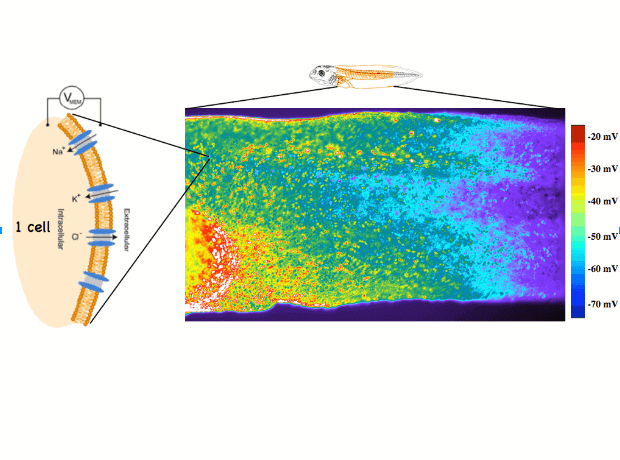
Aging is an extension of the developmental program into a phase of self-destruction. This much has become clear (if not yet uncontroversial) over the last decade. But this insight is of little use to us so long as developmental biology is so poorly understood. I have worked from a perspective in which development and aging are both driven by gene expression—an epigenetic program. Then, last week, I learned about an electrical dimension of developmental biology that is entirely new to me. I’m grateful to Johnny Adams for pointing me to a recent by Michael Levin, summarizing two decades of research from his Tufts University lab.
Levin starts by contrasting the intelligence of an ovarian tumor (teratoma) with the intelligence of a tadpole under metamorphosis. The tumor has stem cells that can create organ tissue, teeth, bones, and hair—but their placement is haphazard, and therefore without function. The different tissues grow in every direction with no guiding logic or structure.
In contrast, the morphing tadpole knows exactly where it is going and what it wants to be when it grows up. Levin cites experiments from the 1960s in which a salamander tail grafted onto the side of the body turns into a functional leg, complete with foot and toes. In experiments in Levin’s lab, he moves an eye to the back of the tadpole head, and it migrates to its correct position as the tadpole becomes a frog.
Where is the information that tells the body how to form itself? In what form is the blueprint for the body’s shape and structure?
“Very much like the brain, Somatic tissues form electric networks that make decisions. The decisions are not about behavior, but anatomy.”
Nerve cells communicate by passing electric currents through ion channels and deploying neurotransmitters to pass electric charge from one cell to the next. Somatic cells use these same mechanisms to communicate with each other and decide where to go, forming into tissues and structures in a functional body. Using voltage-sensitive fluorescent dies, Levin and his colleagues have visualized the electrical structures that precede and determine corresponding anatomical structures.

This is radical. It is a new and unstudied mechanism of biology. Cells in a developing body are wired together electrically, and in their connectivity is encoded the structure of the body toward which they are aiming. The electrical connections work very much the way nerve cells in the brain do, but their purpose is entirely different. And Levin emphasizes that the time scale is very different. Electrical signals that make brains think and make muscles contract last for a few thousandths of a second. The circuits that code for bodily structure last for hours or days.
Extraordinary claims require extraordinary proof, and so Levin has been studying this system to manipulate it for almost 20 years now. Recently, his lab has cracked the code sufficiently to manipulate development and regeneration at a level higher than biochemistry. They have worked with planaria worms and developing amphibians, two experimental models that are capable of regeneration. They have experimented with rewiring the circuits, and now understand the system well enough to create two-headed worms and ectopic limbs on frogs.
The story of 21st Century biology has, thus far, been about gene expression. The body is controlled by chemical signals, and these are produced on demand by masking and unmasking different portions of the chromosome, exposing the code for the proteins that are needed in a given cell at a given time. Our activity and our homeostasis is maintained in this way from moment to moment, and I believe that our life histories, from development to aging and death, are also controlled via gene transcription.
Now comes Levin with a demonstration that, at least under some circumstances, there is a system upstream of gene transcription that is based on electric circuits. The system controls development at a level higher than gene transcription. For example, an entire eye can be ordered up by artificially creating an electric pattern in the right place, and the eye will have all its parts intact and be functional. They have placed eyes on a tadpole’s tail and demonstrated that the tadpole can see through them, and their brains can interpret the images.
Background
Living fluids, within and between cells, contain dissolved salts in the form of positive (Na+, K+, Ca++, Mg++) and negative (Cl–, PO43-, SO42-) ions, Cell membranes have pumps that can pump ions out of the cell selectively and ion channels that allow some ions through, but not others. typically, the cell has more negative than positive ions inside, so it has a negative membrane potential, ranging from a few mV for blood and skin to tens of mV for nerve and muscle cells. Rapid changes in membrane potential are the driving force behind muscle contraction and nerve firing.
There are drugs that can affect membrane potentials by blocking ion channels selectively. Membrane potentials have multiple signaling functions, most notably the potential has to drop close to zero before a cell can reproduce, and drugs that keep membrane potential high are able to inhibit cell replication. There are proposed applications for cancer treatment (inhibiting replication) and for regeneration (promoting replication). Within cells, different organelles also have membranes and there are associated intra-cellular potential differences. Mitochondria are the most negative parts of the cell, at about -140 mV.
DiBAC is a voltage-sensitive fluorescent dye that is used to visualize patterns of voltage variation in and around a cell. [ref] Patterns within a cell show locations and activities of the organelles. Patterns on larger, multi-cellular scales function like blueprints of development, and in animals that can regenerate, the patterns persist and guide later regeneration whenever limbs or organs become damaged.
How do they manipulate electric patterns experimentally, to demonstrate the effect on morphology?
This is not clear in Levin’s oral presentation, but an audience member asked the question. It is not done with external electric voltages. It is done with biochemical modification of the gateways that control ion channels. Levin drops a hint that there are photo-sensitive drugs that can control ion gates that can be used to translate a projected geometric image into a pattern of membrane potentials. He argues that the patterns encode “blueprints” rather than a “construction manual”, based on the fact that the program is adaptive in the face of physical barriers and disruptions, and organisms are capable of detecting damaged parts and growing new parts to the original specs. Levin’s group has tampered with membrane potentials in order to guide the growth of nerve axons in regenerating tissue [ref]. This is just the beginning of the understanding that will ultimately be necessary to reprogram electric circuits to order for medical applications[ref].
In the Levin Lab publication list, there are 28 academic publications in 2018 alone. There’s a lot here to absorb, and it’s all new to me.
Levin was a computer scientist before he was a biologist, and he continues to be fascinated by the ways in which cells in tissues outside the brain can act as logic circuits. Gap junctions are bridges connecting adjacent cells, through which ions can flow, transferring charge. This is the basis of electric circuitry that supports complex logic. A post-doc in Levin’s lab designed a computer simulation that can model the activities of gap junction circuits. This paper from 2018 ALife Conference proceedings is a good introduction, with context and lots of references.
What does this have to do with aging?
I’m writing about this work more because I think it is potentially a paradigm shift, not because I think it has immediate implications for aging. Still, because I am who I am and you are who you are, I include possible implications for aging science.
- Body parts become damaged with age. Regeneration will probably be a necessary part of any long-term anti-aging program. We’ve learned that robust regeneration is available in many invertebrates and amphibians, but it is switched off actively in mammals. The mechanisms remain latent, untapped, and there are examples of turning them back on. Bioelectric programming is a new avenue to explore for regaining control of mammalian regeneration.
- I believe that the developmental clock continues seamlessly into an aging clock. The same timing mechanism controls both development and aging. If development is under electrical control, then we might find that there are electrical signal networks that trigger aging. I’ve written to Levin to ask if he is looking into this.
- Some people in the anti-aging community are also interested in simulating the brain in a computer program, and they imagine that if my brain’s connectivity can be simulated in enough detail, the computer simulation will start to “feel like me”. For people who believe that consciousness is a function of the brain, and that computer modeling of the brain provides a path to a sort of eternal life, Levin’s work may be sobering. Knowledge and information processing take place not just in the brain but throughout the body, and not at the level of neural circuits but at the level of molecules.
- The spirit of modern biology is the reductionist spirit of 19th century physics. Levin argues that we have been remiss in not exploring ways in which living systems are organized from the top down. I agree.
|
A Speculation
In epidemiological studies, it has become clear that exposure to radio frequency radiation is associated with higher cancer risk [review]. There are anecdotal reports of people whose mental function is affected by wifi and by nearby cell phone towers. Part of the reason we don’t know more about the subject is that the entire telecomm industry works behind the scenes to discredit and defund the science. (I have found that the relevant articles are suppressed in Google Scholar and PubMed searches.) Another reason is that we have no theoretical understanding of how radio frequencies interact with living cells. The standard biological paradigm regards living systems as chemical systems, and there are no obvious ways that radio waves at the levels we are commonly exposed should affect chemistry. Interaction of radio frequencies with ion channels is a possible mechanism, and may open the door to understanding (and then minimizing) the hazard. Most interesting is the effect of RF on mitochondrial potential, which may connect to an emerging paradigm that cancer has a mitochondrial origin. [Here’s an older reference from the 1980s. More recent ref. And another]
Discussion
33 reader comments
Imported threads are marked Archive. New comments are welcome and moderated for spam.
Radio frequency exposure is troubling. No one was very concerned at longer wave lengths, thinking they pass through us with no affect. Now with 5G and even 4G it's a different story. Even the heating of the skin can be easily measured. Is there more than heat? Most likely.
the obvious not mentioned? kundalini is a known electric phenomenon flowing up the
“spiinal column” some yogic literature goes into this, but rather than a intellectual pursuit one can pursue for oneself, for example a pleasant testing “hormonal “ secretion (no proof re hormonal”] flows down it seemsfrom the endocrine system via the roof of the mouth.
this aint rocket science, nor “new” it is ancient and folks are looking into and experiencing.
There is a doctor in the Dallas area who wrote "The Body Electric". His name is Jerry Tennant, MD. He states that without proper voltage, ~50mV, cells can not heal.
Correction, the book is "Healing Is Voltage".
Wonderful!.... and, sadly, I lost the title and author of a book published by a sole researcher and the author of a book with Leonardo DaVinci's Scientific man on the cover over 20 years ago.
The researcher (doctor?) measure the electric circuits, currents, voltages in every organ of the body, and the blood, brain, bones, etc .... showed the hundreds or many thousands of complete electric ciruits in the body, ... ANYONE REMEMBER?
pls comment (if allowed by this site) or email me$dulos77$ without $'s at yahoo.
Thanks Josh for this post - the Levine talk is mind blowing; it's always nice to find out something this profound one knows nothing about.
A couple of observations based on the talk:
- cancer may be instigated by loss of intercellular electrical signalling
- we know from the discussions below the last post that cytoskeleton remodeling can create and proliferate progenitor cells from somatic cells through ROCK inhibition (and also reprogram cancer cells in the paper Paul posted); perhaps these electrical signalling is upstream of that
- All life on earth has most of the same DNA and many lifeforms have extremely similar proteins; the fact that Levine can make a planaria grow a head from anothrr species separated by 100s million years of evolution shows that it's not all about the genes - life is much more plastic than that
- defeating aging may require us going right to this fundamental level
- frustrating how little Levine talked about the small molecules he uses and that no one in the audience asked about regenerative medicine (what can you expect from Facebook employees)
Oh and I forgot to add the cytoskeleton extends inside cells too through mitochondrial networks; I'd love to know how mitochondrial fission and fusion fits in with ion channel programming.
Hi Josh,
Thank you for taking the time and mental energy required to examine this topic and bring it to us, your readers.
I was also stunned after coming across a youtube video of Levin's presentation and I have been trying to consider its effects on the paradigm of "aging as being a part of the developmental program" since then. In the Levin presentation I saw, he described that he had the ability to control the shape of the heads of planaria worms such that one species will develop the head shape of another species though they are separated by many millions of years of evolution, without any genetic manipulation just by manipulation of specific synapse-like ion channels in the individual worms and once established the head morphology of the worm persists without further manipulation. To me, this was one of Levins most astounding observations as it seems very unlikely that evolution would have maintained multiple unused but viable alternative head morphologies either genetically or epigenetically within species when random mutation and or epigenetic drift should disrupt the integrity of the unused head morphologies?
This leads us to the conclusion that as Levin proposes that the collective somatic body of cells create a system that is capable of computing and thus orchestrating developmental events is correct. So what then is coded in the genome and epigenome to control development? On the basis of Levins evidence it seems reasonable to conclude that the genome and epigenome codes for creation of a "generic ( common across species) somatic cell based developmental neural network" that controls developmental processes. Like with artificial neural networks, I propose that the epigenome is where "biases" are stored that modify the action of the generic somatic cell neural network required to drive development in any given species.
This also makes sense from an economy of information or complexity perspective, coding for a generic neural network and network element biases stored epigenetically will allow for efficient and rapid evolution and reduce the amount of information to store and maintain. This approach I feel minimized "kolmogorov complexity". This idea of neural network control of body form development, I believe part of the explanation of the Cambrian explosion.
For maximum efficiency, this model of evo-devo will require a mechanism by which the developmental neural network will need a mechanism by which the epigenome in the gametes can be manipulated by this developmental neural network to store changes in body form represented by network element biases.
Aging: This model supports our shared ideas that the rate of aging is fundamentally defined epigenetically and when a species evolves a shorter or longer lifespan the epigenome that is passed to offspring has been modified. It does not escape me that this concept represent a radical rethink to standard evolutionary theory which does not have a computational engine other than natural selection to drive change in a species.
Thanks Josh
Hi Mr. Brown! What do you think of Dr. Levin's 2020 and 2021 YT presentations?
His group has been publishing studies every other month recently.
Hi Josh,
the same kind of theories, only from a slightly different angle:
The Fading Electricity Theory of Ageing: the missing biophysical principle?
https://www.ncbi.nlm.nih.gov/pubmed/22940501/
Can't see more than the abstract, though, sadly.
The cell-non-autonomous nature of electron transport chain-mediated longevity.
https://www.ncbi.nlm.nih.gov/pubmed/21215371/
Deals with the relationship between mitochondria ( hugely important for aging & co.) and electron transport.
Available as full text.
Hi, you could use scihub (it's like the pirate bay for scholarly texts) to open the article.
Just copy the DOI of the article into the search bar of scihub to open the restricted article.
That's what I just did, but I'm not sure if the link works or if you have to do it yourself again to view it.
https://dacemirror.sci-hub.tw/journal-article/7f68e6f30f64e297c05123d817cacb60/deloof2013.pdf
Hi Josh,
Glad I came to your post. I am researching this topic in-depth, about EMFs. Thank you for the references. How do you know that pubmed studies are suppressed, and how to find the suppresses ones? I am predominantly searching pubmed and thought it is uncensored. Also, I use https://sci-hub.tw/
Here is my research on a few pages on .pdf/ I uploaded the document to Mega.nz. The doc can be viewed online, you don't have to download it.
https://mega.nz/#!kb5XjATQ!a_VRJBh1bjGSpGodLkFrB1uSK4WBFL9a-xVm5X-tc4w
Hi Josh,
"In epidemiological studies, it has become clear that exposure to radio frequency radiation is associated with higher cancer risk"
That is not true for frequencies 10 MHz - 1GHZ.
25 years ago my brother worked in a power broadcasting tv-radio station. The union has made a study based on a all workers in the power broadcasting stations all over the country in the last 50 years to see if there are potentially dangers. There were investigated the files of over 2500 people who worked in such stations. The results were contrary. From all there were only one single case of cancer, far below than the average.
An these were power stations with over 10 KW radiated power.
My brother told me that over a radius of 1km the vegetation grew much bigger.
The fruits in the trees were huge. Corn plants grew about 3 m high
One can feel directly the effects of radiation which cause sleepiness.
All were astouned that the wounds heal rapidly and during the cold weather nobody catchy cold or flu. The food did not get rotten (for example meat) but become dried although there was enough humidity.
For reference: The radio broadcast frequencies Florentin is talking about range from 0.001 GHz for AM to 0.1 GHz for FM
Cell phone frequencies start about 1.8 GHz, and bluetooth is 2.5 GHz, same as microwave ovens. Wifi is in this range, too. All of these are more than 10 times higher frequency than FM, which, in turn, is much higher than AM.
New 5G will use frequencies much higher yet, up to 88GHz, or 50 times higher than the upper limit of 4G.
But cell phone have the power of watts not KWats.
The cancers in the industrialized countries would have rised significantly in the last 10 years if cell phones have some significant effect.
Not even watts
Lies.
A main source of electrical charge in biological systems which has yet to be taken into account is the Exclusion Zone that forms in water adjacent to any hydrophilic surface (EZ water). The exclusion zone consists of layers of oxygen molecules formed into layers of repeating hexagons. Hydrogen molecules provide the sides of the hexagons with oxygen molecules at the corners. This formation is powered by radiant energy breaking water molecules apart into a mixture of OH- and H+. This pattern is not charge neutral. It pushes out extra hydrogen molecules and impurities leaving a negatively charged exclusion zone behind and positively charged water beyond. An undisturbed exclusion zone can grow to millions of layers deep. Exclusion zones likely exist around most hydrophilic surfaces in biological systems (both sides of membranes for instance). Low temperature infrared radiation at body temperature can provide all the OH- and H+ needed.
In another topic cells have been shown to affect each other through a transparent chemical barrier, evidently by low temperature infrared radiation. Everything is constantly absorbing and radiating. It is extremely difficult to measure at room temperature, so room temperature radiation hasn't been studied much. The radiant spectrum can be altered by the extant chemistry. Cells may be sensitive to such radiant spectrums.
There is a 4th vascular system besides nerves, lymph, and blood called the Primo Vascular system which is hypothesized to have evolved first (hence primo) before any of the other vascular systems. The Primo system may be critical to creating and maintaining the electric field patterns that create the body. They penetrate through all other vessels and organs and congregate at nodes thought to be acupressure points. Each Primo vessel in cross-section contains of a bundle of seven or more tiny tubes that look like a bundle of wires in a cable. These tubes contain fluid whose flow rate has been measured (as I recall in inches per hour).
The Primo vessels are so tiny and difficult to see that they were unknown to science until South Korean scientists began to study them in the late 20th century..
Rather electric voltage patterns. Levin is emphatic that it is voltages not fields that determine morphology
This is very interesting. I would like to see more experimental results before I'm convinced of it. However, unlike past "bio-electricity" postulates, I find this credible. Levin has a grounded explanation for "bio-electric" idea that is refreshing devoid of the flakiness that "bio-electric" stuff trotted out in the 1970's and 1980's had.