

Methylation clocks are far and away the most accurate markers of a person’s age, and so are a promising tool for evaluating anti-aging interventions, but they are a bit of a black box. We know from statistics that certain places on chromosomes become steadily methylated (or demethylated) with age, but we often don’t know what effect that has on expression of particular genes.
For the first time, a clock has been devised based on proteins in the blood that is comparable in accuracy to the best methylation clocks. This has the advantage of being downstream of epigenetics, so it is less of a black box. What can we learn from the proteins that are increased (and decreased) with age?
I’ve written often and enthusiastically about the utility of methylation clocks for evaluation of anti-aging interventions [blog, blog, blog, journal article]. This technology offers a way to promptly identify small age-reversal successes (perhaps not in individuals, but averaged over a cohort of ~50 to 100 subjects). Before these tests were available, we had no choice but to wait — usually 10 years or more — for enough experimental subjects to die that we could be sure the intervention we were evaluating affected life expectancy. (This is the plan of the worthy but ridiculously expensive TAME trial promoted by Nir Barzilai.)
Can we rely on methylation clocks to evaluate anti-aging interventions? If we succeed in setting back the methylation clocks, are we actually making the body younger? The answer depends critically on the relationship of methylation to aging.
The majority view derives from the belief that aging is a passive process, while methylation (epigenetics) is a process under tight evolutionary control. The majority holds that methylation changes with age are a response to the damage that accrues unavoidably, and the changes in gene expression that result are actually the body’s best effort to fight back against this damage.
My view is with the minority. Aging is a programmed process (evolved, I believe, for the purpose of demographic stability). Changes in methylation and epigenetic changes generally are the primary cause of aging. Far from being a response to damage, epigenetic changes with age invoke the very signals that cause damage (e.g. inflammation) and simultaneously cut back our repair processes (e.g., detoxification and autophagy).
If you hold with the majority, then setting back the methylation clock (with drugs or gene therapies or …) could actually shorten our lifespans. Setting back the methylation clock means thwarting the body’s efforts to rescue itself. We should not use methylation clocks as a measure of whether a particular technology has achieved rejuvenation.
If you hold with the minority, then setting back the methylation clock is an indication that whatever we have done has struck at the root cause of aging, reversing the epigenetic changes that are the primary driver of senescence.
(In the scientific community of aging, there are a few of us speaking directly about the primary importance of epigenetics [Horvath, Barja, Johnson, Rando, Mitteldorf ], and many more who are tacitly accepting the idea that setting back the methylation clock is a good thing. Most scientists remain skeptical and are not embracing the methylation clocks as a reliable gauge for anti-aging technologies [Han, West].)
The battle lines are not clearly drawn, and the basic conflict in beliefs is not yet out in the open. But resolution of this issue is a major next step for geriatric research. I say this because it is likely there is some truth on each side. Most of the epigenetic changes with age are drivers of senescence (Type 1), but some are the body’s attempts to rescue itself from damage (Type 2). Each of the methylation clocks that are now available averages hundreds of methylation sites, and it is likely that they are a mixture of sites that play these two opposing roles. [background in my October blog]
So the urgent need is for a clock that is constructed exclusively of drivers of aging (Type 1), so that we can use it with confidence as a measure of whether an intervention that we are testing will extend lifespan.
Can we design experiments with the methylation clock that would tell us which of the age-related methylation sites are Type 1 and which are Type 2? It’s hard to know how to begin, because we don’t yet have a way to do controlled experiments. What we want is a molecular tool that will methylate a selected target CpG site while leaving everything else untouched, and we don’t have that yet. (It may become feasible as CRISPR technology improves.) Based on present technology, the only way to tell for sure is to compare how different interventions affect the methylation clocks in thousands of experimental subjects, and then wait and wait and wait and see how long these subjects live. LEF is undertaking this ambitious plan, but it will be decades before it bears fruit.
Clocks based on the proteome
This month, a new clock came out of the Stanford lab of Tony Wyss-Coray that is based on measuring levels of proteins in blood plasma, rather than patterns of methylation on chromosomes. It is not the first proteomic clock, but it is the most accurate. For some of the proteins that feature prominently in the clock, we have a good understanding of their metabolic function, and for the most part they vindicate my belief that epigenetic changes are predominantly drivers of senescence rather than protective responses to damage.
Wyss-Coray was one of the people at Stanford responsible for the modern wave of research in hetrochronic parabiosis. In a series of experiments, they surgically joined a young mouse to an old mouse, such that they shared a blood supply. The old mouse got younger and the young mouse got older, though both suffered early death from their cruel and macabre condition (excuse my editorial license). Later, it was found that chemical constituents of the blood plasma (proteins and RNAs but not whole cells) were responsible for moderating the effective ages of the animals. As part of the current study, Wyss-Coray compared the proteins in the new (human) proteome clock with the proteins that were altered in the (mouse) parabiosis experiments, and found a large overlap. This may be the best evidence we have that the proteome changes are predominantly Type 1, causal factors of senescence. (Here is a very recent BioRxiv preprint of a UCSD study relating epigenetic clocks in people to mice and dogs.)
Different proteins change at different ages
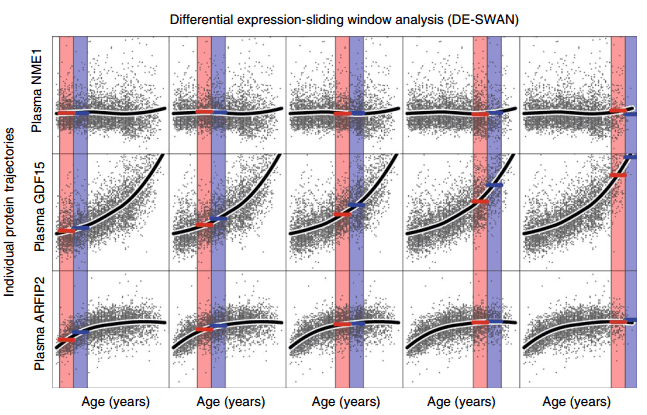
The Stanford group notes that some of the proteins in their clock increase in the blood with age and some decrease. Typically, the changes do not occur uniformly over the lifespan. Though none of the curves is U-shaped (on-off-on, or off-on-off), some proteins do most of their changing early in life, and some later.
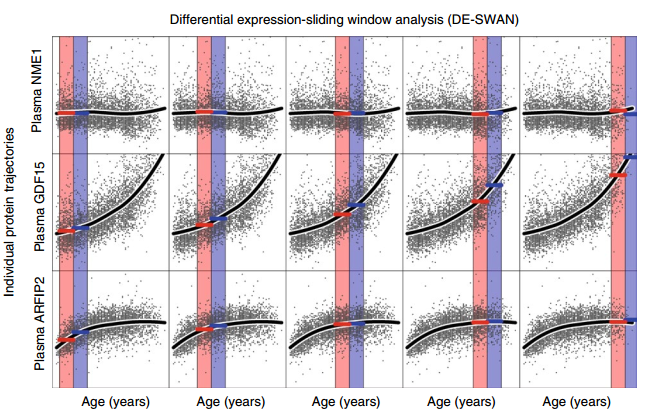
The group identifies three life periods and three groups of proteins: mid-30s, ~60yo, and late 70s.
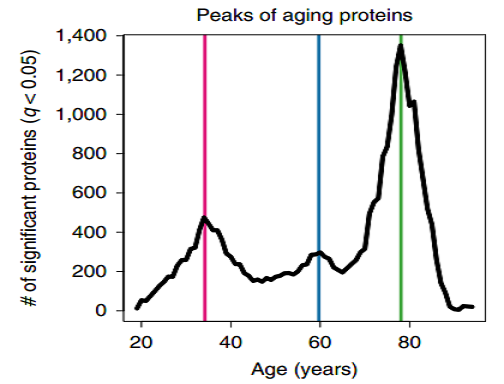
At young age (34 years), we observed a downregulation of proteins involved in structural pathways, such as the extracellular matrix. These changes were reversed in middle and old age (60 and 78 years, respectively). At age 60 years, we found a prominent role of hormonal activity, binding functions and blood pathways. At age 78 years, key processes still included blood pathways but also bone morphogenetic protein signaling, which is involved in numerous cellular functions. Pathways changing with age by linear modeling overlapped most strongly with the crests at age 34 and 60 years (Fig below), indicating that dramatic changes occurring in the elderly might be masked in linear modeling by more subtle changes at earlier ages. Altogether, these results showed that aging is a dynamic, non-linear process characterized by waves of changes in plasma proteins that reflect complex shifts in biological processes.
This paragraph doesn’t tell all we need to know to decide which changes are Type 1 and which Type 2. There is more information in their Supplementary Tables 5 and 14. I don’t have the expertise in biochemistry or metabolics to extract the information, but if you do and you are reading this, I hope you will contact me.
“Intriguingly, the three age-related crests were largely composed of different proteins”
For example, the top four proteins changing at age 78 are
- PTN.3045.72.2
- CHRDL1.3362.61.2
- SMOC1.13118.5.3
- CCDC80.3234.23.2
With Google searches, what I could find about all of these was that they have been previously identified as CV risk factors, and they all are increasing rapidly at age 78. The third one (SMOC) is described as binding calcium, which presumably affects blood clotting. All are clearly Type 1 — an important bottom line — but it would be nice to know more about their metabolic roles. Caveat: the technology used to measure these proteins comes from SomaLogic, and their mission was to look for proteins that could signal CV risk.
I could find nothing about numbers 5 through 8
- WFDC2.11388.75.3
- PTGDS.10514.5.3
- SCARF2.8956.96.3
- SVEP1.11178.21.3
It is interesting to me that almost all the proteins identified as changing rapidly at age 78 are increasing. The few I have identified seem to be increasing in a way that makes us more vulnerable to CV disease. It is natural to interpret this phenomenon as programmed aging.
In contrast, a few of the fastest-changing proteins at age 60 are decreasing (though most are increasing). The one decreasing most significantly is identified as SERP a2-Antiplasmin, which seems to me to be involved in autophagy, but I’m out of my depth here. At age 60, the proteins increasing most rapidly is PTN.3045.72.2, another CV risk factor, and GDF15.
GDF15 deserves a story of its own. The authors identify it as the single most useful protein for their clock, increasing monotonically across the age span. It is described sketchily in Wikipedia as having a role in both inflammation and apoptosis, and it has been identified as a powerful indicator of heart disease. My guess is that it is mostly Type 1, but that it also plays a role in repair. GDF15 is too central a player to be purely an agent of self-destruction.
Why not make use of different proteins at different ages in constructing the clock?
The implication is that a more accurate clock can be constructed if it incorporates different information at different life stages. Age calculation should be based on different sets of proteins, depending on how old the subject is. (You might object that you have to know how old the subject is in order to know which proteins to emphasize, but this problem is easy to overcome in practice, by calculating age in two stages, a rough cut using all proteins, and then a fine tuning based on proteins that change most rapidly around that age.) In my reading of the paper, the Stanford team prominently notes that patterns of change roll along in waves through the lifetime, but then they fail to incorporate this information into their clock algorithm, which is independent of age. This seems to be a lost opportunity. The methylation clocks, too, might gain accuracy by this approach. (All the Horvath clocks use the same collection of CpG sites for young and old alike.)
Maybe I am misreading the text about how the clock was constructed, and maybe the authors have already optimized their algorithm with different proteins at different ages. The text in question is
To determine whether the plasma proteome could predict biological age, we used glmnet and fitted a LASSO model (alpha= 1; 100 lambda tested; ‘lamda.min’ as the shrinkage variable was estimated after tenfold cross-validation). Input variables consisted of z-scaled log–transformed RFUs and sex information. [ref]
In any case, I know that none of the Horvath clocks have been derived based on different CpG sites at different ages, and this suggests an opportunity for a potential improvement in accuracy.
Comparison to Predecessor
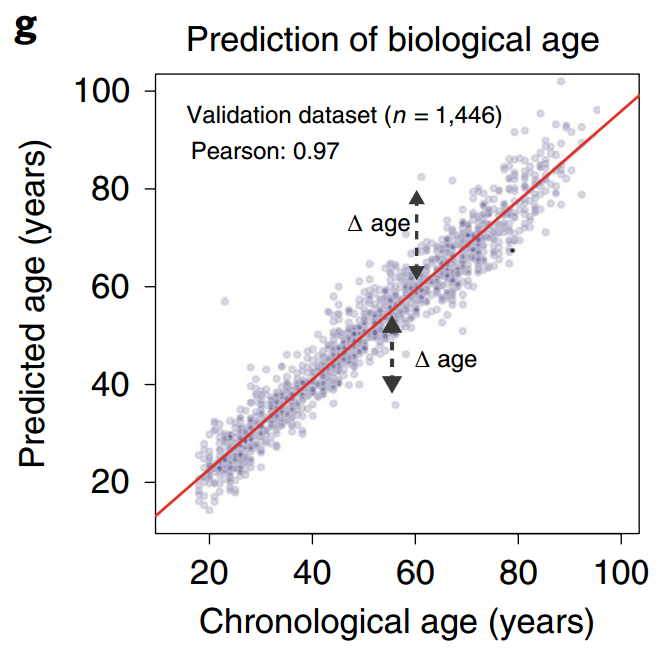
Last year, this paper was published by a group at NIH, describing their own study of how the human proteome changes with age. Their sample was smaller, but they also found that aging is characterized more by increasing plasma proteins than by proteins lost with age. They also singled out GDF15 as their most prominent finding. They didn’t look for different proteins at different ages, as the Stanford group did. “The functional pathways enriched in the 217 age‐associated proteins included blood coagulation, chemokine and inflammatory pathways, axon guidance, peptidase activity, and apoptosis.” The clock they constructed showed correlation with age r=0.94, compared to r=0.97 for the new Stanford clock. (The difference between 0.94 and 0.97 implies that the Stanford clock is twice as accurate (half the uncertainty)).
The bottom line
If proteome clocks eventually replace methylome clocks, the process will take several years. Proteome lab procedures are more complicated and more expensive than technology for measuring methylation. More to the point, the Stanford results must be replicated by independent labs, and must be stress-tested and cross-checked against other markers of aging. For the next few years, we have more confidence in the methylation clocks, which have been through this process and found to be solid.
But starting immediately, we can use the specifics of the proteome clock to engineer anti-aging remedies. The plasma proteome is directly related to the metabolism, and it can be altered with intravenous transfusions. (We cannot yet directly directly modify the methylome.) So let’s apply the results of the proteome clock. Most of the significant changes with age involve increases in certain proteins, so we will have to either remove these from the blood or infuse antibodies designed to bind to them and neutralize them. The infusions will probably have to be carefully titrated so as not to overdo it.
The large and crucial question hanging over the clock technologies (methylome and proteome) is which of these changes are drivers of senescence and which are protective responses to damage. The new proteome data provides reassurance that the predominance are of Type 1 (drivers of aging), and we can safely use them to gauge the effectiveness of our anti-aging interventions. But this issue is central, and deserves explicit attention. Every methylation site and every plasma protein that we use to evaluate new technologies should be individually validated as Type 1.
Discussion
99 reader comments
Imported threads are marked Archive. New comments are welcome and moderated for spam.
In light of the recent Coronavirus pandemic, I’d like to share this study with everyone. People often succumb to the acute inflammation from activation of the cytokines cascade. PEA can and does limit that excessive response
https://www.ncbi.nlm.nih.gov/pmc/articles/PMC3771453/#!po=1.66667
Hi Paul:
Thank your for that information.
Thanks for that information Paul. It puzzles me, why even younger people get hard hit by COVID19. In Denmark e.g. patients receiving intensive care at hospitals are between the age of 20 and 60 years, and very often without any pre-existing conditions like diabetes, hypertension, asthma etc.
Their symptoms are often benign during the first week (often no fever or low grade fever), until suddenly their immune system goes havoc and releases massive amounts of cytokines, ultimately resulting in lung damage.
I wonder, what theses patients may have in common, besides maybe genetics? Thinking maybe low micronutrient status, lack of vitamin d etc.?
Hi Josh,
I want to draw attention to the possibility of rollback of these new biological clocks with the help of directional degradation of certain proteins.
To act on a protein-based clock, you can use Proteolysis targeting chimeras (PROTACs). See: Targeted protein degradation: current and future challenges
https://doi.org/10.1016/j.cbpa.2019.11.012
Targeted protein degradation aims to reduce overall levels of age & disease relevant proteins. Mechanistically, this can be achieved via chemical ligands that induce molecular proximity between an E3 ubiquitin ligase and a protein of interest, leading to ubiquitination and degradation of the protein of interest.
Proteolysis targeting chimeras (PROTACs) are bivalent molecules that bring a cellular protein to a ubiquitin ligase E3 for ubiquitylation and subsequent degradation. Targeted protein degradation using bifunctional molecules to remove specific proteins by hijacking the ubiquitin proteasome system has emerged as a novel drug discovery approach. Several challenges remain in designing optimal degraders that also show efficacy in vivo. see also: https://doi.org/10.1039/C9CC08238G
Josh,
Here are a couple papers that support your view of the hypothalamus being the controller of aging.
Theaflavin 3-gallate is found in black tea.
"Theaflavin 3-gallate mimics Hnscr and ameliorates aging-related physiological disorders"
"Reducing Hypothalamic Stem Cell Senescence Protects against Aging-Associated Physiological Decline"
https://www.sciencedirect.com/science/article/abs/pii/S1550413120300024
"Hypothalamic programming of systemic ageing involving IKK-b, NF-kB and GnRH"
https://sci-hub.tw/10.1038/nature12143
A more recent study from the same lab:
https://www.nature.com/articles/nature23282
I think the finding that hematopoetic stem cells transplants track the age of the donor and of not the receiver show that intrinsic cell ageing, as measured by the methylation clocks, is not affected by circulatory signals.
Then again, hormone therapy in women has shown to decrease meth. age in buccal cells, which apparently have a higher amount of estrogen receptors, but not in other tissues.
There's also the fact that men have a higher average DNAm age than women. The cause of this could be a number of things, but different hormonal profiles are a likely candidate.
I believe that ageing starts in the cell gene expression, and it manifests itself as a proteome profile later. It is likely a feedback loop to a degree, but it must start somewhere. For for the most part, I think that's inside the cell.
That't not to say that a 'rejuvenation' of the proteome or the hormonal profile will not have its benefits, and perhaps, for now, it may be one of the easiest therapeutic avenues to pursue. But if you believe that ageing is an underlying cause and it lies at the cell's tightly controlled gene expression, then a proteomic change alone will leave many issues unsolved.
Adrian. I absolutely agree with you that aging starts at the gene expression of the cellular aging program that determines the proteome at each stage in the life cycle, which changes at a rate determined by the species program (see Fig. 2 on Barja Exp. Gerontol. 2019).
In addition to this basic primary mechanism, of course there are many interactions between aging program effectors and feedback loops back to the aging program, as well as changes in life stages affecting aging program stage- specific expression involving both genes and epigenetics proteins, and also involving TFs, modulators, coactivators, RNAi etc
I agree 100%. I would add that DNAm age is just a proxy of the chromatin degradation that happens in a tissue specific manner.
This is because DNAm is easy and cheap to assay, so there is a lot of data to analyse.
But I believe what really matters is the DNA accessibility for transcription factors. Mostly histone modification, histon linker regions. There we need more data on h3 or h4 binding chipSeq or ATAC Seq.
Unfortunately most of the chromatin accessibility databases are made on immortalized or cancer cell lines, which tell us nothing about aging and tissue specific histone profiles. I believe this will be the final push, then a good understanding will be formed about development and aging. I would guess within 5 years.
Gabor said: Josh, if primary driver of aging are the proteins and other biologicals floating in blood plasma, it’s easy to verify it, at least in mice. Dialysis is a mature technology. Just replace plasma with water solution of electrolytes through modified dialysis technique. That way the body will get no signals to age and will stop […]
JM answered: "I think it cannot be so simple. Organisms without circulation do age as well."
I agree with Josh that "organisms without circulation do age as well". But I do not think this means that the experiment proposed by Gabor (just in case it were posible to perform it without damaging the animal -eg: in addition to electolites, the replacement solution for plasma should have at least proteins to avoid osmotic problems due to lack of Donnan effect-) could not answer the question whether aging is SOLELY due to those plasma proteins from the old parabiont or not.
Josh, if primary driver of aging are the proteins and other biologicals floating in blood plasma, it's easy to verify it, at least in mice. Dialysis is a mature technology. Just replace plasma with water solution of electrolytes through modified dialysis technique. That way the body will get no signals to age and will stop aging. Of course body will also be deprived of other important signals whose effects need to be probed but replacing plasma with electrolytes is simple enough experiment to verify the primary hypothesis.
I think it cannot be so simple. Organisms without circulation do age as well.
This isnt very new, but quite substantial finding
Ageing-associated DNA methylation dynamics are a molecular readout of lifespan variation among mammalian species
They transplanted human chromosome 21 into mouse and found
"the rate of change of methylation with age at these chr21 aDMP sites is approximately 21 times faster in the mouse relative to what is observed in humans"
This is a very striking find IMHO and also a good model to find out what accelerates aging in the mouse relative to human.
I believe I've commented on this paper before. I don't find it a surprising result, given the greater rate at which mouse cells respire. IMO the methylation changes are downstream of inadequate homeostasis in the face of metabolism. I'm much more of a type 2 rather than type 1 believer, to use Josh's parlance. That's not to say I don't believe in ageing being tuned by evolution, I think it is. But I don't think there's a hidden clock, beyond simply the clock of a fetus having a limited replicative/regenerative capacity; enough for growth, reproduction and to raise a few kids.
I really think people get tied in great Gordian knot about ageing.
Hi Mark,
yes I agree, damage is upstream of the changes in the epigenetic landscape. But is aging upstream, too? I believe not, I believe the epigenetic landscape defines the identity of the cell and also the age of it. The epigenetic landscape is what differentiates multicellular, sexually reproductive, ageing organisms from multiplicating simpletons. The epi clocks only capture a fraction of the epigenetics changes that happens as the cells and the organism ages. But this is all they need.
Anyways I brought this article up as a response to the very first referred publication in the comment section about CpG density vs lifespan of mammalian species. I believe the correlation they found is rather cooccurence than casuality in any ways. I checked a few of the promoters that they had in their model with the greatest explanatory power (greatest weights) and there was not a nice, smooth increase in CpG density between mice and men but reappearance of new CpG islands around the TSS several hundred basepairs up or downstream. The original promoters were highly conserved. I think what the paper captures is rather the differences in the gene regulatory networks between species. If you have 20k plus promoters and 252 species (which are in fact can probably be clustered into 10-20 closely related groups) than this is an undetermined problem and you can easily find correlations among the promoters. Maybe they just found a 42 dimensional embedding that defines promoter network similarity between those species and correlates with maximum lifespan too.
Anyway I think the real problems that we are faced with now is:
- safe production of hESC like iPSCs that is safe iPSCs
- differentiation protocols into youthful progenitors
- successful engraftment into living tissue
I just read the latter can be a real issue, for example there are papers that hESC derived cardiomyocytes were transplanted into infarcted hearts of primates. They engrafted and improved ejection fraction dramatically, but they also caused arrythmias as they did not integrate well into the existing circuitry of heart muscles, they formed microcircuits of their own.
I somehow dont believe the chemical way of changing our old cells back into youthful state works. I would be happy if that worked but why would nature conserve such a pathway if it is never used?
Good question. I'm not yet sure whether ex vivo or in vivo approaches will turn out to be best.
Probably a good starting attempt should be to increase the number of circulating stem cells with youthful gene expression, and see what that can do for the rest of the body rather than trying rejuvenate organs en masse. I expect this way organs will gradually be replaced with young cells and they in turn will gradually improve the extracellular matrix. We might do better using adult stem cells rather than iPSCs as these already do the job of repairing the body (only currently it is a losing battle).
I think we are able (or will be able) to do things nature is not. For example with my old friend telomeres, nature has found a balance between cell cycling ability and cancer suppression. If there were a mechanism for cells in the organism to cheat and activate telomerase at higher levels, it would naturally run the risk of oncogenesis if cancer cells used the same trick. But we have the ability to use chemicals or gene therapy to activate telomerase temporarily and only in the presence of the stimulus, and overcome that particular barrier. Similarly spontaneous de-differentiation would be useful to the organism for de-ageing but could easily compromise tissue function and also risk cancer. But perhaps we can do it without downside if it is strictly controlled.
One question to the experts here is what differences should we expect from therapies minimizing Type 1 actions and the ones reinforcing Type 2 ones. I think those targeting truly Type 1 actions should always lead to "younger" phenotypes but I'm not that sure the same applies to those reinforcing Type 2 ones. If we take two subjects with exactly the same "type 1 condition" and we somehow increase in one of them the type 2 response and so better mitigating the type I damage, we may expect this one to live longer and look somehow younger at later stages of their lifespan. Nonetheless, at earlier stages of life the one with reinforced type 2 activity may look older relative to the "control" subject. I challenge the idea that any intervention increasing lifespan has to produce a "younger-looking" phenotype independently of the age we are talking about.
As an example I think about the IGF-1 decline with age which might be a compensatory response to aging. An intervention reducing IGF-1 may result in a longer lifespan but a somehow "older" appearance early in life as result of less cell turnover and muscle mass. Comments welcome
Your example of IGF-1 is a good example. Take someone who fasts and becomes much more catabolic. At advanced ages in a state of metabolic crisis, overweight, cardiovascular problems, etc.- such an intervention will extend life. In a youg person it will almost certainly make you 'older'; I speak from personal experience with experiments with things like berberine in my thirties. A young person has long telomeres and a younger epignetic state. Addressing metabolic issues (which admittedly do kill many people) only deal with a small part of that, and have negative consequences.
TO ME THE BEST THING IS:
-1) TO STUDY THE hierarchical STRUCTURE OF THE AGING program
-2) To localize its master genes controlling the many target genes of interest in the right proportions (you will never guess with cocktails of e.g. 500 different things in the right proportions (each!), but mother nature knows perfectly how to do to it, because it has at least 500 million years of experiece doing that on each new species it generates! (so dozens or hundreds of millions times done by her?)
(you´d better ask HER how she does it)
3) You experimentally downregulate the appropriate aging program master genes
(to get higher longevity-big effect- without undesirable side effects: having children only at 200, looking old as you say, being the body size of a house, or having 0,2 fertility etc.
THEN YOU WILL both LIVE LONGER AND LOOK YOUNG TOO (AS A 20 YEAR OLD HUMAN NO DOUBT "LOOKS YOUNG" WHILE A MOUSE HAS BEEN DEAD ALREADY FOR THE LAST 16 YEARS if both are born at the same time (20-4 = 16) AND its remains- if any- DO NOT "LOOK" oung at all no doubt either.
Why this "BOTH"? Because Mother Nature (Aging Program) knows what proteins to push up, what to push down (to modify ALL the necessary involved aging effectors, MANY! different ones, all of them, not only telomers! (epigenetics is part of the Aging Program, not an aging effector. DNA and proteins work together, they collaborate inside the nucleus generating our life stage from egg to 120 years
Thats what i think myself. Moreover, i struggle to find truly Type 1 interventions and i am personally reluctant to apply to myself those leading to younger-looking results with unknown long term costs. So far i think there is not much to include as Type 1 therapies besides senolytics? Even DR / rapamycin seems to be too downsrtream to be targeting the core of aging but more likely to mitigate it. Increasing telomeres and sirtuins could be near-to-core by provided longer time of heterochromatin stability? Things like NR, NAD+ upregulation, and everything today targeting regeneration seem too suspicious long term....
You are full wrong Guillermo.
DR is not dowstream at all.
Look at Fig. 2 of my Barja Exp. Gerontol. 2019 paper
DR is a signal towards thenuclear Aging Program (part A in the Fig., maximum upstream)
Telomers, llike miROSp etc is at the right, part C, downstream lof Aging Program but still before aging changes are performed.
That Fig. 2 is my best Fig.on Aging model.
It is the result of 40 years of lab work and 10,000 papers read IN FULL. I retain on my head around 7% of them simultaneously
You will find few scientists in the aging field that can say the same....Fig. 2 is my best synthesis, together with Part II extracellular etc Iam finishing this course
If you donot beleive me judt think how impossible it is that DR does not decrease aging rate if it increases (for sure) maximum longevity by up 40% (no other tretment does this!. Blasco long lived" mice live less than our controls! 3,9 years our Aging Cell atenolol paper 2014.
And look at pictures of Rhesus monkeys on R. Weindruch paper on DR (Colman et al. Science 2009)
There is a lot of business in this area, leading to too much untrue statements
Thanks for the clarifications Gustavo. I acknowledge DR is tightly integrated into whatever the aging program is and the point about DR achieving a 40% increase to max lifespan is key to show how much metabolism is linked to the aging program. Nevertheless, I expect a truly effective "type 1 targeting intervention", whatever it is, to achieve far more that DR. I will start accepting theories of aging when interventions based on them produce a mouse living longer than the 3,9 years you achieved or the 4,9 of the GHR-KO 11C. Neither senolytics, reprogramming, telomeres extension or epigenetics are close to be good enough as theories of aging to this standard. I hope I live long enough to see an immortal c-elegans ;)
Mark what you mentioned earlier about balance between growth and repair. We must not jump from one lopsided position to the other. Continuous mTOR inhibition without work out can also be harmful as you rightly pointed out causing sarcopenia amongst other things. Here is a paper backing your contention:
https://www.ncbi.nlm.nih.gov/pmc/articles/PMC6920138/
A very thorough and high resolution analysis of epigenetic changes with age.
https://epigeneticsandchromatin.biomedcentral.com/articles/10.1186/s13072-018-0191-3
Age-related DNA methylation changes are tissue-specific with ELOVL2 promoter methylation as exception
DNA methylation changes with age are highly tissue specific and affect more than a thousand genes.
Horvath et al replied to the paper above, but the consequences are similar
https://www.ncbi.nlm.nih.gov/pmc/articles/PMC6286821/
"approximately 90% of the DNA methylome is altered with age"
I have to near important deadlines for 2 papers, so I will not participate (at least not so actively) in this blog from now on. If not I will never finish my due work. Sorry for this.I will try to look at comments but much less frequently than until now.
Should any of you need something important from me do not doubt, nevetheless, to write directly to me to:
[email protected]
Thanks
Happy New Year for all of you
(and God saves you from Donald Duck! (hum hum)
"Most of the significant changes with age involve increases in certain proteins, so we will have to either remove these from the blood or infuse antibodies designed to bind to them and neutralize them. The infusions will probably have to be carefully titrated so as not to overdo it."
Why not "consume" the protein naturally by muscle training ?
All the ones I know (including myself) that still do a lot of weight training after 55 look and feel much younger as they are. I think this is a better alternative to other antiaging medication. And also keeps you fit. A friend of mine who is 78 still make 20 reps bench press with 35 lbs and look like one who is 65. He was not a professional bodybuilder and began weight training only when he was over 50
Because it will only slow aging a small amount. There is likely no amount of exercise that will get you past 100 and certainly not past 120. I say this as an active weightlifter and aerobic exerciser.
Josh/we are looking for ways to get past 120 with high functionality.
You are right Lee
Florentin
Exercise makes you fit. I agree. But it us well known that exercise can increase mammalian MEAN lifespan but Does NOT increase at all MAXIMUM lifespan. So exercise effect does not decrease the aging RATE.
And in tge part if that rate controlled by mitROSp, I know why that is so..
I agree, all the weight lifters I know look young for their age. It's probably got something to do with always having a ready source of amino acids (i.e. muscle) for antioxidant production, collagen, etc. Yes it won't get you to live forever,but you'll look and feel good for longer, by which time hopefully we'll have some genuine therapies that actually make you younger. We're very close now.
Myokine signaling is likely at work too.
2 more replies
I'm following this excellent blog and the longevity field for about 5 years.
My question to the experts is: Do we really have any anti-aging treatment available that can beat resistance exercise and fasting, which triggers the body's self-repair mechanism?
sTEPHAN,
I do not think anything better than DR has been CLEARLY DEMONSTRATED to increase longevity IN MAMMALS.
Not as far as I am aware
Sorry if this is trivial in this expert thread but is DR=CR in this context?
Yes. DR = CR
I prefer to use DR as a general term because:
1) Now it is thought that at least in part it is not the restriction in calories THEMSELVES what increases longevity.
2) In addition to CR, protein restriction (PR), and methionine restriction (MetR) also increase longevity, although the PR and the MetR effects on longevity in rodents are around half intense compared to that of CR. The term DR is more general, because it includes the 4 paradigms CR, PR, MetR as well as IF (intermitent feeding, analogous to the old one EOD= Every Other Day method).
Thank you for your reply mostly knowing you are in hurry and busy in the end of year rush. I asked also because DR (in particular Methionine DR) looks to be effective on a frailty index (FI) as measured by two different clocks in mice by Sinclair's team: Age and life expectancy clocks based on machine learning analysis of mouse frailty, https://doi.org/10.1101/2019.12.20.884452
Evidence from dogs suggests rapamycin may be a worthy addition, even if it doesn't beat fasting and strength training. Also, note that fasting and chronic underfeeding are related but different, with fasting likely the better alternative.
One important caveat when it comes to exercise is that if the cellular theory of aging or the 'damage-accumulation' theory are correct, then an excess of activity should increase the aging rate. All things being equal more exercise should stimulate cellular turnover, potentially depleting stem cell niches faster, shortening telomeres faster, dialing up senescent cell transformation and increasing mitROS. I think there is some circumstantial evidence of this when it comes to joints (chondrocyte ageing?).
Now, this does not seem to occur as per the expected rate. Hence, the hormetic effect which has been discussed many times on this blog. However, it is something to keep in mind, especially with the 'bigger is better' attitude that many body builders seem to have (intentional mTOR pathway stimulation comes to mind).
I think training in general is likely to increase health and life span by preventing elevated muscle and bone waste. This is probably the biggest effect. Exercise itself is likely to relatively mimic caloric restriction, which otherwise would not take place in a more sedentary individual. The relatively larger muscles will also consume more calories and therefore increase the basal metabolic rate, again mimicking CR. And finally, it will prevent excessive fat accumulation, which so often happens as we age due to a variety of factors. With fat deposits themselves likely to contribute to a hormonal imbalance which may set off a feedback loop of more pro-fat accumulation hormones.
aDRIAN,
iT IS A COMMON MISTAKE TO ASSUME THAT MITrosP GOES UP IN EXERCISE. iT IS THE REVERSE, IT GOES DOWN (OTHERWISE A MAN WOULD DIE BEFORE RUNNING 20 kM, AND EXERCISE WOULD BE UNHEALTHY (but it is healthy, the opposite, in agreement with the decrease in miROSp
Tyhe misunderstanding comes from the wrong assumption than the FRL% at the ETC is a constant, which is not. Ist is also lower in birds (vs. mammals) and in DR and MetR animals vs. Ad libitum fed ones
I explained this on my fully explanatory (FOR THIS) paper in Revuv. Research in 2007. You should read it. I wrote it not to have to explaion to people one by one. ROS are NOT a "byproduct" of the ETC (That is the most common false sentence at the Introduction of almost every MFRTA related paper!!
Yesterday someone put a blue link of it here in this blog. You just click it and you have it
I wanted to type:
Barja G. Mitochondrial oxygen consumption and ROS production are independently modulated. Implications for aging studies. Rejuvenation Research 10: 215-223 (2007).
I practice different fasting routines to induce autophagy. I go every weekday to the gym. Before my workout, I haven't eaten for 16 - 18 hours. After my 90 min workout, I have a feeding window of 4 - 6 hours. That works very well for me. This way, I believe I can balance out any adverse effects of activating mTOR.
Also, I understand that activation of mTOR when exercising is not systemic, only in the muscle tissues but not, for example, in the liver tissues.
I definitely, restrict calories, but I'm making sure I have an intake of 120g (I'm 64, weight: 77 kg) of proteins on my workout days to promote muscle repair and growth.
Sorry, this should be the first sentence:
Yes, I read here and elsewhere that exercise actually shortens lifespan, mainly due to activating mTOR.
Experiments in rats have clearly shown that exercise can increase MEAN (and thus your individual) lifespan but not MAXIMUM lifespan (so, no effect on aging rate was demonstrated). I read similar results in humans (e.g. large Harvard alumni study) although reliability of many human studies is poor because of many potential pitfalls
@Mark:
Thanks for your insides. I remember reading at least one paper suggesting that people 65+ should increase their protein intake by 30% or so.
I UNDERSTAND THAT YOU WANT TO EAT SO MUCH PROTEINS BECAUSE YOU WANT STRENGTH and you do exercise
HOWEVER, FROM THE POINT OF VIEW OF LONGEVITY 1,56 GRAMS OF PROTEIN PER Kg IS TOO MUCH.
Present RDA for meal protein is 0,85 g/Kg body weigth, and you can be sure that 0,6 grams of protein/Kg of body weight is not unhealthy, but rather more on the side of longevity promoting PR.
If you want more precise information of PR in humans you can go to papers by Luigi Fontana. He is a well known and experienced researcher on that area
Old humans suffer from sarcopenia. I would not recommend that an old human cuts protein intake. Not only does low protein reduce lean mass, low protein intake also means limited cysteine intake, which compromises antioxidant production. Elevated ROS can then block autophagy (insulin receptor is ROS sensitive) and block muscle building via ROS sensitive inflammatory cytokines.
I think it is a common misconception that amino acids are the biggest activator of harmful mTOR. mTOR is needed by muscle. Harmful mTOR is primarily in the liver and caused by excessive (and constant) carbohydrate consumption.
Hi Gustavo, I'm just reporting what is known to happen to old humans, as opposed to lab mice. Actual experiments have shown cysteine supplementation (and also glycine) can help old humans start to build muscle and recover from sarcopenia. I would not expect them to live shorter as a response, quite the contrary due to being less susceptible to falls, etc. I am not talking about bodybuilder physique, which is in any case out of the reach of most, even if it were desirable.
Many things are important in the rate of ageing. MtROS, rate of telomere shortening, level of DNA damage, epigenetic regulation, etc. But not all are equal if your aim is to turn back the clock, as opposed to age slower.
What I am interested in is EXTENDED or RESTORED YOUTH. I know well how to be an old man for (slightly) longer. It is not that difficult (or interesting) an aim.
I agree with you Gustavo, ageing is good for the group. Yet I aim the same as Mark, a restored and extended youth. I know there is a contradiction, and I do not pretend to have the solution. But obviously it implies a radical change of our way of life.
131 million people are born per year at the moment, although that is falling rapidly due to people having less children (almost all of Europe is below replacement rate already). 55 million people a year die (so net gain is 76 mill). If we were to completely abolish ageing that would remove about 40 million of those deaths (so the net gain would go up to 116 million). I expect however that abolishing (or even modestly delaying) ageing would naturally decrease the birthrate further and we'd end up not increasing population much over its current trend. This is because women would no longer be against the clock to have children. I can speak for Europe that this is the main thing causing couples to have children, mostly now in their 30s and 40s. I can see this change to 50s and 60s or even later, should biology allow. And we will probably not suddenly abolish ageing, it will be a series of improvements (unless we get really lucky!), so the fall in deathrate will not be as dramatic as I have used in this example. In any case, I've been in care homes and hospices to see people I love wither and die. The humane thing to do is to stop it happening to anyone else. Otherwise we might as well go back to living on caves and dying by wild animal, starvation and infectious diseases.
Hi Mark:
As people age, the way their body processes protein changes. Even if they eat more animal protein, the body may not be able to utilize it in the same way a younger person does.
Too much protein can cause kidney issues or other health issues, in the elderly. So high quality protein is likely important.
Once the body has enough protein, eating more protein has an inverse negative affect rather than a positive effect, according to numerous studies.
Some studies suggest substituting whey protein for meat, others say the source makes no difference and that eating protein throughout the day is better than one large protein meal.
Again over consuming protein, whether from whey or pea protein or meat fish or dairy can cause other health issues in the elderly, according to some studies.
Lastly protein requirements likely change, requiring more or less, depending on the elderly person's health status.
Another interesting paper
https://www.sciencedirect.com/science/article/pii/S1568163719301837?via%3Dihub
I find appealing the idea of nature taking advantage of retrovirusis to program death. It is remarkable that as chromatin gets modified and gives access to TE transcription more DNA breaks are to be repaired and therefore the epigenetic clock ticks forward. I would expect part of the transcription process should be shared to neighbor cells to allow for similar effects whole body and so getting coordinated epigenetic age patterns. To me, this is the most plausible mechanistic theory of aging so far although many pieces of the puzzle should still have to be worked out....
Thanks Gullermo. The Andrenazzi et al. ARR paper looks most interesting to me. 1st time I see TE involvement in Aging. And TEs are 50% of total nuclear DNA. Their implication must be important (I never believed on thrash DNA selfish gene generated "bullshit "theory" -mot a theory really, not even in the 1970's when I was a bachelor student. Then I did not know what the alternative evolutionary mechanisms were, -I do know-, but I never beleived in Thrash Brain Richard Dawkins thinking with his ass, not in Neodarwinian "Talibans".
Selfish reductionistic theory is unteanable for ANYONE who knows human proper thinking.
But again, I would not consider this (heterochromatin loss and TEs INVOLVEMENT) to be a "dysregulation", any error or malfunction. On the contrary, that should be part of the Aging Program too.
This is also Andrei Gudkov's theory. That transcriptional activation of TE's is the underlying cause of ageing and is ultimately responsible of leukocyte senescent-like behaviour which in turn allows s. cell accumulation.
One criticism I would make of this theory however, is that as per my understanding methylation is reduced to a minimum, complete absent?, at the embryonic stage. Why do TE's do not wreck havoc at that point then? Personally I don't quite believe that such a carefully controlled process as gene expression, responsible for tissue specification and development can be hijacked that easily by random processes.
"as per my understanding methylation is reduced to a minimum, complete absent?, at the embryonic stage. Why do TE’s do not wreck havoc at that point then? "
I think they do and this is the reason for their existence, they introduce genetic diversity while active for only a few days after conception.
What I read earlier about this theory is that TE expression is low in normal aged tissues and when they are set lose it is usually cancer/ senescent cell that results. Unfortunately I did not save the references.
Both the essay and the numerous comments here are grist for a tremendous amount of further study and consideration, even without much input from the second law contingent. Great progress is clearly pending!
One consideration not emphasized: If indeed there are type 2 changes, where shifting methylation and/or plasma protein profiles reflect a struggle to self-repair (irrespective of where/why the damage has arisen), then augmenting their shift might be an avenue for therapy. Similarly, insofar as type 2 changes reflect actual (not just attempted) repair, their magnitude might be useful in refining aging clocks to include healthspan enhancements that partly negate adversity reflected or caused by type 1 changes.