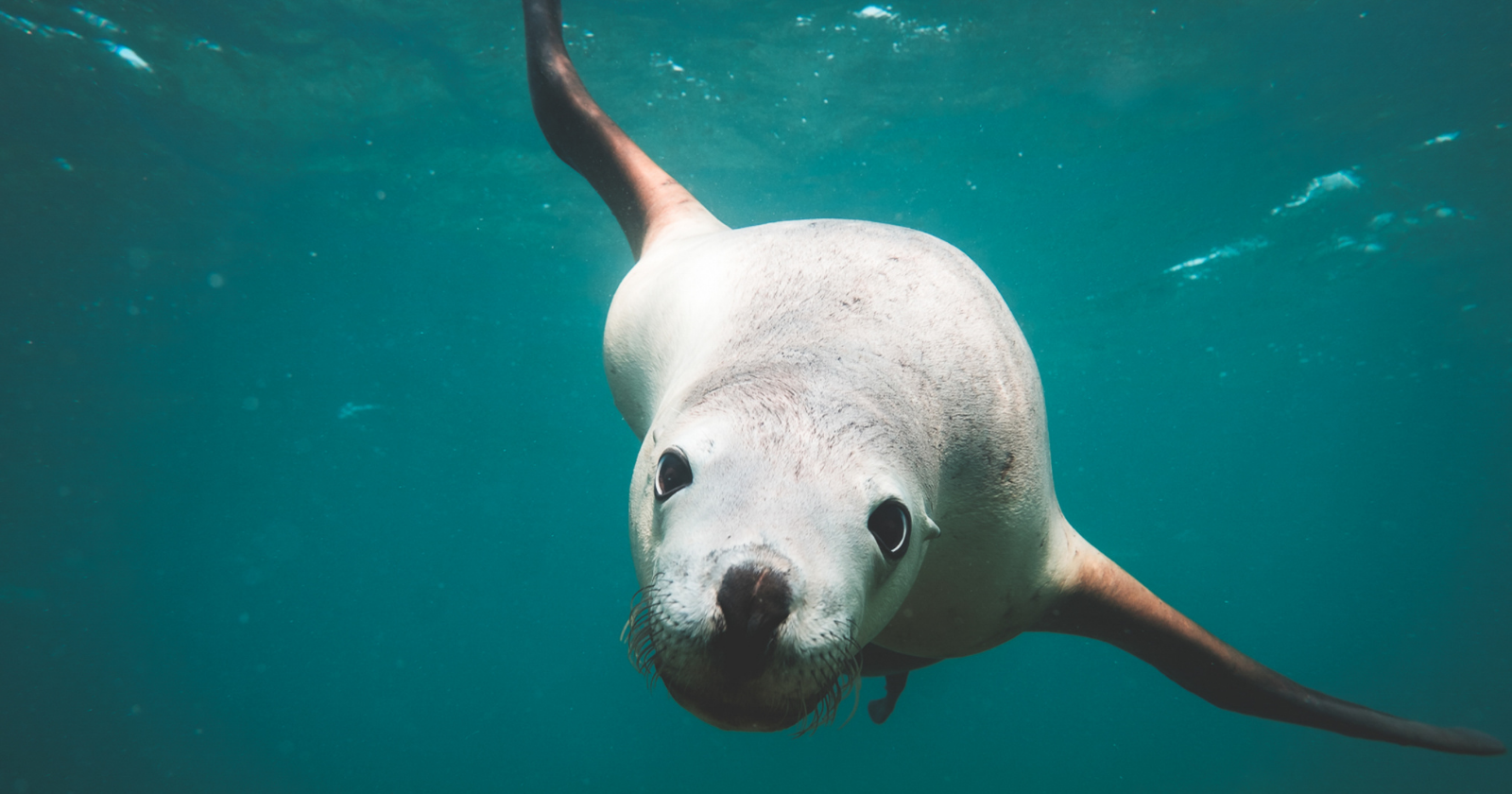
Elephant seals spend most of their lives underwater. That single fact turns out to be, on the accumulated field evidence of the last forty years, one of the more consistently surprising things about the biology of any large mammal on Earth.
When a northern elephant seal leaves the beach at Año Nuevo in California and heads out into the Pacific for her post-breeding or post-molting migration, she doesn’t come up for air the way a person or a dolphin does. She dives to the deep water column, stays there for the better part of half an hour, surfaces for two or three minutes, and dives again. And she keeps doing this, dive after dive after dive, at a rate of two or three per hour, for the entire two to eight months she is at sea.
On the mission’s own accounting, an adult female elephant seal spends roughly ninety per cent of her time at sea underwater. Which is a strange proportion for an air-breathing mammal to maintain, and it stayed almost entirely invisible to marine biology until somebody worked out how to strap a small pressure-recording device to one seal and get it back.
The first depth logger and what it revealed
The person who eventually did that was Burney Le Boeuf, a marine biologist at the University of California, Santa Cruz. In the early 1980s, working with Daniel Costa, Anthony Huntley, Gerald Kooyman, and Randall Davis, Le Boeuf attached a time-depth recorder to a single adult female northern elephant seal at Año Nuevo just as she was about to leave the beach following the end of her lactation fast. The device was small and self-contained. It recorded pressure at regular intervals, from which the depth of the seal at each moment could be reconstructed once the animal returned to the rookery and the recorder was recovered.
If you enjoy learning about our amazing animal kingdom, you’ll love this video we made on a young elephant bull who surprised researchers with his adventurous route in Zambia:
The seal was at sea for eleven days. The recovered instrument had captured six hundred and fifty-three dives, each with its own descent, bottom time, ascent, and surface recovery interval. Mean dive duration was twenty-one minutes. Mean surface interval between dives was three minutes. Mean dive depth was 333 metres. The single deepest dive during the eleven-day period reached 630 metres, which was the deepest dive that had ever been documented for any pinniped species anywhere in the world. The results, published in the Journal of Zoology in 1986 under the title “Pattern and depth of dives in Northern elephant seals,” effectively rewrote what the field understood about the physical capabilities of large marine mammals.
What made the finding genuinely startling wasn’t the depth of any individual dive. It was the pattern. This single seal, across those eleven days, had spent only eleven per cent of her time at the surface. The other eighty-nine per cent of her existence had been happening in continuous rapid succession at depths hundreds of metres below the sunlit water she surfaced through to breathe. Nobody in the field had known that. The seal wasn’t doing it because there was anything unusual about her. She was doing it because that’s simply what elephant seals do all the time, out of sight, in an environment marine biology had almost no other way of observing at the time.
How much deeper the story got
According to reporting by ScienceDaily on a subsequent 2012 study by Patrick Robinson, Daniel Costa, and colleagues at UC Santa Cruz, published in PLoS ONE and drawing on satellite tag data from nearly three hundred adult female elephant seals across the northeast Pacific, the UCSC team continued to instrument individual seals every year through the 1990s and 2000s. As the tagging technology improved, the deployed devices could record location, depth, dive duration, and other variables at high resolution across the entire duration of a foraging trip, meaning up to eight months at a time. The dataset accumulated. And the deepest recorded dives kept getting deeper.
The current record, held by a single female who feeds near Vancouver Island on the outer edge of her foraging range, sits at 1,754 metres. Which is a mile and ninety-four feet straight down from the surface of the Pacific. On one occasion documented in the Robinson team’s 2012 paper, the same seal reached 1,747 metres. On a subsequent trip, she went seven metres deeper. Both dives were made by an individual female northern elephant seal weighing considerably less than a small car, breathing air the way any mammal does, holding her breath for the duration of the descent, the bottom time, and the ascent, and then surfacing for a few minutes before diving again. She wasn’t doing it because researchers had trained her to. She was doing it because that was where the squid were.
According to a 2024 data descriptor by Daniel Costa, Rachel Holser and thirty additional collaborators at UC Santa Cruz and partner institutions, published in the journal Scientific Data by Nature and describing the compiled two-decade dataset of adult female elephant seal tracking and diving records, the combined UCSC dataset now covers 653 instrument deployments from 475 individual seals over seventeen years, containing 3,844,927 recorded dives and 596,815 recorded locations. The deepest single dive in the dataset reached 1,764 metres, meaning the current confirmed maximum depth for the species is now slightly deeper than the previous 1,754 metre record. Dive durations across the dataset were coarsely filtered to exclude records over 150 minutes as biologically implausible, meaning that the operational upper bound on how long an elephant seal can hold her breath under normal foraging conditions sits somewhere between the ninety-minute range that is common and the two-and-a-half-hour range that is at the outer edge of what has ever been recorded.
The environment at the depths these animals routinely occupy is one no human can survive in for any length of time. Water pressure at 1,700 metres exceeds one hundred and seventy atmospheres. Temperature sits at around four degrees Celsius. Sunlight of any wavelength has never penetrated to those depths on any day in the planet’s history, meaning the elephant seal is hunting entirely by sound, by touch, by the sensory data her whiskers pick up from the water around her, and by whatever bioluminescent flashes her prey may briefly emit as she approaches. The dive to depth takes about half an hour. The bottom time is another twenty to thirty minutes. The ascent is another half hour. The surface recovery is three minutes. Then she does it again. And again. And again. For months.
What the Le Boeuf team’s original single-female recorder made visible in 1985, and what the accumulated multi-decade record has only reinforced since, is that this is not an extreme case of anything. It’s the ordinary daily life of an ordinary adult female northern elephant seal. The physiology that makes it possible, including collapsed lungs at depth, dramatically slowed heart rate, muscle-stored oxygen reserves several times higher than any human athlete has ever measured, and an ability to sleep at depth while continuing to descend and ascend on autopilot, is the accumulated evolutionary answer to the specific problem of being a warm-blooded air-breathing mammal that needs to eat squid living a mile below the ocean surface. Nothing about the answer is intuitive. All of it works.