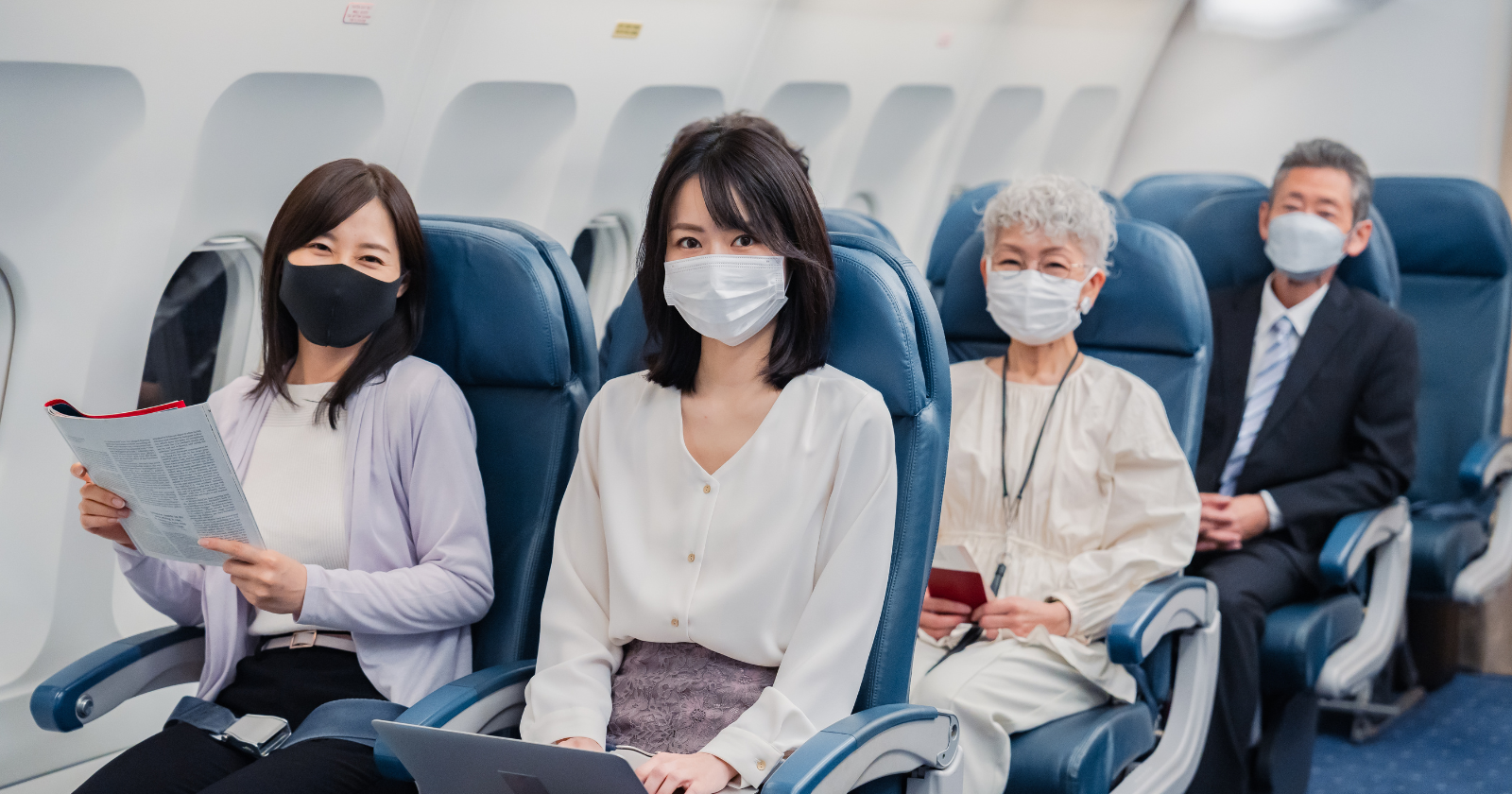
Almost nobody who flies commercially believes this. The specific experience of a long-haul flight, on the felt sense of the passengers moving through it, is one of stuffy air, recycled breath, and the low-grade certainty that whatever illness anyone else on the plane is carrying will be shared out to the rest of the passengers by the time the aircraft lands. Every survey conducted on the subject over the past two decades has confirmed that the flying public generally believes cabin air is worse than the air on the ground. Every peer-reviewed and industry-technical study conducted over the same period has confirmed that the belief is, on the current engineering measurements, incorrect.
The air on a modern commercial aircraft is not merely acceptable. It is, on almost every metric a public-health inspector would use to assess an indoor space, better than the air in the average home, office, restaurant, classroom, or hospital ward.
How the system actually works
The confusion is understandable. Almost every ventilation system a person encounters on the ground operates on the same basic principle. Some volume of fresh air is drawn in from outside, mixed with some volume of stale air that has already been in the room, filtered lightly, and pushed back into the space. Home HVAC systems do this. Office ventilation systems do this. The distinguishing feature of the airliner version is not that its principle is different. It is that its numbers are different, in a specific direction, by a considerable margin.
According to the Federal Aviation Administration’s official reference materials on cabin air quality, which govern the certification standards for every commercial airliner operating in United States airspace, the air breathed by passengers on a modern large transport aircraft is approximately a fifty-fifty mixture. Half of it is fresh outside air, drawn in through the aircraft’s engines, compressed, cooled, and delivered to the cabin. The other half is recirculated cabin air, which has been passed through High Efficiency Particulate Air filters that remove 99.97 per cent of all particulate material larger than approximately 0.3 microns. These are the same HEPA filters used in hospital operating theatres and pharmaceutical clean rooms.
The filtration itself would be effective enough on any single pass. What makes the whole system unusual is how often the whole pass repeats. According to the International Air Transport Association’s technical briefing on cabin air quality, the entire volume of air in the passenger cabin of a modern large jet is replaced somewhere between twenty and thirty times an hour, or once every two to three minutes, depending on the specific aircraft type. A Boeing 737 or Airbus A320 sits at the lower end of that range. A wide-body long-haul aircraft like a 777 or an A350 sits closer to the higher end. On any of them, the volume of air a passenger is breathing when they board has been entirely removed and replaced with fresh, filtered air roughly six times before the safety demonstration has finished.
The direction the air is moving matters just as much as the rate. Cabin air enters through vents in the ceiling, flows downward at approximately one metre per second, and exits at floor level along the sides of the fuselage. The airflow is vertical, not horizontal, which means aerosols released by an infected passenger do not travel fore or aft through the cabin the way they do in a room where the ventilation is stirring the air laterally. The specific engineering result is that anything a passenger breathes out is being pulled downward toward the floor within seconds and drawn into the recirculation system, rather than drifting toward the passengers three rows ahead of them.
While the air quality might be higher than expected, there’s something else that most passengers don’t realize is happening. This video explains more:
How it compares to the room you’re in right now
The comparative numbers are worth sitting with, because they run against the common assumption in the direction almost nobody expects.
An average American home, on typical residential HVAC settings, exchanges its air roughly once every one to two hours. A typical office building, under ordinary commercial ventilation standards, exchanges its air two to four times an hour. A hospital operating room, which is one of the most tightly ventilated indoor environments on Earth, exchanges its air roughly fifteen to twenty times an hour. A commercial airliner exchanges its cabin air twenty to thirty times an hour.
Which is to say the aircraft cabin, on the exchange-rate measurement alone, replaces its air roughly twenty to thirty times more often than the room in your house, five to ten times more often than the office you spend your workday in, and roughly fifty per cent more often than the operating theatre where a surgeon might be doing open-heart surgery. It also passes the recirculated portion of that air through the same category of filtration used in the operating theatre, which is not something most homes or offices do at all.
According to a World Health Organization expert consultation on tuberculosis and air travel, published as a formal reference chapter in the WHO’s public-health guidance for airline operations, the combined effect of the HEPA filtration and the high air-exchange rate is that properly maintained aircraft ventilation systems remove any airborne particle large enough to carry the tuberculosis bacterium, and there is no evidence in the published epidemiological record that the recirculation of cabin air has ever facilitated the spread of an infectious respiratory illness on a commercial flight. That statement is a strong one and it has been carefully qualified by public-health researchers since it was made. But its central proposition, on the accumulated evidence of decades of subsequent transmission studies including several conducted during the COVID-19 pandemic, has continued to hold.
None of this means the flying experience is genuinely pleasant. It is not. Cabin humidity on long flights typically runs at fifteen to twenty per cent, which is drier than most deserts, and the low humidity produces the dry throat, dry eyes, and general sensation of stale air that passengers routinely misattribute to poor ventilation. The seats are cramped. The air pressure is set to the equivalent of standing on top of a two-thousand-metre mountain, which by itself produces mild hypoxia and headaches in a small fraction of passengers. The noise is high. The smells of several hundred people, their food, and their clothing are all recirculating through the same shared volume. All of that is real. What is not real, on any of the specific engineering measurements the aviation industry publishes and public-health authorities routinely verify, is the belief that the air itself is dirty.
The air is, on the measurements, exceptionally clean. What is dirty is almost everything else about the experience of being crammed into an aluminium tube at cruising altitude for eleven hours next to people you did not choose. And the specific human tendency to conflate one uncomfortable indoor environment with another has, for the whole modern history of commercial aviation, quietly generated a folk belief about airplane air that the actual engineering evidence does not support.
Kiran Athar is not an aviation engineer or a public-health researcher. She writes about the ordinary corners of modern life where engineering and public health quietly intersect, drawing on peer-reviewed research and primary-source scholarship.