

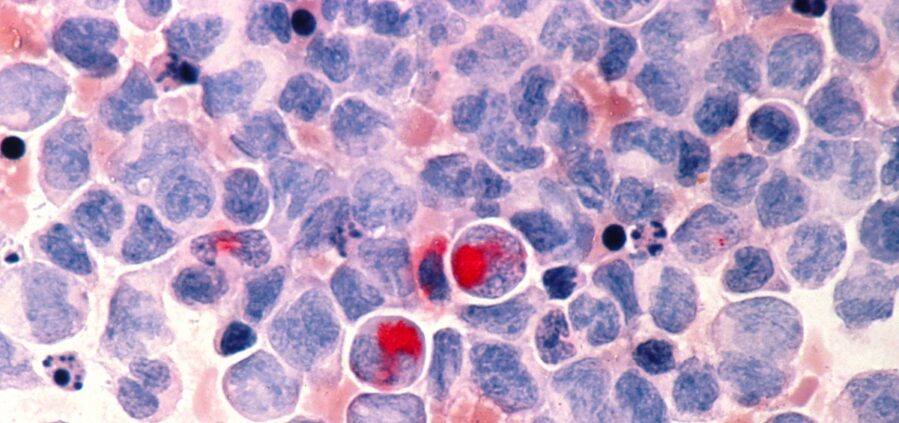
Look closely at a leukemia cell and you might spot something strange: bright puncta clustered in the nucleus, structures that healthy blood cells never make. Scientists at Baylor College of Medicine now report these droplets are not just debris. They are organizing hubs that different genetic mutations use to maintain the same cancer program, a shared weak point that could reshape how doctors target blood cancers.
The work, published in Cell, began when graduate student Gandhar Datar noticed the puncta under the microscope. His advisors, physicist Joshua Riback and stem cell biologist Margaret Goodell, suspected phase separation, the same physical process that makes oil bead up in water. Inside the nucleus, molecules can let go of the usual mixing rules and clump into condensates. The team wanted to know if these droplets were doing something functional.
Mutations With Different Names, Same Address
The answer turned out to be yes. In NPM1-mutant acute myeloid leukemia, the study reports, mutant nucleophosmin forms nuclear condensates distinct from nucleoli. Those structures concentrate proteins the cancer needs: XPO1, NUP98, KMT2A, and MENIN. They also park near active chromatin and key loci like HOXA genes and MEIS1, the molecular switches that keep leukemia cells from maturing.
What surprised the researchers was how broadly the pattern held. Cells carrying entirely different leukemia mutations formed droplets with the same behavior. To test whether these were truly identical structures, the team developed a quantitative miscibility assay rooted in polymer physics. When they co-expressed proteins from different leukemia subtypes, the condensates mixed into a single phase. The authors call them “coordinating bodies,” or C-bodies, because they pull together disparate pathways.
“All these different leukemia drivers, each with its own recipe, ended up cooking the same droplet, or condensate. That’s what unites these leukemias and gives us a common target,” Riback explains.
The finding held across human cell lines, mouse models, and patient samples. Nucleoporin and KMT2A fusion proteins, which drive other leukemia subtypes sharing HOXA/MEIS1 programs, recruited a similar network of proteins into condensates the team could physically distinguish from other nuclear bodies.
Dissolving the Hub Shuts Down the Program
The team argues C-bodies are not byproducts of disease but requirements. When researchers altered proteins so they could no longer form droplets, or disrupted condensate stability with drugs, leukemia cells stopped dividing and began maturing toward healthier states. Disrupting XPO1-NPM1c interactions dissolved C-bodies. MENIN inhibition changed C-body composition by depleting MENIN from condensates, connecting existing drug sensitivities to the condensate framework.
That mechanistic link matters because patients with very different genetic changes can show strikingly similar gene activity and respond to some of the same drugs. The study suggests the shared behavior has a shared address. By targeting the droplet itself, rather than chasing individual mutations, researchers might hit a vulnerability that cuts across leukemia subtypes.
The authors are careful about limits. While they argue C-bodies drive key leukemic features in NPM1-mutant AML across tested models, additional experiments will determine how universal the framework is. Still, the physical principle offers a template. If other cancers or diseases governed by similar rules rely on their own versions of these structures, understanding the physics gives scientists an address to target.