

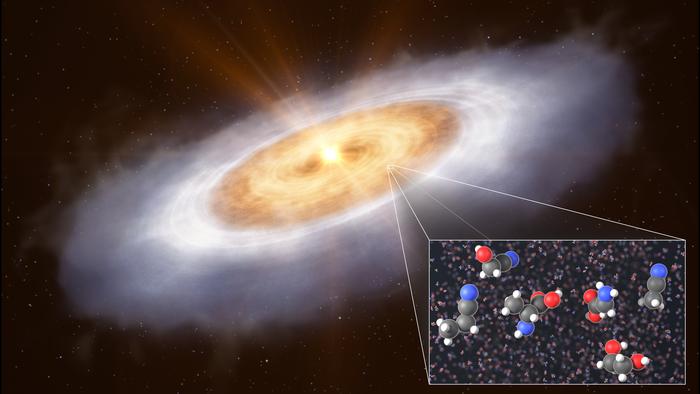
In a discovery that challenges long-held assumptions about how life begins, astronomers using the ALMA telescope have detected complex organic molecules—including key ingredients for amino acids and DNA precursors—in the planet-forming disc of a distant young star.
The tentative detection of ethylene glycol and glycolonitrile around V883 Orionis, a protostar 1,300 light-years away in Orion, suggests that essential building blocks of life may form well before planets do, and could be common across the galaxy.
Signs of Prebiotic Chemistry in a Young Star System
The international research team, led by Abubakar Fadul at the Max Planck Institute for Astronomy, used the Atacama Large Millimeter/submillimeter Array (ALMA) to search for faint radio signals from complex organic molecules (COMs). These molecules contain more than five atoms and at least one carbon atom—criteria that put them on the list of life’s likely precursors.
In the disc around V883 Orionis, they identified:
- Ethylene glycol (a sugar alcohol)
- Glycolonitrile (a potential precursor to amino acids and nucleobases)
- 15 transitions of ethylene glycol and 6 of glycolonitrile
“Our finding points to a straight line of chemical enrichment and increasing complexity between interstellar clouds and fully evolved planetary systems,” said Fadul.
From Star Nurseries to Potentially Habitable Planets
This isn’t the first time COMs have been found in space. But V883 Orionis represents a critical evolutionary stage: the transition from a protostar to a young star surrounded by a disc where planets will eventually form. Earlier models assumed that the violent energy and radiation during this transition would destroy any complex chemistry from earlier phases.
“Now it appears the opposite is true,” said co-author Kamber Schwarz. “Our results suggest that protoplanetary discs inherit complex molecules from earlier stages, and the formation of complex molecules can continue during the protoplanetary disc stage.”
Frozen Clues, Unlocked by Stellar Outbursts
Much of this chemistry occurs on icy dust grains in deep space. But detecting those molecules is difficult unless something disturbs the ice. In the case of V883 Orionis, a sudden outburst of energy from the growing protostar heated parts of the surrounding disc, vaporizing ice and releasing COMs into the gas phase where ALMA could detect them.
“Complex molecules, including ethylene glycol and glycolonitrile, radiate at radio frequencies. ALMA is perfectly suited to detect those signals,” Schwarz explained.
What the Chemistry Suggests About Life Elsewhere
The presence of these molecules in a young, still-forming star system strengthens the case that the ingredients for life are common and widespread. Ethylene glycol and glycolonitrile have been seen before in star-forming clouds and cometary material, but never in a planet-forming disc.
“This further suggests that protoplanetary disks inherit complex molecules from protostellar envelopes and that COM formation can continue during the protoplanetary disk stage,” the researchers wrote.
Looking for More Clues, and More Molecules
While the detections are currently tentative, the team is confident in their spectral analysis and is already planning follow-up observations with higher resolution to confirm the findings. They also hope to spot even more chemically evolved species.
“We still haven’t disentangled all the signatures we found in our spectra,” said Schwarz. “Perhaps we also need to look at other regions of the electromagnetic spectrum to find even more evolved molecules,” added Fadul.
The Cosmic Origin of Biology?
This research adds a new chapter to a growing story: that life’s ingredients may not have been unique to Earth, or even to our Solar System. If complex organics can endure the harshest transitions in stellar evolution and seed the formation of planets, then biology may have a head start across the cosmos.
It’s a provocative idea. Are we, in some fundamental way, made of molecules that were born in ice around stars long before our planet ever formed?
Journal Reference
Journal: The Astrophysical Journal Letters
Title: A Deep Search for Ethylene Glycol and Glycolonitrile in the V883 Ori Protoplanetary Disk
Authors: Abubakar M. A. Fadul et al.
DOI: 10.3847/2041-8213/adec6e
Published: July 24, 2025