

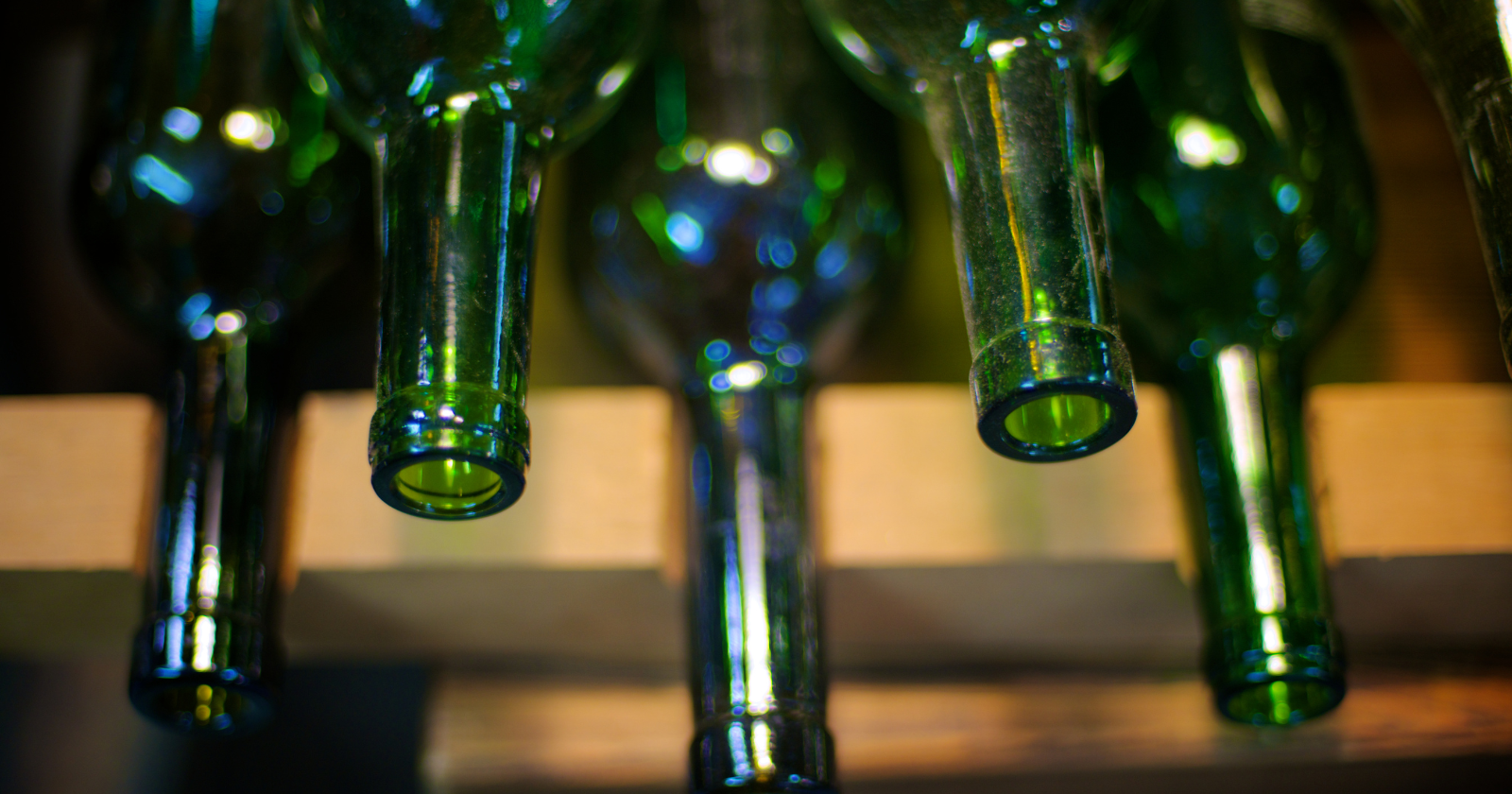
Discarded glass does not usually end up holding a coastline together. But in June 2023, on the north shore of Lake Pontchartrain, that’s what it did.
About 100 volunteers spent two days stacking burlap sacks filled with recycled glass sand. The result was a 300-foot barrier across a broken stretch of marsh. The sacks held roughly 50 tons of ground-up glass. It was the work of a New Orleans recycling outfit that began four years earlier, when two students couldn’t find anywhere to recycle their empy wine bottles.
Does bottle glass really do anything for an eroding shore? The short version: it is less strange than it sounds, and the early numbers are encouraging without being anything close to proof.
What ReCoast actually did at Big Branch Marsh
The recycling business is Glass Half Full, and its restoration arm is called ReCoast. The site was Big Branch Marsh National Wildlife Refuge, where Hurricane Ida had torn a gap through the shoreline in 2021. That let saltwater bleed into freshwater marsh and killed off the plants. According to the group’s account, reported by Good Good Good, the volunteer crew filled donated burlap sacks with glass sand and walked them into place to close the gap.
The glass-into-sand part is what trips people up. Glass is made from sand in the first place, mostly a mineral called silica. Grinding a bottle back down to a fine grit returns it close to where it started.
A set of early peer-reviewed studies, reported by Science News, found the recycled glass sand behaves much like natural sand. In greenhouse and field tests, fish, crabs, oysters and barnacles survived in it, and wetland plants grew about as well in the glass sand as in natural mud.
Why a bag of glass sand slows a shoreline down
A berm is a simple thing. It is a low barrier that takes the energy out of incoming waves before they reach the softer marsh behind it. Slow the water down and it drops the sediment it was carrying instead of stripping more away. That gives planted bulrush a calmer, shallower spot to send roots into. Once the roots hold, the marsh starts to knit itself back together.
The group’s own monitoring at Big Branch suggests that is roughly what happened. Along one line photographed and measured monthly for a year, vegetation coverage rose by 60% over 12 months, and the site gained 1.25 inches of sediment. ReCoast’s project manager Kat Fogg put it more vividly: “We’re seeing all kinds of species now and massive amount of [vegetation] spread. It’s so lush.”
Two caveats belong alongside that. Fogg runs the project, and “so lush” is a first-person read, not a lab result. And the 60% figure, encouraging as it is, comes from a single site monitored by the group itself over a single year. A promising signal, not a settled finding.
The bottles, and the coffee sacks
Glass Half Full grew out of an ordinary frustration. Founders Franziska Trautmann and Max Steitz, Tulane classmates, started the operation in 2020 after failing to find anywhere in New Orleans to recycle their wine bottles. Since then the company says it has recycled more than 14 million pounds of glass, sorting it and grinding it into different grades of sand, some of it headed to the coast through ReCoast’s work.
The burlap came from a second waste stream. Coffee roasters get their beans in large jute sacks and mostly throw them out. ReCoast filled those sacks with glass sand to make the building blocks of the berm. It is a satisfyingly tidy loop, two discarded materials propping up a marsh.
Where 300 feet sits against the scale of the loss
The sobering context: Louisiana’s coast is disappearing at a pace that is hard to picture. A USGS study found the state’s coastal zone lost about 1,883 square miles of land between 1932 and 2010, a 25 percent drop. The 1985–2010 trend of 16.57 square miles a year works out, at a steady rate, to roughly a football field of land every hour.
Set a 300-foot volunteer berm against that and the mismatch is obvious. A pilot like this cannot slow the state’s land loss in any measurable way, and it was never meant to. What it can do is test whether recycled glass sand behaves the way its backers hope, in a real marsh, over real seasons, under real storms. Hank Bart, a Tulane professor who co-authored some of the glass-sand research, called the results so far “great evidence that we can use recycled glass as a resource for coastal restoration.”
The other honest limit is supply. As Bart added, the whole idea only scales “if we can just crush and recycle enough,” and the hard part is collecting the glass, not grinding it. Trautmann’s own rallying cry is blunter: “We need more glass!”
Our read is not that this is a fix, nor a gimmick, but a modest field experiment wrapped in a very good story. A 300-foot line of bagged glass will not turn the tide on a coast shedding land by the hour. It might, though, answer a narrower and genuinely useful question: whether the millions of bottles a city throws away can be sent back to the shoreline and asked to do a little work.