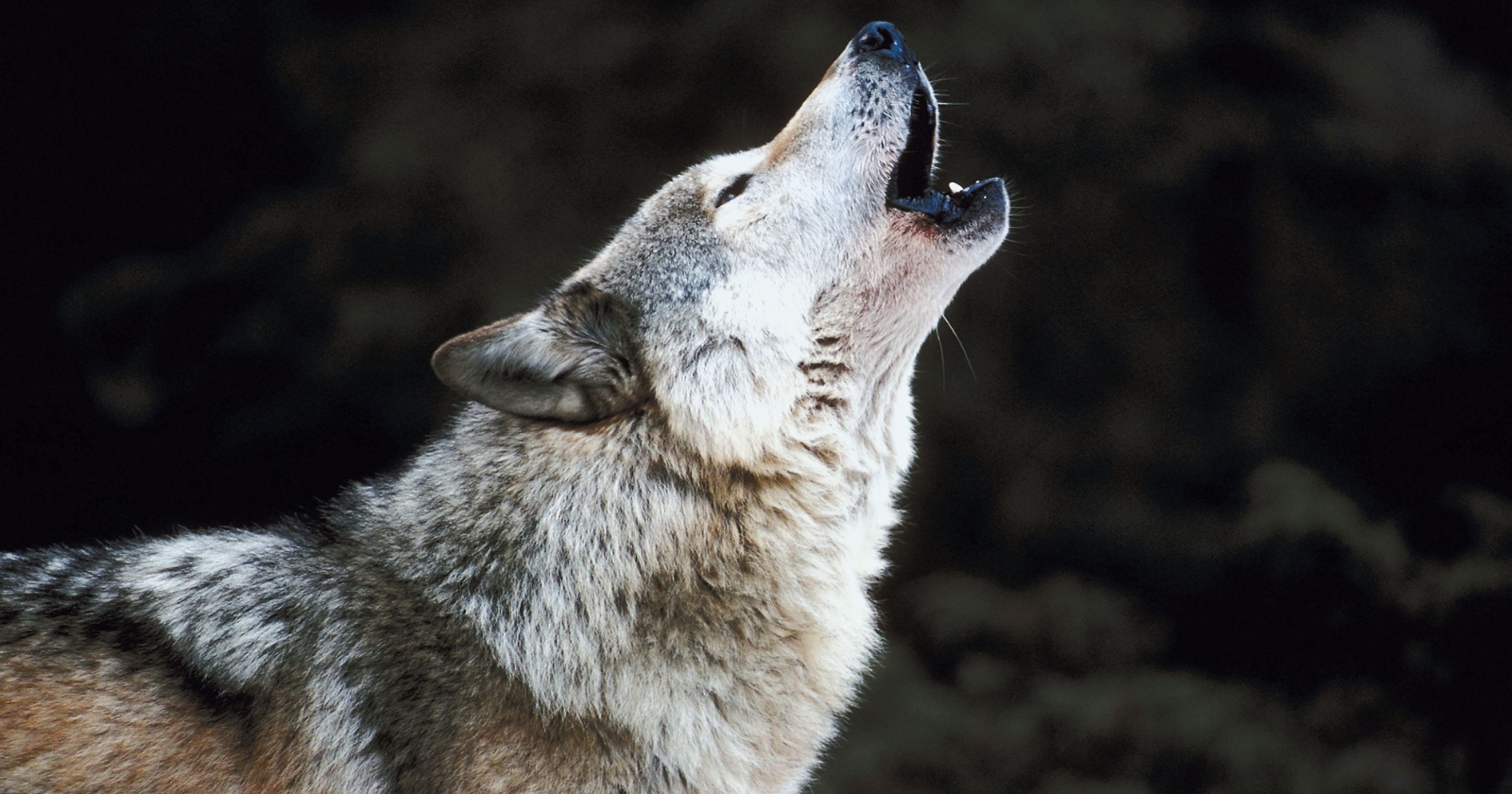
Picture a stretch of open ground at dusk, the air still and cooling, no trees to break it up. A wolf tips its head back and lets out a long, low howl, and the sound rolls out across the grass and rock, over a ridge, down into a valley, and out the other side. That carrying power is not an accident. A wolf’s howl is shaped, by evolution rather than intent, to travel over long distances.
Built to carry across open ground
The physics is simple. The Wolf Conservation Center puts it plainly: “A howl’s low pitch and long duration is well suited for transmission on the wild landscape.” That’s the whole design in one sentence.
What the howl is doing matters as much as how far it goes. Holly Root-Gutteridge, who led some of the key work on identifying wolves by their calls, describes the job it performs for the pack. “Wolves use howling as a territorial defence, to help locate other pack members and also as a social activity: they seem to really enjoy it,” she told The Conversation.
The territorial function isn’t just a guess. A classic study by Fred Harrington and L. David Mech in northeastern Minnesota examined how wolves responded to simulated howling and the role howling plays in territorial maintenance. It’s a way of advertising presence without the animals having to meet. A sound that carries far is a very efficient fence.
How far it actually travels
Some wolf conservation groups say a howl can be heard up to ten miles away in open terrain. But it is a maximum rather than a distance every howl will reach.
Other sources land lower. Reporting on Root-Gutteridge’s research, National Geographic said wolf replies can carry six miles (ten kilometres). A peer-reviewed study of Indian wolves found their howls can be detected over more than 6 km, or nearly four miles.
Those figures are not necessarily contradictory. How far a howl remains audible depends on conditions, including distance, weather, environmental noise and the landscape. The ten-mile figure is best read as an upper-end claim for favourable open terrain, not a typical range. Even the more conservative peer-reviewed figure, though, is easily enough to carry across many valleys.
Every wolf sounds like itself
Individual wolves have distinctive vocal characteristics, and researchers have repeatedly been able to identify animals from their howls.
How researchers figured it out is the interesting part. Earlier attempts to tell wolves apart using pitch-related information achieved about 75.7 percent accuracy. Root-Gutteridge’s team added amplitude information — how the acoustic energy of a howl changes — alongside frequency.
Adding that information paid off. The team identified six captive eastern gray wolves with 100 percent accuracy. Applied to recordings of wild eastern gray wolves, mostly from Ontario’s Algonquin Provincial Park, the method again identified solo howlers with 100 percent accuracy and reached 97.4 percent accuracy on overlapping chorus howls.
A later study of Indian wolves reached about 98 percent accuracy on its training data.
But can the wolves themselves tell?
Yes, there is experimental evidence that they can. A 2015 playback experiment with captive Iberian wolves tested whether wolves could discriminate howls according to the identity of the caller. The wolves responded differently to howls from familiar and unfamiliar individuals, providing what the researchers described as the first experimental evidence that wolves can discriminate individuals from the acoustic structure of their howls.
The experiment was conducted with captive wolves rather than free-ranging packs calling across kilometres of wild terrain, so it does not tell us exactly how recognition performs at extreme distances. But individual discrimination by howl is more than a reasonable guess.
So here’s the picture that holds up. The howl carries far, with six miles supported in reporting and greater distances sometimes claimed for favourable open terrain. The individual signature is real and measurable. And experimental playback work shows that wolves can distinguish individual callers from the structure of their howls. The valley really can be crossed by a voice — and the wolf listening on the other side may know something about who sent it.