

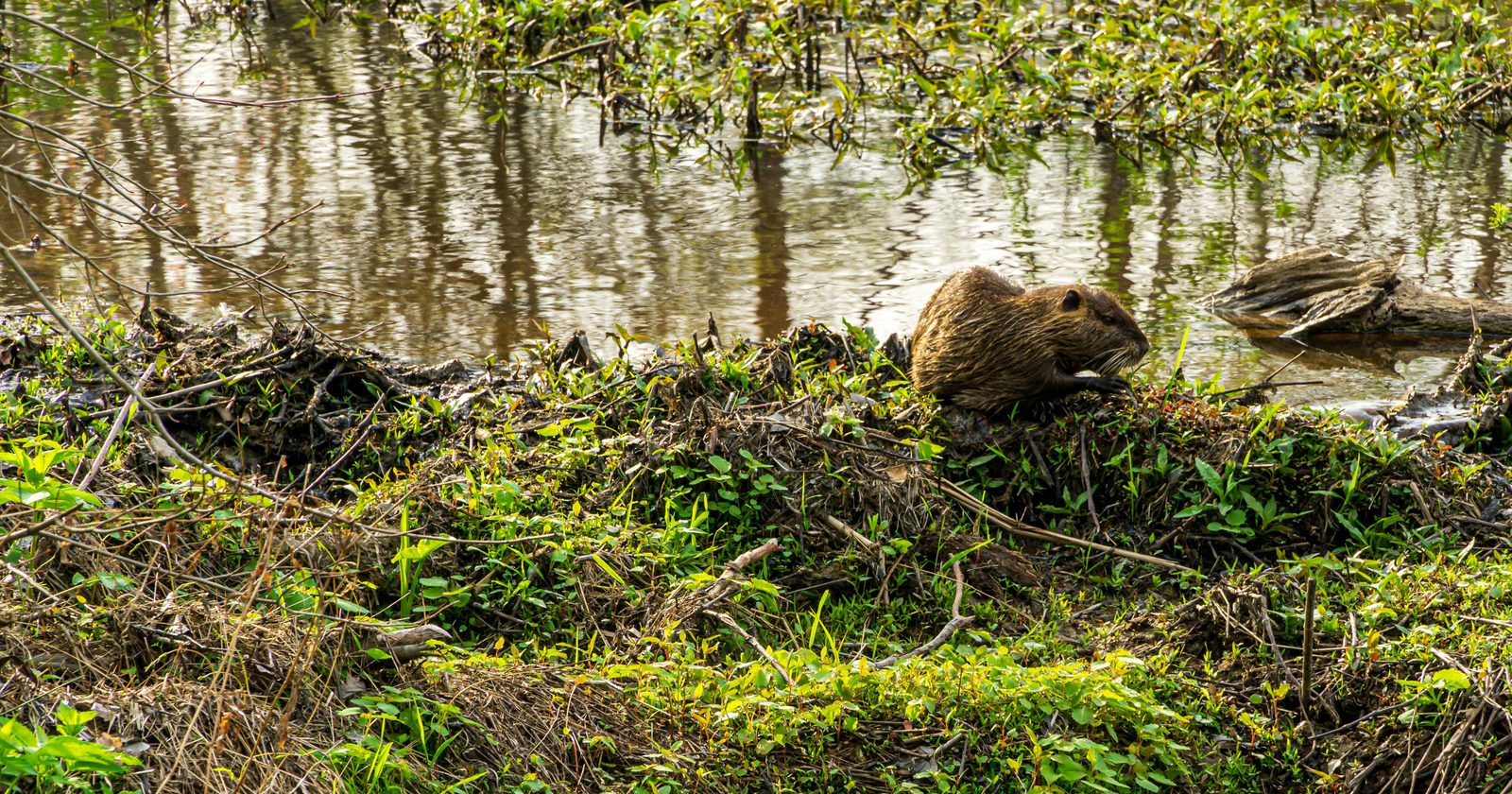
In Britain, beavers were hunted to extinction around 400 years ago. By the sixteenth century the largest rodent in Europe was simply gone from the island.
Now it’s back, and the return is being sold less as a conservation story than as a piece of flood engineering.
However, the thing a beaver does when it dams a stream, holding water on the land, is a gift on one site and a headache on another. The difference is mostly about whose field the water is sitting on.
We are not hydrologists, ecologists, or flood-risk engineers, and nothing here is guidance for anyone deciding what to do with a river or a floodplain. This is a reading of the reporting and the agency documents. The figures below come from single projects in specific places, and a result on one 10-hectare site is not a rule about how beavers behave everywhere.
The animal Britain wiped out, and why it’s back
The official return began in Scotland. Beavers were released at Knapdale Forest in mid-Argyll between May 2009 and Septemeber 2010, the first authorised mammal reintroduction anywhere in the UK. They were watched for five years, and in 2016 the Scottish Government confirmed they could stay. In 2019 beavers were given legal protection in Scotland.
Why flood planners care is simple enough. A beaver builds a dam, the dam slows the water, and the water spreads out and soaks in instead of rushing downstream all at once. Where that slowing happens on land nobody minds getting wet, it reads as free infrastructure.
The upside: a golf course in Greenford, and a giant sponge
In October 2023, a family of five Eurasian beavers, two adults and three young, was released into Paradise Fields, a former golf course of about 10 hectares in Greenford. The aim was blunt: cut the flood risk in a part of Ealing that kept getting flooded. The beavers got to work and built eight dams.
Sean McCormack, the local vet who started the Ealing Beaver Project, put the effect plainly. According to McCormack, “They effectively turned this site into a giant sponge that can take heavy rainfall and slowly release water back into the landscape, creating a lot more resilience for flooding.” By the beavers’ second winter, the target flood area had seen no flooding for the first time in a decade.
That is a genuine result, and it’s also one enclosure watched by the people who built it. The reporting is careful on this point: beavers won’t save every village, and they don’t replace engineered flood defences. What they do, on the right site, is buy a margin. Paradise Fields happens to be close to the ideal, a bounded patch of green with nothing downstream that anyone farms.
The downside: Tayside, where the water sits on prime farmland
Scotland has a second beaver population. From around the early 2000s, beavers settled in the Tay area and spread, and there is now a large established population across the Tay and Forth. The trouble is that the rivers there run alongside some of Britain’s best farmland. The exact behavior that makes a beaver useful in Greenford makes it a liability there.
Bob Strachan, a Perthshire farmer on the River Ericht, described the problem to STV News: “The beavers burrow in, which destabilises the edge of the riverbank, and then when we get high water, the river just washes the riverbank away.”
The burrows can be large, weakening the banks that hold rivers back and posing a danger to livestock. During Storm Babet in October 2023, several flood banks in the region were breached, and some advisory group members highlighted the contribution of beavers to flood bank weakness.
The middle ground: a scheme for living alongside them
Between the London result and the Tayside complaint sits the actual policy, which is neither wiping them out nor giving them a free pass.
NatureScot runs the Scottish Beaver Mitigation Scheme, which offers land managers free expert advice and practical support, from protecting vulnerable trees to installing flow devices that regulate water levels through beaver dams. Support is also available through existing government grant schemes for land-management changes that can reduce conflicts and help farmers live alongside beavers.
The demand for it is real and lopsided. NatureScot logged 84 mitigation cases between January 2023 and March 2024, with 76 of them, or 91 percent, in the Tay area. Separately, after the damaging storms of 2023, the Scottish Government offered farmers grants of up to £30,000 per farm business to repair flood banks. Grants went to 57 businesses, which NatureScot said illustrated the extent of the damage..
One animal, two verdicts, decided by geography
What strikes us, laying the two places side by side, is how little the beaver’s behavior changes and how much the human judgment does. In Greenford the water pooling on a disused golf course is exactly what the borough paid for. On the River Ericht the water pooling on a wheat floodplain is a bill. The dam-builder is doing the same job in both places.
So the useful question was probably never “are beavers good or bad for flooding.” It’s where you let them work, and what you’re willing to spend to keep the water where you want it. Britain spent four centuries without beavers and then decided the water-holding was worth having back. The mitigation scheme is the honest admission that comes with that: you can have the sponge, but on the wrong ground somebody has to manage where it soaks.