

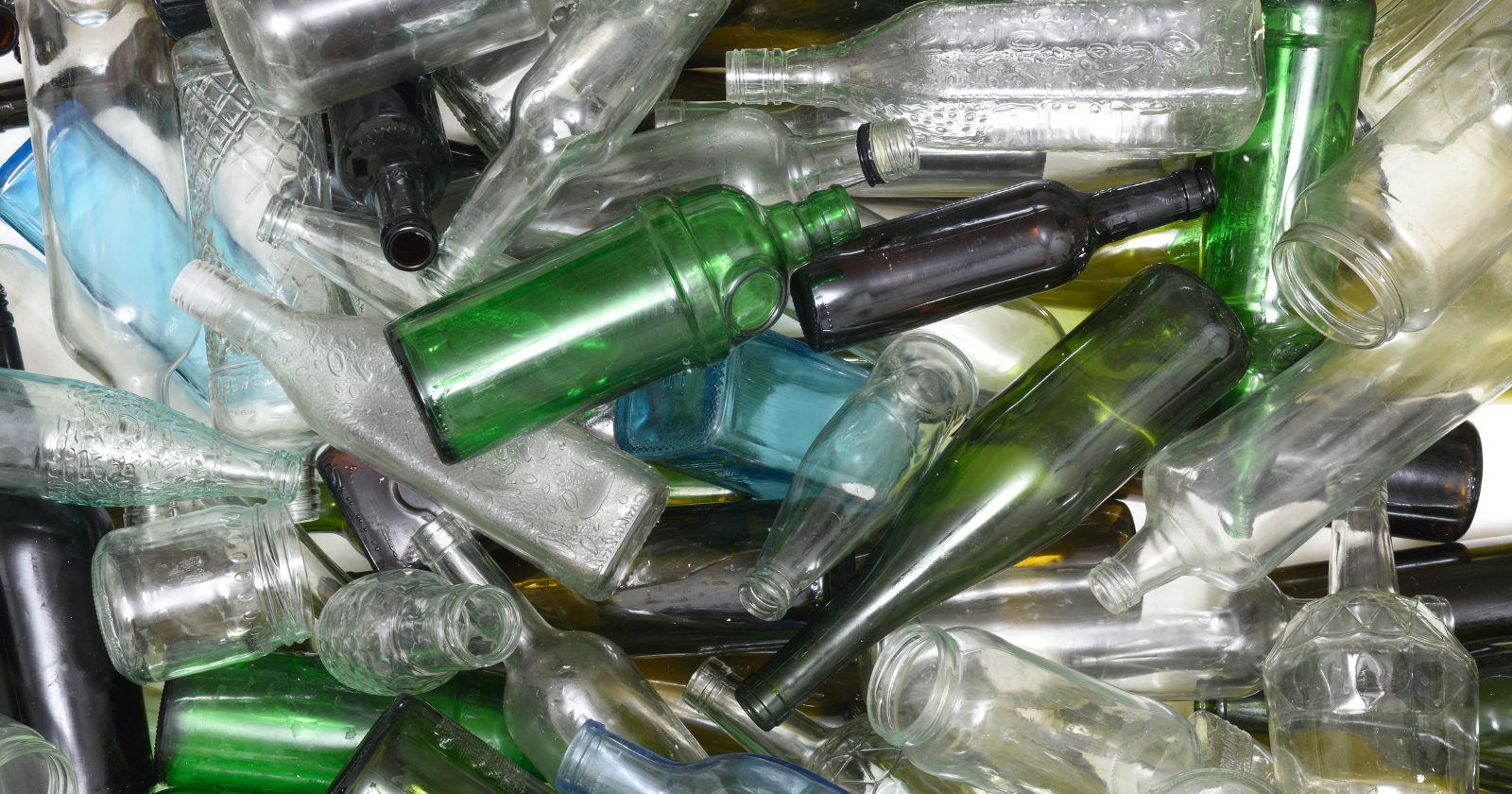
The idea behind two New York towers is simple: grind old bottles and jars into a fine powder and use it to replace some of the cement in concrete. Cement accounts for around 10% of world’s carbon dioxide emissions, so replacing part of it without weakening the structure cuts emissions. These buildings show it can be done at real scale.
The material is called ground-glass pozzolan. A pozzolan is a fine material that reacts with compounds in wet cement paste to form additional cementitious material. The name comes from the volcanic ash used in Roman concrete. This modern version uses post-consumer glass milled fine enough to perform a similar role and replace some Portland cement.
What ground-glass pozzolan actually is
Concrete is mostly sand, gravel, water and cement. The cement is the glue, and it is also the problem.
Cement production heats limestone to make clinker, releasing carbon dioxide as the limestone breaks down. Replacing some cement with a reactive powder therefore cuts both the amount of clinker and the associated emissions. Engineers have long used coal fly ash and ground granulated blast-furnace slag for this purpose. Both face supply constraints as coal-fired generation declines and slag availability varies.
Urban Mining Industries turns discarded bottles and jars into Pozzotive at its plant in Beacon Falls, Connecticut.
The Halletts Point pour
An early high-rise application came at the Durst Organization’s Halletts Point development in Astoria, Queens. According to BuildGreenCT, the project marked the first cast-in-place use of ground-glass pozzolan in high-strength structural concrete.
Industry accounts also describe Halletts Point as the first US high-rise built with concrete containing ground-glass pozzolan. That distinction should be treated as an industry claim rather than an independently certified record, but it is reported consistently and established that the material could be used in the structural concrete of a large building.
270 Park Avenue and the 40 percent replacement
The larger application came at 270 Park Avenue, JPMorganChase’s 60-story Manhattan headquarters, designed by Foster + Partners with structural engineering by Severud Associates. Fortunato Orlando, a principal at Severud, said the design included 52,000 cubic yards of concrete in which locally sourced Pozzotive replaced 40 percent of the cement, apart from the building’s 16,000-psi concrete mix.
Replacing four out of every ten parts of cement across most of a tower’s structural concrete is not a token gesture. Architectural Record confirms that ground-glass pozzolan replaced about 40 percent of the cement in the floor system. An account in STRUCTURE magazine also confirms the 52,000 cubic yards and the 40 percent substitution.
STRUCTURE reports that the ground-glass pozzolan saved about 5,000 tons of embodied carbon and diverted more than 28 million glass bottles from landfills, figures it identifies as estimates from the material’s producer.
Why cement is the part worth cutting
Concrete is one of the world’s most heavily used materials, and cement produces most of its manufacturing emissions. Global cement manufacturing generated about 1.6 billion metric tons of CO2 in 2022. Reducing the quantity of cement in each cubic yard is therefore one of the most direct ways to lower concrete’s embodied carbon.
The producer claims Pozzotive has a carbon footprint equal to about 6 percent of the cement it replaces. That is a company figure, and results will depend on factors including electricity and transport, but milling recycled glass generally requires far less carbon than producing clinker from limestone.
Where the caveats sit
This is a genuine use of a standardized cement substitute at structural scale, although some of the environmental claims come from parties promoting the material. The buildings exist, and multiple accounts confirm the 40 percent replacement at 270 Park Avenue.
The remaining question is whether ground-glass pozzolan can spread beyond projects near suitable recycling and processing facilities. The Beacon Falls plant reportedly has capacity to produce 50,000 tons annually. That is substantial for one facility but small beside national concrete demand. Halletts Point and 270 Park Avenue prove the idea can work in major buildings; expanding it will require more clean recycled glass, processing capacity and regional supply chains.