

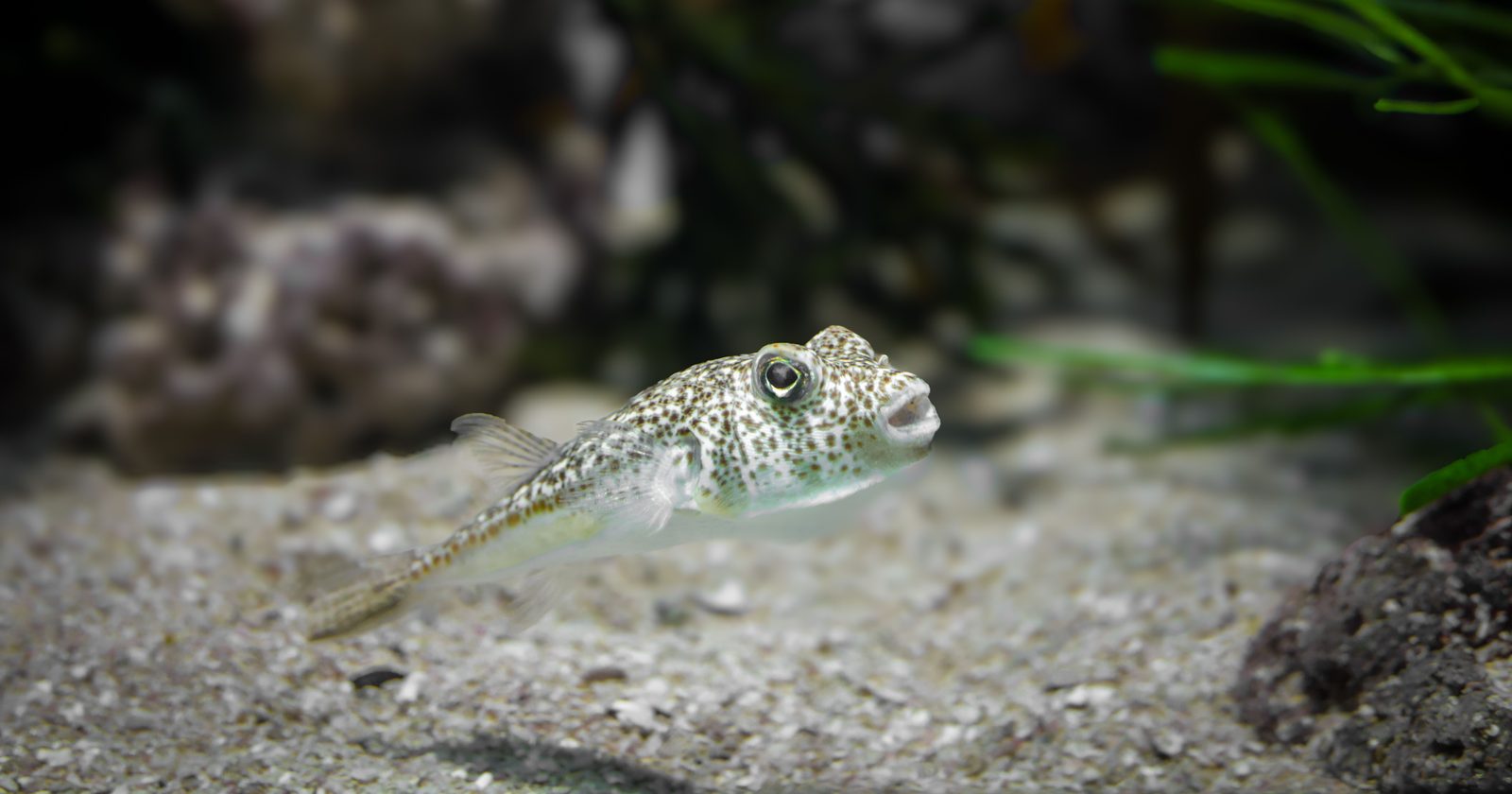
On the sandy seabed off Amami Oshima Island in southwest Japan, on bare bottom where nothing much grows, divers kept coming across large ringed patterns cut into the sand. Symmetrical. Radiating out from a center like the spokes of a wheel, ridged and grooved, close to two meters across.
They looked designed. They looked, frankly, like the sort of thing that gets a person talking about crop circles.
For a long stretch, nobody could say who or what made them. The circular structures had been turning up off Amami Oshima since the mid-1990s, and the identity of the builder stayed open for more than a decade.
The pattern was right there to photograph. The maker was not.
The circles that appeared with no explanation
The answer turned out to be almost comically small. In 2011, an underwater photographer named Yoji Okata filmed the builder at work. The maker of these two-meter designs was a pufferfish you could cup in one hand. The species was formally described in 2014 by fish scientist Keiichi Matsuura, who named it the white-spotted pufferfish.
The size mismatch is the whole hook. The fish is about 10 centimeters long. The finished nest is about two meters across.
In human terms, that is one person, working alone, sculpting something the size of a small room using nothing but their own body against the ground. No tools. No help. And the divers who first found these things had been staring at the finished work of an animal small enough to miss entirely.
How a hand-sized fish builds a two-meter structure
The building is slow, grinding labor. The first full record comes from a 2013 study in Scientific Reports by Hiroshi Kawase, Yoji Okata and Kimiaki Ito, who filmed the whole process. A single male swims along the seabed, flapping his fins and beating his body against the sand, cutting valleys and raising peaks as he goes. By one account it takes him seven to nine days to finish.
Later work showed how the pattern comes together. A 2018 paper by Mizuuchi, Kawase and colleagues found the fish is not following some grand blueprint. He just repeats a few simple habits: dig the ditches from the outside in, start at the low spots, cut in straight lines. Do that enough times and the ordered circle, with its 25 to 30 ditches around the outer ring, falls out of the repetition. A computer simulation using only those rules produced the same shape.
There is a bit of physics buried in all that fin-flapping. The valleys are not just decoration. A 3D reconstruction of the nest showed that water moving through the valleys always funnels toward the middle, no matter which way the current comes from, dragging the finest grains of sand to the center with it. The 2013 team measured water slowing by nearly 25 percent at the center, which is exactly where the female lays her eggs.
Why he does it, and what nobody can answer yet
A female swims in, inspects the finished circle, and either accepts it or moves on. If she stays, she lays her eggs in that soft central patch of fine sand, the male fertilizes them, and he stays for about six days to guard them. Then, oddly, he abandons the whole thing. The 2013 authors noted that “the males never reuse the nest, always constructing a new circular structure at the huge cost of construction.” Their tentative guess is that the used valleys may no longer hold enough fine sand.
What we cannot tell you is the thing you probably most want to know: what the female is actually judging. The 2018 team found that larger, stronger males dig wider-spaced ditches, which a female might read as a sign of a fit mate. But the researchers who filmed all this are careful. As Hiroshi Kawase, a curator at the Coastal Branch of Natural History Museum and Institute in Chiba, put it, “nobody knows exactly what the females are looking for in these circles or what traits they find desirable.”
So the case that looked closed in 2011 mostly moved the mystery inward. The divers wanted to know what carved the circles, and we have a name, a species, and film of the whole build. In exchange we got a harder question sitting one step further in. A small fish spends more than a week reshaping the seafloor with its own body, does it once, walks away, and never uses it again.
What a female weighs when she decides to stay is still, as far as anyone can honestly say, an open question.