
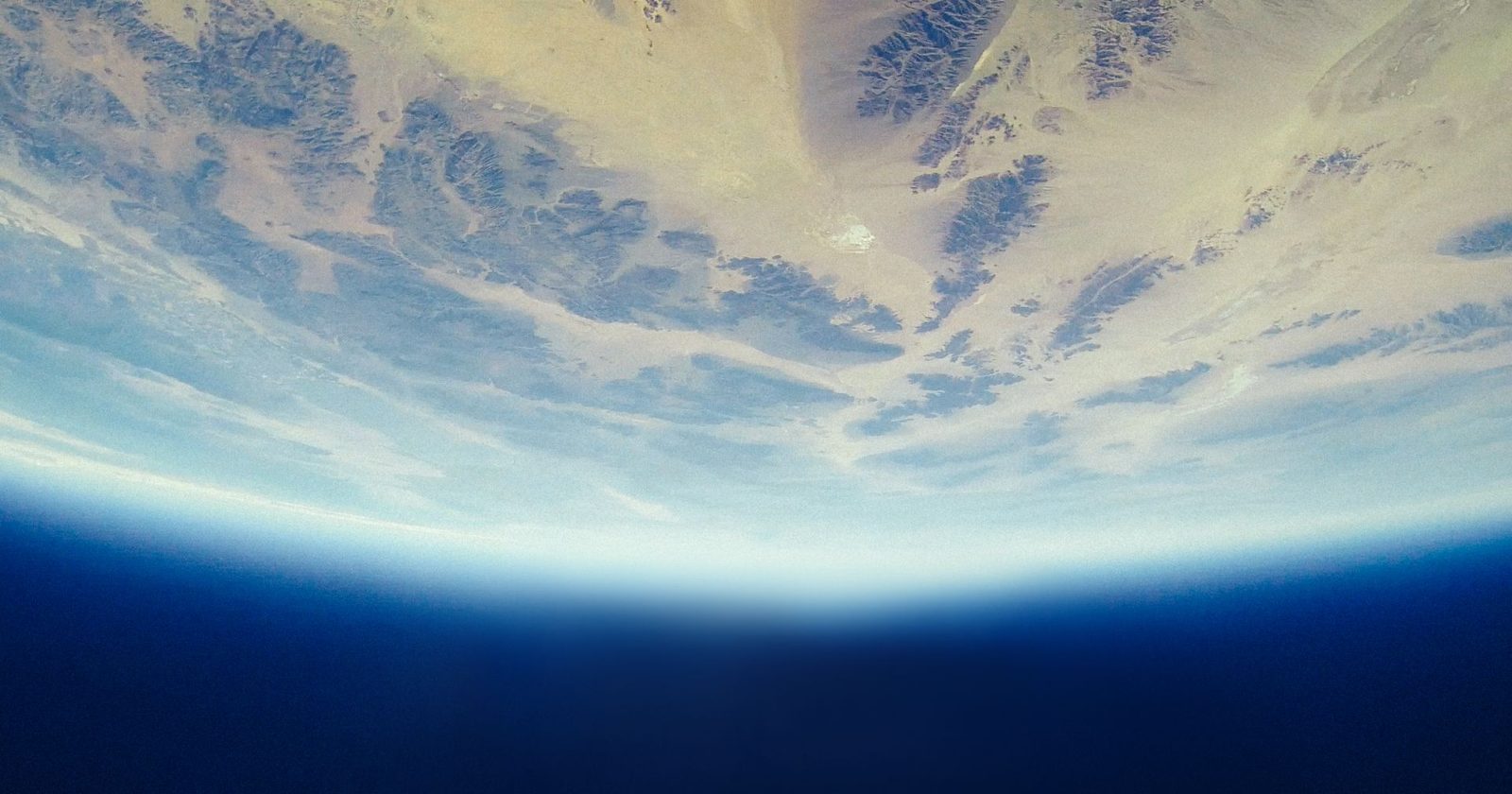
Pick up an apple and look at the skin. It’s so thin you barely notice it as a separate layer, just a taut, shiny film around the fruit. Now scale that up to a planet. The air you’re breathing, the air that carries every cloud and storm and jet stream, the whole envelope we call the sky, is proportionally even thinner than that skin.
That’s not a metaphor stretching for effect. It’s roughly what the numbers say when you do the math.
Plenty of people have made the comparison. Astrophysicist Neil deGrasse Tyson put it plainly: “The size of Earth’s atmosphere relative to Earth is the same as the skin of an Apple relative to the Apple.” It’s a good line. It’s also, as the people who use it tend to admit, a rough shorthand rather than a precise measurement.
So the question is: how thin, exactly, and thin compared to what?
The catch: air has no hard edge
The trouble with measuring the “thickness” of the atmosphere is that there’s no top. Air doesn’t stop; it just keeps thinning out. The higher you go, the thinner it gets, and there’s no clean line where the sky ends and space begins. Even the 100-kilometre Karman line, often treated as the edge of space, is a convention rather than a physical wall. Almost all of the air sits below it, and a faint trace still lingers above.
So “eight kilometres thick” can’t mean the real, ragged, fading-into-nothing atmosphere. It means something more specific and more useful: what you’d get if you took the entire column of air above you and squeezed it down to the density it has at sea level.
What the eight-kilometre number actually is
At sea level, air weighs about 1.225 kilograms per cubic metre. It gets thinner as you climb because there’s less air pressing down from above. If that sea-level density held all the way up instead, the whole atmosphere would form a neat, even shell. Do the calculation and that shell comes out at about 8.43 kilometres thick, exactly the depth needed to produce the pressure we actually feel at the surface.
Physicists have a name for roughly this quantity: the scale height. As the Australian Space Academy puts it, “The scale height is a very useful concept because it is the height at which the atmosphere would extend if it were all compressed into one of constant density.” For Earth that’s roughly eight kilometres.
Running the ratio
Now set that eight-kilometre shell against the size of the planet it wraps. Earth’s average radius is about 6,368 kilometres. Eight divided by 6,371 is about 0.13 percent. That’s the whole breathable, weather-making, climate-carrying atmosphere as a fraction of the world it sits on.
Now the apple. A skin about 0.3 millimetres thick, around a fruit with a radius of maybe 40 millimetres, works out to roughly 0.75 percent of the apple’s radius. That’s about six times thicker, proportionally, than our compressed atmosphere.
The Penn State meteorology course that runs this comparison is careful with it, noting the atmosphere is “only as thick as an apple skin when compared to the radius of the Earth.” The comparison holds, and if anything it’s kind to the atmosphere. A real apple skin is the thicker of the two.
Easy to picture, hard to feel
The thinness is simple to picture and almost impossible to take seriously, because that same thin skin does everything. Most of the air sits in the lowest layer, the troposphere, which holds roughly 75 to 80 percent of all the atmosphere and reaches up only about 12 kilometres . That’s where the weather happens, where nearly all the water vapour lives, and where you and every living thing draw breath.
NASA science writer Alan Buis calls the troposphere a “very shallow layer” that is “tasked with holding all the air plants need for photosynthesis and animals need to breathe.” Stand on the ground and the sky feels endless. Climb to the cruising altitude of an airliner, around 11 or 12 kilometres, and you’re already near the top of the layer that holds most of the atmosphere. The whole life-support system is that shallow.
What we take from the number
What strikes us about the apple-skin figure isn’t that it’s startling, though it is. It’s that it turns something we habitually treat as endless into something with an actual measurement. An ocean of air has no edges to worry about. A shell 0.13 percent of the planet’s radius does. You can weigh it, map it, count its layers, and track what we put into it.
The comparison is imperfect, as the people who popularise it keep pointing out. An apple skin has a defined edge and the atmosphere doesn’t, so the analogy is a teaching tool, not a boundary you could point to. What it does cleanly is take the sky, which feels infinite from underneath, and hand it back as a finite, thin, countable layer. The kind of thing you could run out of if you weren’t paying attention.