
In 1902, a small book about a rabbit in a blue jacket went into print. Within a few years its author was spending the money it earned on hill farms in Cumbria. The woman who drew Peter Rabbit spent the second half of her life becoming a serious hill farmer, and she used her will to lock that work in place long after she was gone.
The author and the hill farmer
Beatrix Potter is remembered as the illustrator of small animals in waistcoats. The sheep breeder is a much quieter figure.
In 1905 she used the money from her early books to buy Hill Top Farm in Near Sawrey. Over the following decades she kept buying land, until she had assembled a large estate of working farms.
This was not a rich woman’s hobby. She bred prize-winning Herdwick sheep, worked closely with her shepherd Tom Storey, and by 1943 had been elected the first woman president of the Herdwick Sheep Breeders’ Association. She died that December before she could take up the post.
Two lives, then, in one person. Her writing paid for the farming, and the farming is the part that changed the map.
The land she was saving
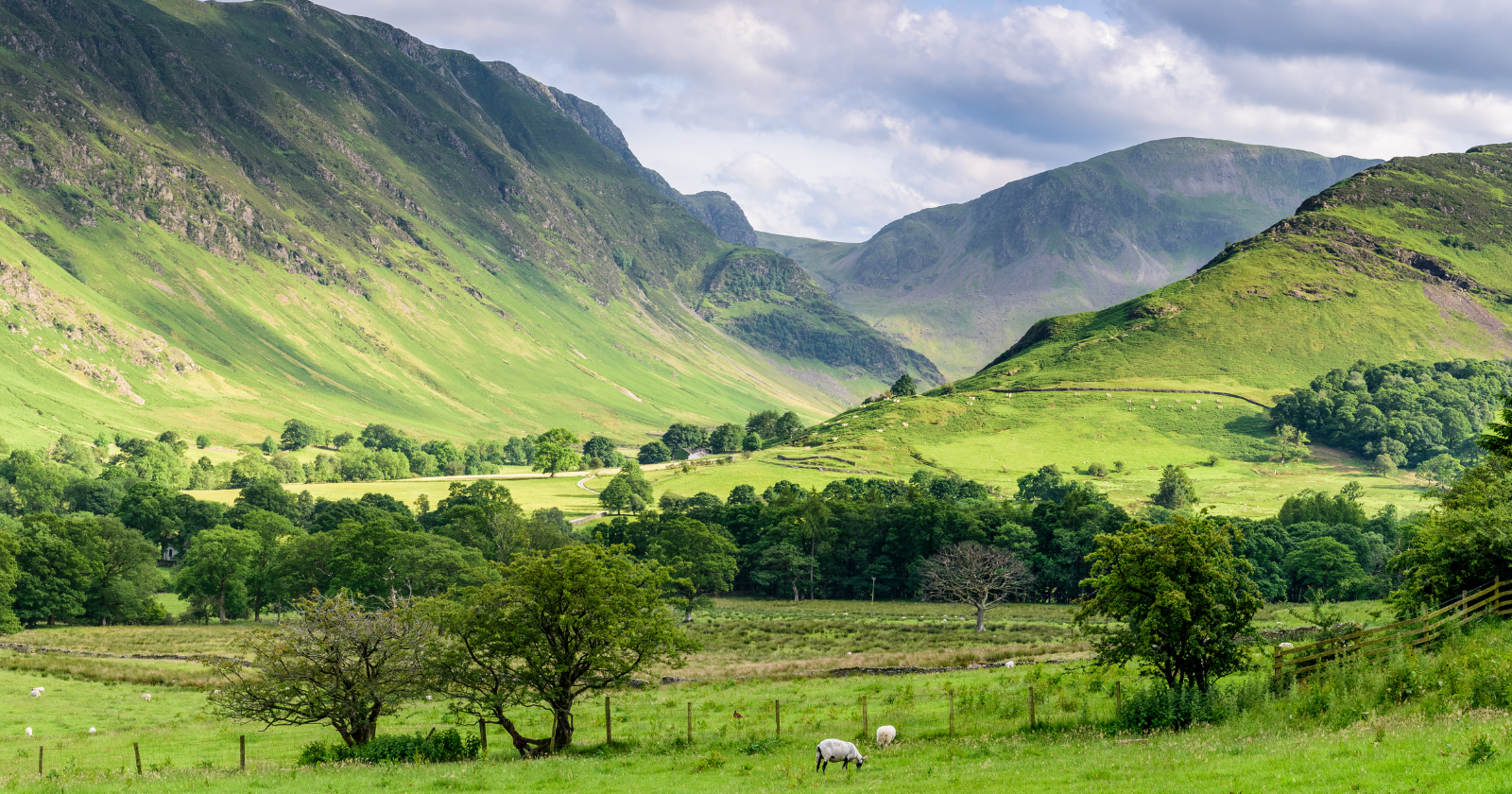
The Lake District Potter loved was under pressure. As tourism grew and property speculators eyed the valleys, whole farms came up for sale with an uncertain future.
In 1923 she bought Troutbeck Park, a hill farm at risk of being sold for development, and kept it running as a farm, breeding Herdwicks there with her shepherds. It was one of the largest holdings in the district, running to almost 2,000 acres.
A rescued field can be turned into something else by the next owner. What she wanted was continuity, and for that she needed the land to stay in the hands of people who would keep grazing it the way it had always been grazed.
The Herdwick and what “pure” means
The animal at the centre of all this is worth understanding. The Herdwick is a tough, grey-fleeced native breed. The Rare Breeds Survival Trust calls it among the hardiest of Britain’s hill sheep, able to live high on the open mountainside with little or no extra feed. What makes it central to the landscape is a behaviour called hefting: a flock learns its own patch of unfenced hillside and stays there, generation after generation, with no walls to hold it.
That instinct is more than an animal curiosity. As Emma Bray writes for the Ullswater Heritage resource, “The Herdwick’s hefting instinct has helped shape the system of common fell grazing in the Lake District.” A heft is knowledge held in the sheep themselves. Lose the flock and you lose the map it carries.
That is why “pure Herdwick” is not a breeder’s vanity: cross the breed with others and you slowly lose the hefting, the hardiness, and the grazing pattern that keeps the fells open rather than choked with bracken and scrub.
The bequest and its clause
When she died on 22 December 1943, her estate was valued at £211,636. She left the National Trust over 4,000 acres and fifteen farms, given so that they could never be sold off.
But she did not simply hand it over and hope. She attached conditions.
According to a summary of the will by Arnison Heelis, “Her sheep flocks on her full farms were to be maintained of the pure Herdwick breed.” The same summary says her cottages were to keep being let “at moderate rents to the same class of tenants”, and that she wanted the Trust to manage the land on the same lines as she had. The exact wording of the will may differ from the firm’s paraphrase, but the shape of the instruction is clear enough.
A will written as a land-management instruction
Most bequests are gifts. You give the thing and let the recipient decide what to do with it. Potter did close to the opposite. She wrote a working set of farming instructions into a legal document and made them a condition of the gift, so that the farming she had spent forty years learning would carry on whether or not anyone remembered why.
The clause is still doing its job. At Yew Tree Farm near Coniston, the tenancy comes with a “Landlord’s Flock” of around 100 pure Herdwicks that the tenant must keep. Jo McGrath, who runs the Herdwick Experience there while her husband Jon Watson tends that flock, puts the economics plainly. “Economically, I would say we would not have them if it was not for her,” she told In Cumbria. That is one farmer’s view rather than proof, but it captures how directly a line in a 1943 will still reaches into which sheep graze which fell today.
In 2017 the Lake District was named a UNESCO World Heritage Site, recognised as a farmed landscape shaped by people rather than a purely natural one. The open fells that earned that status are grazed largely by the breed Potter insisted on keeping pure.
Our read is that she understood something a lot of conservation missed at the time: you cannot preserve this landscape by fencing it off from the people and animals that made it. You preserve it by keeping the farming alive. She did not leave the National Trust a view. She left it a job, and she wrote the terms of that job into her will.