

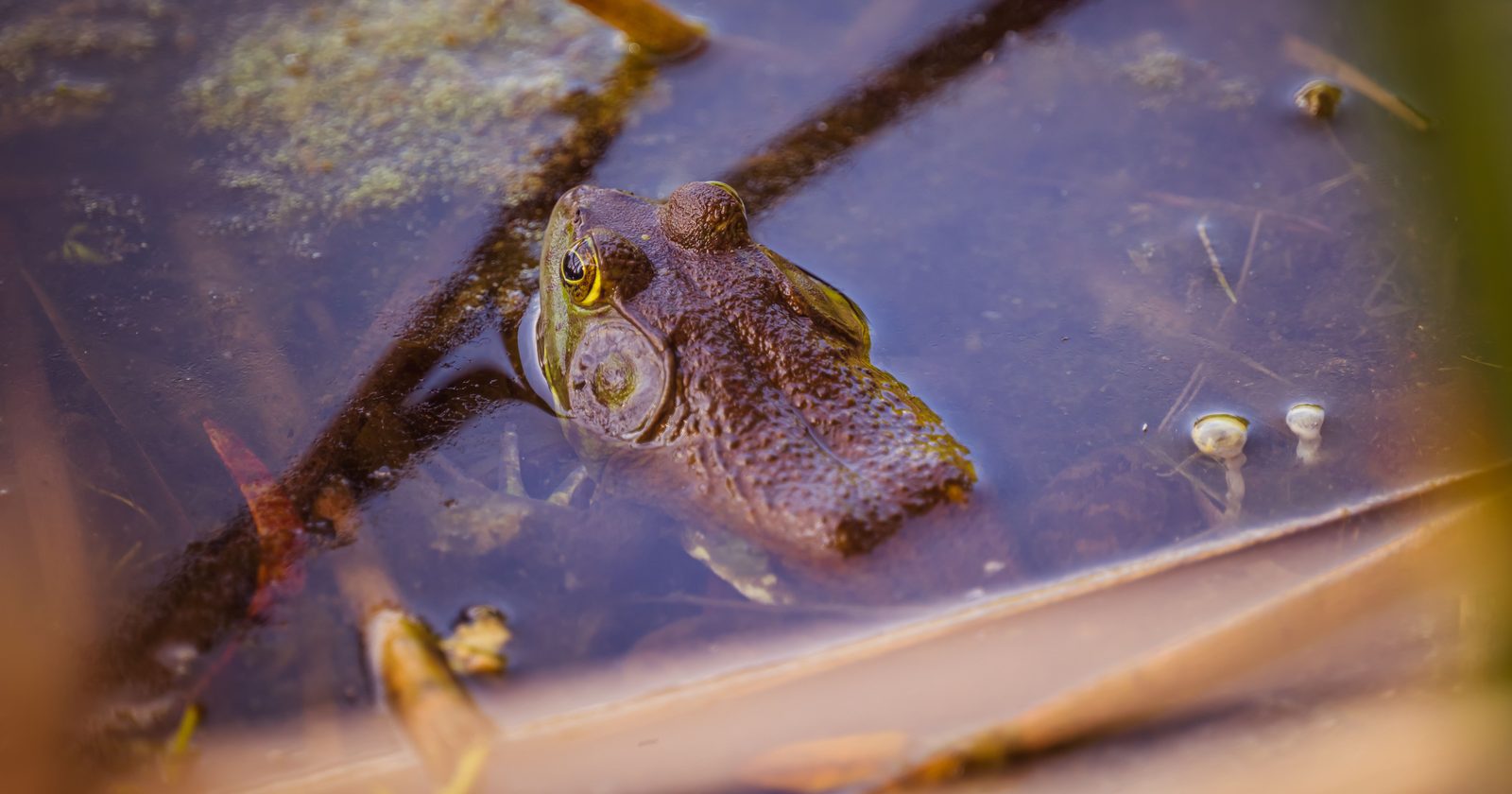
Import a big, fast-growing frog from North America, farm it for its meat, and turn a pond into a small food business. South Korea tried exactly that, bringing in the American bullfrog as a food resource. The farming never paid. The frog stayed anyway, and half a century later it is one of the country’s most damaging invasive animals.
The American bullfrog is native to eastern North America and has since established feral populations in more than 40 countries, which is part of why it turns up on lists of the world’s worst invasive amphibians. South Korea’s version of that story starts as an agricultural plan and ends as an ecological problem the country is still working through.
The plan on paper
The exact dates shift a little depending on which record you read. According to Kang and colleagues, “In both 1957 and 1973, the species was introduced to the Republic of Korea, in order to be bred as a food resource.” Either way the logic was the same across both attempts: bring the frog in, breed it, sell it.
The appeal is easy to see. This is a large animal for an amphibian. Adults grow to over 150 mm, and a single female can lay more than 20,000 eggs in one clutch. For anyone thinking about it as livestock, those are attractive numbers: a lot of meat on the frame, and a lot of offspring per breeding pair.
Why the business collapsed
Breeding did work. Getting the frogs to reproduce in captivity was never really the problem. The market was. The demand the whole plan depended on simply did not show up.
Kang and colleagues put it plainly: “the introduction of the species failed to generate sufficient income, and as the species value as food decreased, because of changes in eating habits, many farmers illegally released the frogs into the wild.”
A separate risk assessment reaches the same conclusion by a slightly different route, noting that the farming “was not profitable due to a lack of taste and cost-effectiveness.” A food animal nobody wanted to eat is not a food business.
Farms that could not sell their stock had thousands of large, fertile animals on hand and nowhere for them to go. Some were let loose on purpose. Others escaped. The distinction stopped mattering once they were in the water.
What escaped the farms
Through the 1970s, released and escaped frogs entered native ecosystems and began to spread but they did not spread evenly. The bullfrog settled hardest along the warmer, wetter southern and western lowlands and coasts, and stayed scarce in the north and along the eastern coast. A nationwide survey later recorded the frog at 2,716 sites, concentrated on those southern and western coasts and their islands.
Part of why it spread so well is that it moves. The longest recorded movement for the species stretches to 1,363 m, so a population is not stuck in the pond it started in. Combine that dispersal with the clutch sizes above and you get an animal well suited to colonising new ground. Recent modelling by a 2025 study estimates that around 46.2% of the country is potentially invasible under current climate conditions, with about 26.5% already invaded.
The bill coming due now
A note before going further: we are not ecologists or conservation biologists, and this is us reading the published research rather than issuing findings of our own. The studies here describe population-level patterns across surveyed sites, not guarantees about any single pond.
The trouble with the bullfrog is not the frog itself so much as what it does to everything smaller than it. Kang and colleagues describe it as an opportunistic predator that “eats a variety of smaller organisms such as frogs, insects, and even small turtles,” with the small turtles as an occasional catch rather than a staple.
Its size and output are what turn that generalist diet into a real threat to native species. The risk assessment found that the frog’s large body, large clutch size, and feeding habits let it outcompete native species, with the native frogs Pelophylax nigromaculatus and P. chosenicus reported as directly impacted. Predation is not the only concern, since the bullfrog is also linked to the spread of the chytrid fungus that harms amphibians worldwide.
The country’s regulators have caught up with the picture the science paints. As the risk assessment records, the South Korean Ministry of Environment “has announced L. catesbeianus as an ‘ecosystem-disturbing species.'” That is the official designation for animals whose presence damages native ecosystems, and it is a long way from the food crop the frog was imported to be.
None of this is a knock on eating frog, or on trying a new farmed animal. If any of this reads as relevant to something you’re weighing up, an ecologist or a local wildlife authority is the right person to ask.
Reading the pattern
What strikes us about the Korean bullfrog case is how ordinary the original decision was. A country looked at a large, prolific animal and saw a food source. The reasoning was practical, the animal delivered on every trait it was chosen for, and the only thing that failed was the part nobody controls: whether people would actually buy it.
That, we think, is the useful lesson here. A species imported for one narrow purpose does not disappear when that purpose falls through. The bullfrog’s usefulness as food was always conditional on a market that changed its mind. Its usefulness to itself, as a big generalist that breeds fast and travels far, was never conditional on anything. When the business closed, the second set of traits was the one still running, and the ecological cost is the part the country is still paying.