

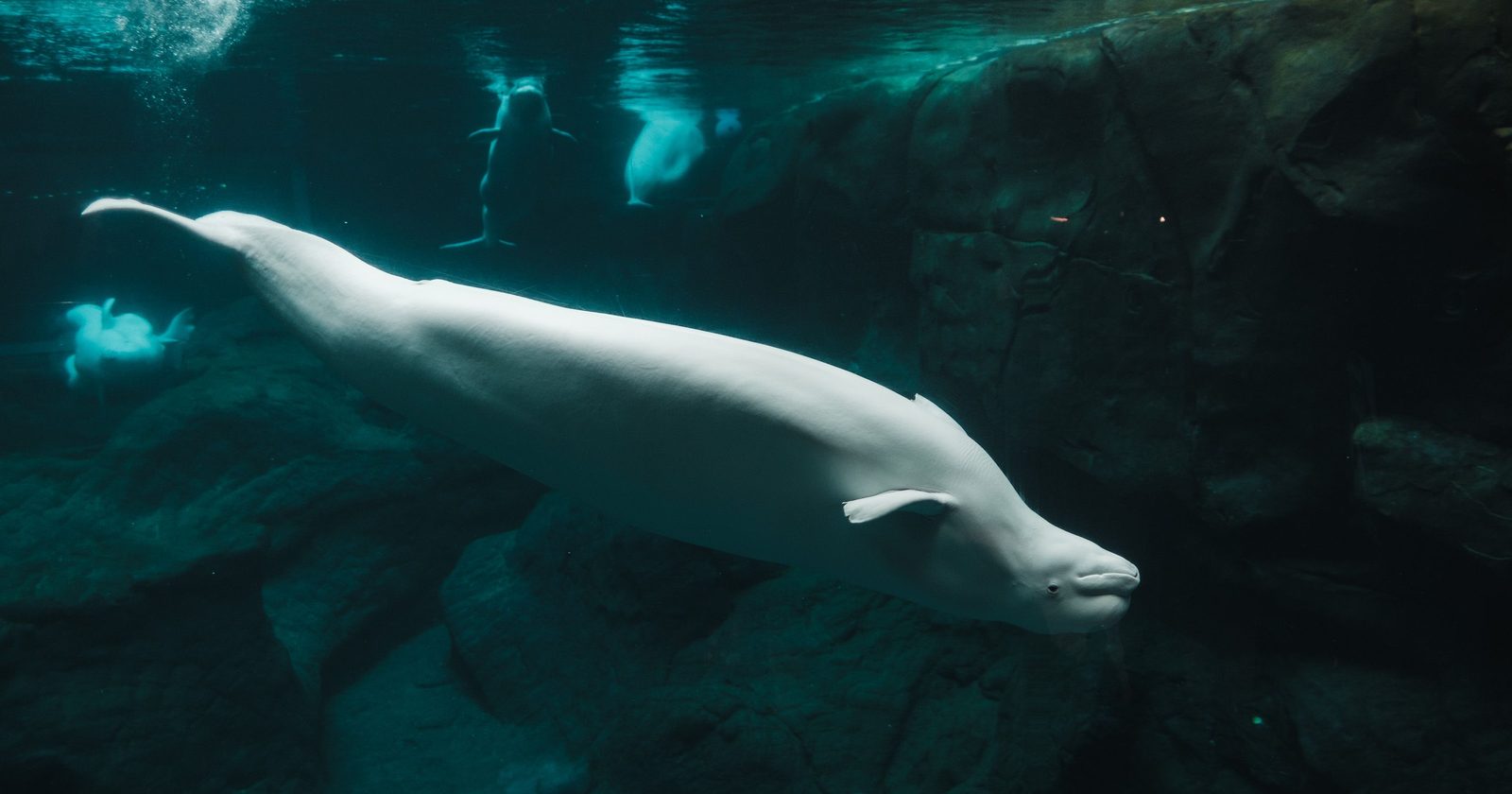
At a time when the US Navy could throw expensive machinery at the job of retrieving lost weapons from deep, cold water, it decided a whale would do it better. According to Charles Siebert’s reporting in Smithsonian, these belugas reached platforms set at depths of over 2,000 feet. That number comes with a caveat, though, and we’ll get to it.
The obvious question is why. Why pick a living animal over a robot, at depths and temperatures that kill unprotected humans and stall a lot of equipment? Well, in the early 1980s the whale really could outperform the machine, and the Navy’s own paperwork says so.
Why a whale instead of a machine
The capability is written down in a US Navy patent, “Beluga whale object recovery system”, filed in August 1985. It reads like an engineering document, because that is what it is: a method for training a whale to dive, find an object, and attach recovery gear to it.
The cost argument sits right in the patent. Getting a lost torpedo back the usual way meant sending down remote-operated vehicles on cables or crewed submersibles, and the inventors were blunt. “Recovery operations are manpower intensive and can be extremely time consuming and costly,” they wrote. A whale, by contrast, dives on command, drags no cable, and needs no pressurized hull to survive the depth.
This fed into a program with deep roots. The Navy’s Marine Mammal Program began in the early 1960s. It first studied dolphins to learn what their bodies could teach torpedo and submarine designers, then started training animals for underwater work directly. At its 1980s peak the program ran on an $8 million budget with over 100 dolphins, plus sea lions and beluga whales. The belugas were a later addition for one particular setting.
What the belugas had that the others didn’t
That setting was the Arctic. With Soviet submarines operating under the ice cap through the 1970s, the Navy wanted animals that could work in freezing, dark water. Its existing performers couldn’t. The program’s sea lions worked well but topped out around 650 feet for object recovery, and neither they nor the dolphins were built for the cold.
So in August 1977, with Canada’s consent, the Navy sent a team to collect its first belugas off the coast of Manitoba, for an Arctic effort it called Cold Ops. The patent gestures at the gap the belugas were meant to fill, noting that the earlier animals “may have operational limitations in cold and fresh water or in areas of low salinity or at deep diving depths in excess of 1,000 feet.”
On depth, the figures vary by source. The patent aims the system at targets around 1,300 feet and trains belugas to depths over 1,000 feet. Siebert’s Smithsonian feature puts the platforms the animals reached at “over 2,000 feet.” We didn’t find that 2,000-foot figure backed up in the Navy’s own document, so we’d treat it as the upper, less-certain end of the range.
The problem of the torpedo that stopped pinging
Depth and cold explain why a beluga could go where the hardware struggled. But the trick that made the animals genuinely hard to replace was their echolocation, and it solved a specific, persistent problem.
Test torpedoes carry small sound beacons, called pingers, so a recovery crew can find them on the seabed. When the pinger works, the torpedo announces where it is. When it fails, the crew is searching a large, dark stretch of water for a silent metal tube. The patent puts it plainly: “torpedoes are equipped with acoustic beacons (pingers), but if the pinger malfunctions, torpedo recovery is often impossible.”
A beluga, however, doesn’t need the object to make a sound, because it makes its own. Its echolocation clicks bounce off a silent torpedo the same way they bounce off a fish. The inventors claimed exactly this, writing that “applicants have discovered that beluga whales have sonar and deep diving capabilities and that these animals can be trained to utilize these capabilities for recovery of pingered as well as non-pingered objects in water.” That is a patent applicant making the case for their own invention, not an independent finding, so read it as the pitch rather than the verdict. The patent was eventually abandoned.
Faster, cheaper, and then obsolete
The whole system was sold, in the patent’s words, as “a safe, rapid and economical means of marking and/or recovering acoustically active (pingered) and acoustically passive (non-pingered) objects.” That is the inventors describing what they hoped it would do, not a measured result. But it captures the logic cleanly. Against a crewed submersible with a budget, a trained whale looked like a bargain.
The edge didn’t last. The Marine Mammal Program was downsized and declassified in 1992 as the Cold War wound down, and the beluga work was scaled back. Machines improved, and the strategic reason to keep whales patrolling under the Arctic ice faded. What had been a real advantage for the animals in the 1980s became something a robot could increasingly handle on its own.
The Navy program still exists, now working mostly with dolphins and sea lions, and it has drawn steady criticism over the years about the ethics of using wild-caught marine mammals for military tasks. Those concerns are not settled.
What we keep coming back to is the tension in the whole episode. On one side is a real, documented ability: an animal that could dive past a thousand feet into water that would stop a person and a lot of hardware, and find a silent object using a sense we can’t match. On the other side are the questions about how those animals were taken, kept, and used, which the ability doesn’t answer and doesn’t excuse.