

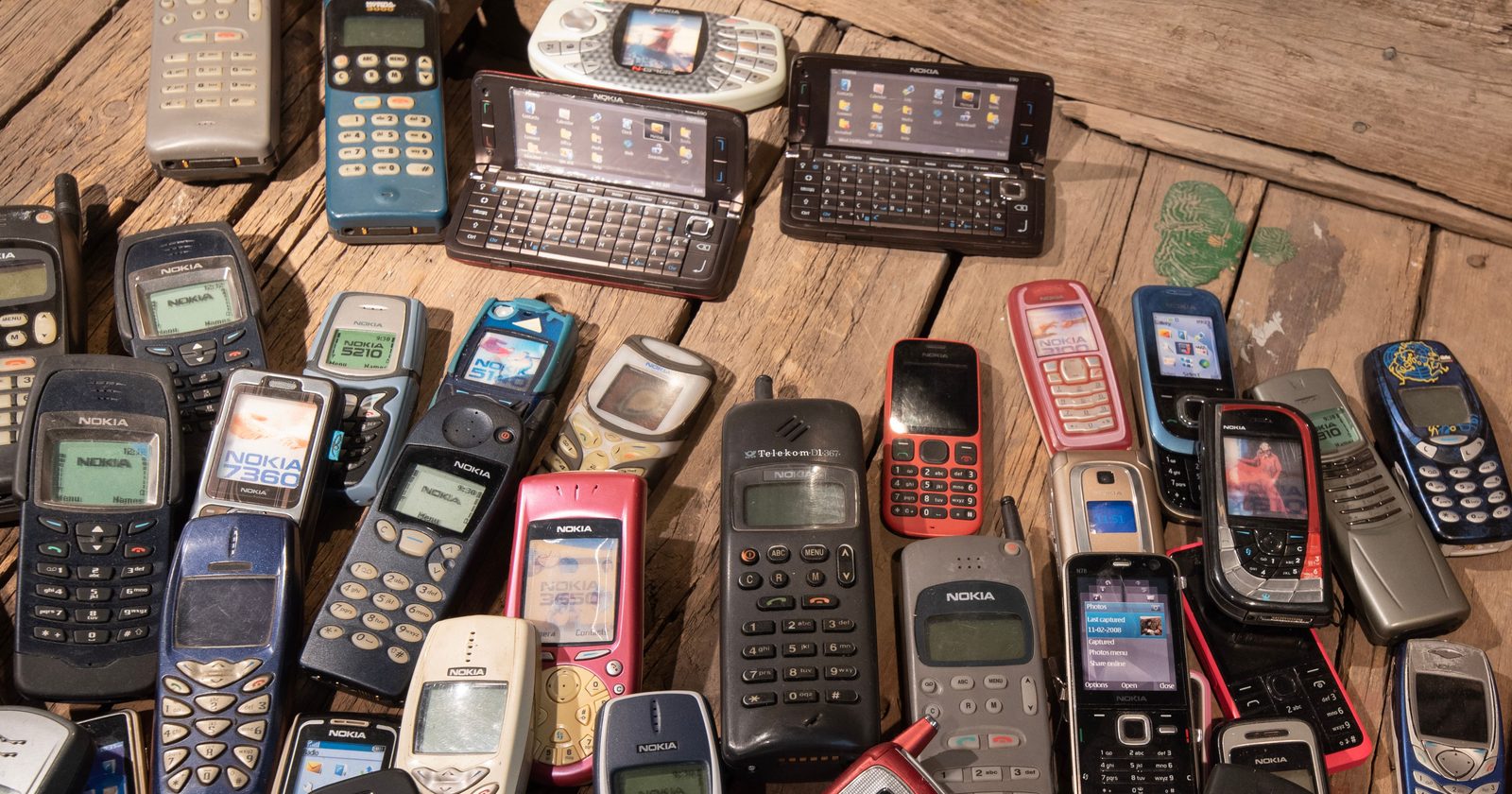
A working gold mine is doing well if it pulls 5 to 20 grams of gold per tonne of rock. A tonne of dead mobile phones holds several times that. Same metal. One lot is buried in rock; the other is probably sitting in a shoebox.
So what is really inside a tonne of retired phones, why is that metal worth more in the phone than in the ground, and why do we recover so little of it? The chemistry is settled. The awkward part is us.
Just how rich is a tonne of dead phones?
The most-cited figures come from a 2006 US Geological Survey fact sheet, based on data from the mining firm Falconbridge. Weighed without their batteries, a tonne of old cell phones holds roughly 140 kg of copper, 3.14 kg of silver, and 300 g of gold, plus some palladium and a few grams of platinum. Other estimates run wider, with copper quoted as low as 53 kilograms per tonne, but the picture holds: a tonne of handsets is packed with useful metal.
The gold is where the contrast bites hardest. Natural gold ore usually holds just 1 to 5 grams per tonne of rock. The gold packed into phones is many times more concentrated, and it has already been found, dug up and purified. That work is done.
Why the metal is worth more inside the phone than in the ground
This is the idea behind what people now call the urban mine. The gold, copper and silver in the world’s discarded electronics have already been through the expensive part: found, extracted, melted down and refined, then packed into a device at a density no rock can match. Recover the phones and you recover all that without repeating any of that work. “Mining your drawer” is only half a joke.
The scale is real. The UN’s Global E-waste Monitor 2024 valued the metals in the 2022 wave of electronic waste at around US $91 billion, including about $19 billion of copper and $15 billion of gold.
So why don’t we recover more of it?
Because almost none of it ever reaches a recycler. The same UN report found that only 22.3% of e-waste was formally collected and recycled in 2022. Back in 2006 the USGS noted that less than 1 percent of retired cell phones were being recycled at all. The problem was never the chemistry. It is getting the phones out of the house.
And they really do stay in the house. A 2022 WEEE Forum survey of 8,775 European households found the average home holds 74 electronic products, of which 9 sit unused but still working and 4 are broken. Phones were among the most hoarded of the small items. The most common reason people gave for keeping them was simple: “I might use it again in the future”. The Forum estimated that around 5.3 billion phones would drop out of use in 2022 alone, out of roughly 16 billion owned worldwide.
Pascal Leroy, who runs the WEEE Forum, put the psychology plainly. “People tend not to realise”, he said, “that all these seemingly insignificant items have a lot of value, and together at a global level represent massive volumes.” That comes from an organisation running an awareness campaign, not a neutral audit, so read it with that in mind. But billions of handsets each carrying a fraction of a gram of gold, does add up to something large.
What happens to the phones we do hand in
What a phone contains and what a recycler actually recovers are two different things. The per-tonne figures assume clean, efficient processing. Real recycling loses some metal along the way, to contamination and to the difficulty of extracting tiny amounts from circuit boards, screens and connectors. A tonne of handsets in a shredder does not hand over 300 grams of gold on a plate. But even after those losses, the metal that reaches a proper recycler comes out at a concentration ordinary mining cannot match. That is why specialist smelters take e-waste seriously.
Leroy’s point about why the small stuff slips through is hard to argue with. The campaign focused on small e-waste, he said, “because it is very easy for them to accumulate unused and unnoticed in households, or to be tossed into the ordinary garbage bin.” A dead washing machine is hard to ignore. A dead phone is not.
The value in a tonne of old handsets is genuine, already mined and already refined, more concentrated than the best ore in the ground. What stands between that value and the world is not a hard science problem. It is a drawer, a “might need it later”, and the fact that a phone is small enough to forget.