

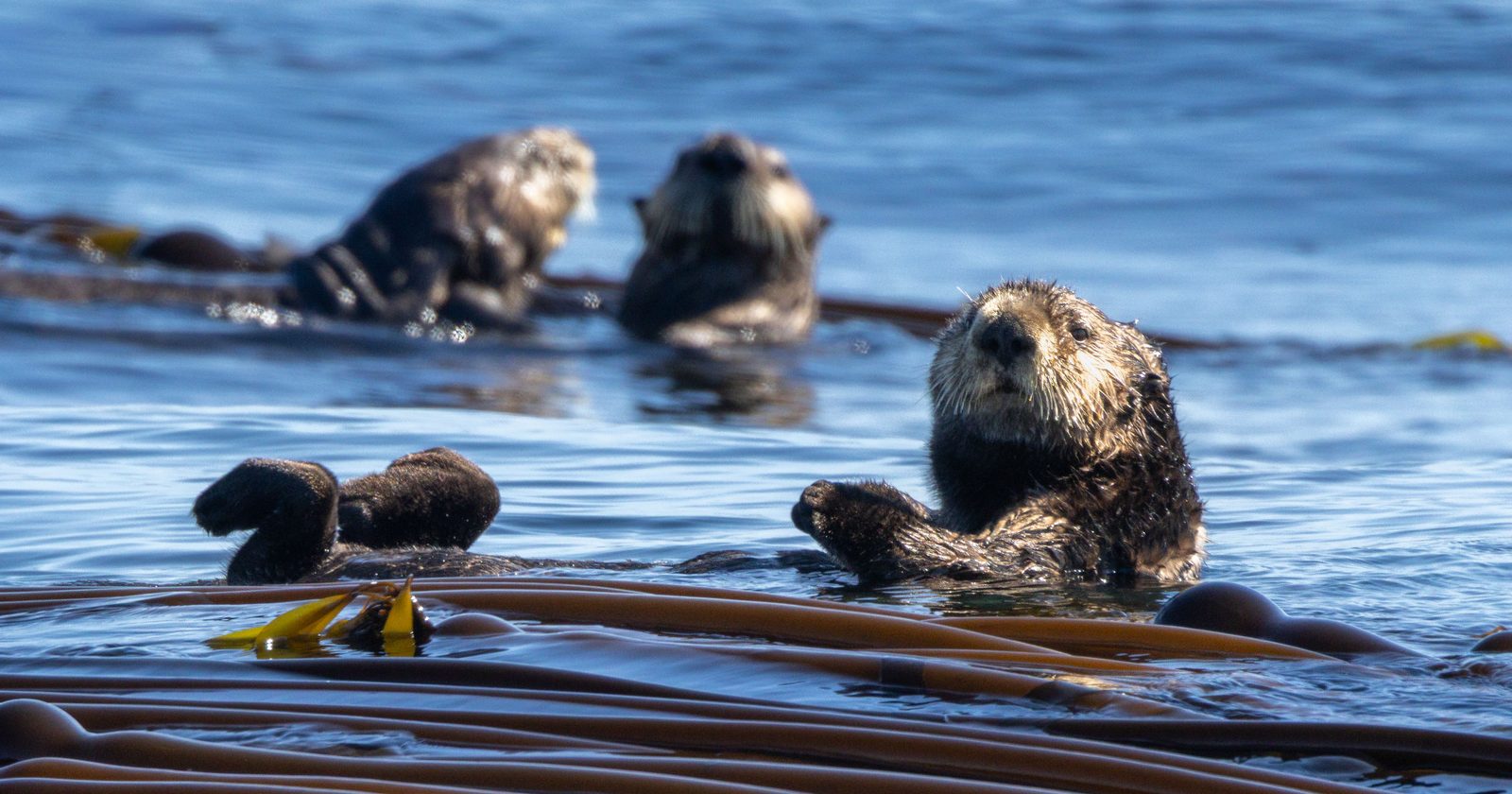
Sea otters are famous for cracking shells open on rocks balanced on their chests. A new study says that habit is more than charming. It can be the difference between eating and starving.
Chris Law, the evolutionary biologist who led the work, puts the stakes plainly. Teeth matter for survival because when an otter’s teeth become too worn or damaged, the otter could starve. An otter that can no longer process its food is an otter running out of time.
The study came out in the journal Science in May 2024. What strikes us is how ordinary the tools are. Sea otters are one of the few animals that use objects to get at food, and those objects are just rocks, discarded shells, sometimes human trash. The team wanted to know whether the habit actually pays off in a way you can measure, or whether it only looks clever.
We are not marine biologists or veterinarians, and this is one observational study read closely, not settled fact about every otter in the ocean. The researchers combined field observations with estimates of biting ability, so the findings are best read as a strong pattern in this group of animals rather than a rule for any single otter.
What 196 tagged otters revealed
The dataset is the heart of it. The team tracked 196 radio-tagged southern sea otters along the central California coast over time. Then they matched how often each otter used a tool against two things: what it could eat, and the state of its teeth.
The link was clear. Tool users could get into larger, harder-shelled prey, and their teeth held up better for it. The researchers reported that, for the first time, tool use among both male and female otters was tied to fewer tooth injuries. Co-author Rita Mehta described the approach plainly: “We combined these extensive data sets with estimates of otter biting ability, their diet preferences, and frequency of tool use to show how that behavior is important for their survival.”
One number we keep coming back to is the range. Some otters used tools more than 90% of the time when feeding, and others rarely or never. That spread is what makes the pattern visible. If every otter did it the same amount, you couldn’t tell what it bought them.
Why it’s mostly the females
The clearest split in the data is by sex, and the reason is physical. Female southern sea otters are smaller, with a weaker bite than the males. A male can often just crush what a female has to work around.
So the females work around it, and the payoff shows. Tool-using females could get into prey up to about 35% harder than what tool-using males were eating. Law reads it as compensating for a disadvantage, not a preference. “Female otters are likely using tools to overcome their smaller body size and weaker biting ability in order to meet their calorie demands,” he said. His own phrasing hedges: this is an interpretation of the pattern, not a proven cause.
There’s a second pressure on top of the first. Sea otters burn energy fast, and a pregnant or nursing female is feeding for two on an already-tight budget. Mehta laid it out directly: “Females need the calories. They are smaller than males, and pregnant or nursing females have elevated caloric demands.” The tooth benefit and the calorie benefit are really the same thing from two angles: a mouth that stays intact is a mouth that keeps bringing in food.
The workaround when the good food runs out
Southern sea otters have favorite prey, the easy, calorie-rich stuff like abalone and sea urchins. When that runs short, they fall back on tougher, more armored food such as snails and clams. Cracking a snail with your teeth, over and over, is exactly what wears a mouth down.
That’s when tool use stopped looking like a quirk and started looking like insurance. The advantage mattered most where favorite prey had already run out. An otter that could hand the hard work to a rock kept eating the fallback food without wrecking its teeth. One that couldn’t paid the price in wear.
Law is careful about how far to push that. “Raising pups takes a lot of energy, and the females need to be efficient in their foraging,” he said. “The study shows that, for some animals, tool use is an important behavior for survival.” For some animals, not all of them, not as a rule for the whole species, but for the individuals living where the ocean has already been picked over.
What a learned trick means for a threatened population
What gives all this urgency is the state of the population. Southern sea otters are listed as threatened under the U.S. Endangered Species Act, and they number only about 3,000 along the California coast, where they keep sea urchins from overrunning kelp forests. That’s a small margin.
What we take from the study is that the survival work here isn’t being done by a body. It’s being done by a behavior. A female otter isn’t outgrowing her size limits or evolving a stronger jaw. She’s picking up a rock, and that choice, learned and repeated, is what keeps her fed and her teeth working as the food supply thins out. In a population this small, a habit that can be learned rather than waited on across generations is a different kind of resilience than the slow one biology usually offers.
It doesn’t guarantee anything. A learned workaround only helps the otters who actually use it, and the range in the data, from otters that almost never use tools to ones that nearly always do, shows the benefit isn’t shared evenly. But for a threatened animal facing a shrinking food supply, the fact that part of the answer is something an otter can do, rather than something it has to become, seems to us like one of the more hopeful things this dataset had to say.