

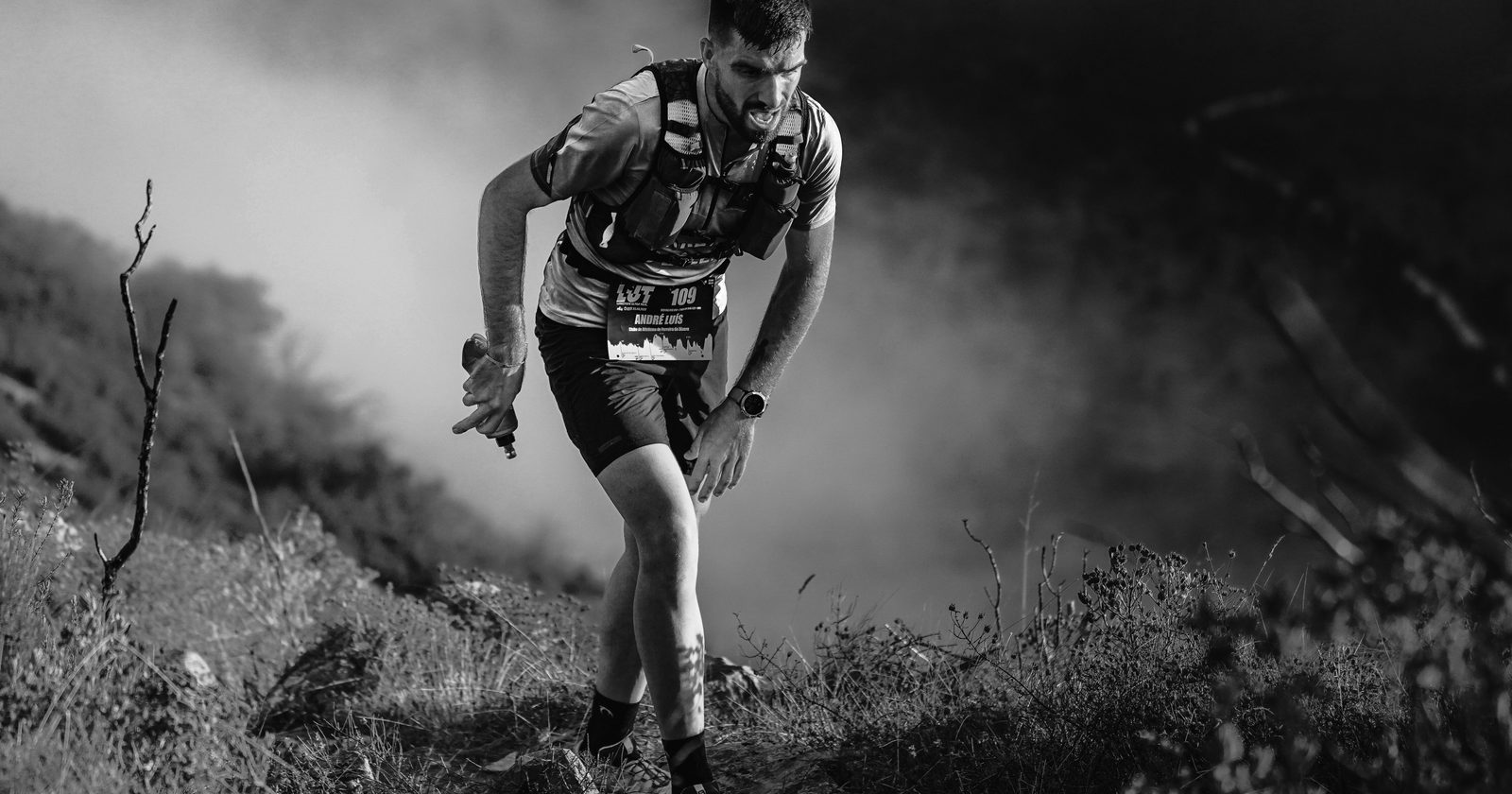
Why does the climb leave you gasping, but the descent leaves you hobbling down stairs two days later?
Anyone who has done a hilly run or a long day in the mountains knows the odd mismatch. Going up feels like the hard part while you are doing it. Going down is where the real damage builds up, and it shows up on a delay.
We are not clinicians, physiologists, or sports-medicine doctors, and this is reading and reflection on the research rather than advice. The work cited here comes from lab studies and reviews, and broad patterns are not prescriptions for any individual runner or hiker.
Why going up costs more but going down hurts more
The energy side is well measured. In a treadmill study covering slopes from steep downhill to steep uphill, Minetti and colleagues found running on the flat cost about 3.40 joules per kilogram per metre, rising to 18.93 on a very steep climb. On a moderate downhill the same team measured a low of 1.73 joules per kilogram per metre, less than half the flat-ground cost. By the numbers, descending is the cheap part.
Energy is not where the descent gets you, though. The damage is. When you run uphill, your muscles shorten as they contract, doing work to lift you against gravity. When you run downhill, they do the opposite job: they lengthen while still pushing back, acting as brakes to absorb your momentum on each landing. That braking is what physiologists call an eccentric contraction, and it is the source of much trouble. As muscle researchers David Morgan and Uwe Proske put it, “Mechanically eccentric contractions use muscles as brakes rather than motors, and occur in activities such as horse-riding, skiing and walking down hill.”
What the braking actually does inside the muscle
To see why braking damages tissue that lifting does not, it helps to zoom in to the smallest working unit of a muscle, the sarcomere. Think of it as a tiny overlapping structure that makes force best at a certain length and less at the extremes. Morgan and Proske’s “popping sarcomere” hypothesis describes what goes wrong when an active muscle is stretched. Once the muscle is stretched past the length where it makes the most force, the weakest sarcomeres give way first, over-stretching fast until something finally stops them. When the muscle relaxes, some of those over-stretched units do not snap back into place, leaving pockets of damage scattered through the fibres.
This is the small-scale disruption behind exercise-induced muscle damage, and it is why the braking side of a workout hurts more than the lifting side at the same effort. The descent, not the climb, is what researchers call eccentrically biased, the pattern that drives strength loss, soreness, and a rise in creatine kinase, a marker of muscle damage in the blood. Mountain ultramarathons produce big jumps in that marker, much of it has been traced to the pounding of the downhill sections.
Why the soreness arrives late
The damage happens during the run, but the ache does not. You can finish a long descent feeling fine and wake up a day or two later barely able to sit down. That delay is the defining feature of what gets called DOMS. As Cedars-Sinai puts it, “Delayed onset muscle soreness simply refers to the normal muscle discomfort that develops 24-48 hours after vigorous physical activities to which your body is not accustomed.”
The timing has been noted for a very long time. Morgan and Proske observe that “It has been known for over 100 years that active stretch of muscle, also known as eccentric or pliometric contraction, can lead to sore and stiff muscles, beginning the day after exercise and lasting up to a week.” The soreness rises and then eases: Cedars-Sinai notes that “DOMS typically peaks approximately one to three days after exercising and then begins to lessen gradually.”
The reason it hurts less the second time
The body does not just repair the damage. It adjusts for the next round. This is the repeated-bout effect, and as a review by McHugh describes it, a single bout of eccentric exercise protects against muscle damage from later eccentric bouts. One hard downhill session buys real protection against the next one.
The same protection shows up in the blood work of downhill runners, whose creatine kinase rise is smaller on a second run weeks after the first. Part of the change appears to be structural. One idea in the same review is that the muscle adds sarcomeres end to end, making the fibres longer so the same stretch is shared across more units, with no single sarcomere pushed as far onto the fragile part of its range.
That is probably the practical thing to take from all this. The first big descent of a season, or the first hilly race after a flat winter, is the one most likely to leave you sore, and building up downhill running gradually tends to be easier on the tissue.
We are not sports doctors, though, and there is a line between ordinary next-day stiffness and pain that is sharp, involves swelling, or is slow to fade. If soreness feels wrong rather than just uncomfortable, a physiotherapist or doctor is worth talking to.