

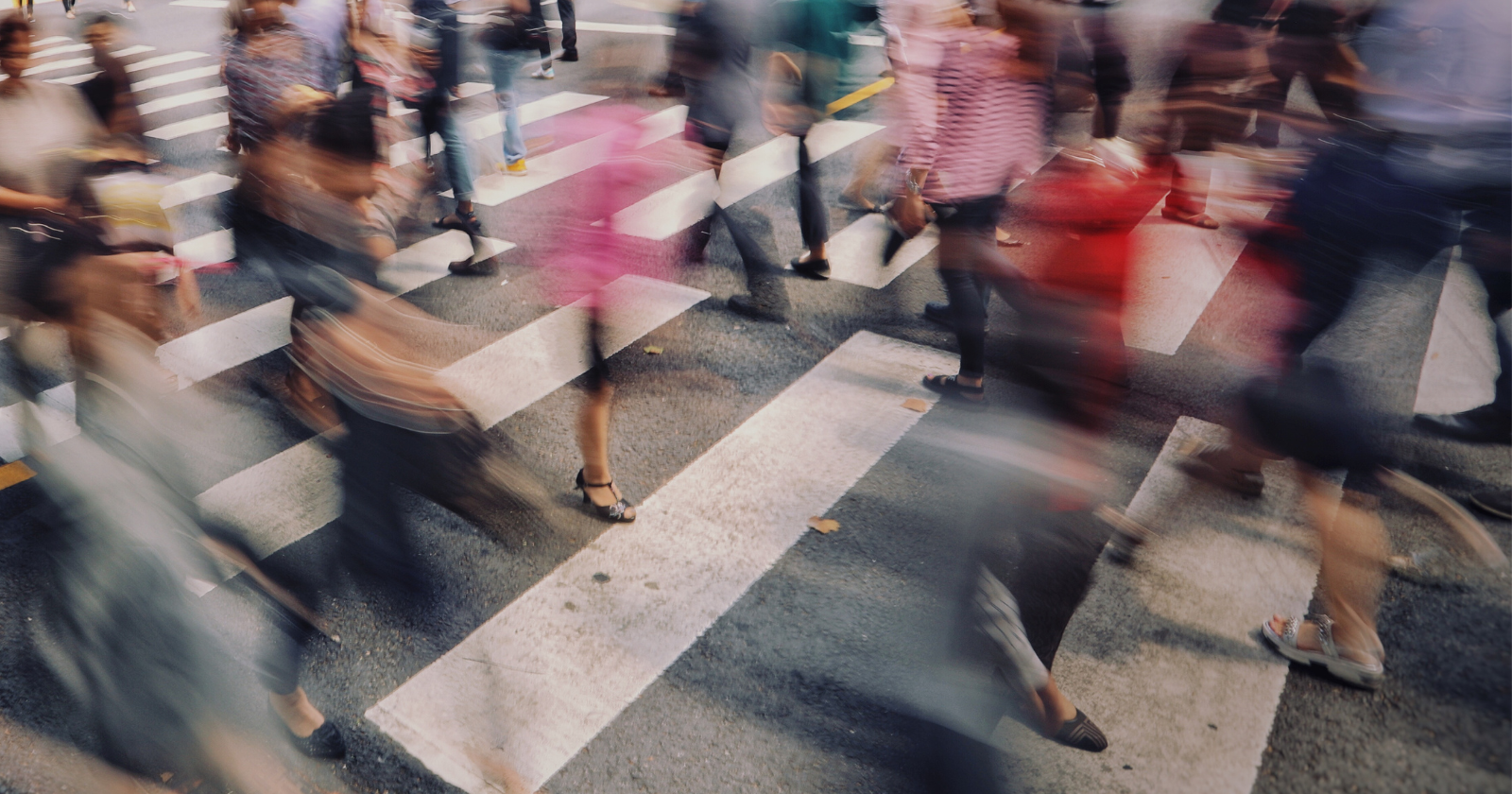
At a busy corner, needing to reach the far diagonal side, the usual way takes two steps. You wait for one signal, cross, wait again on a curb or island, then cross the other leg of the intersection. Two waits, two crossings, and in between you stand on a corner while cars turn past you.
There’s another way: every car stops at once, in all directions, and you walk straight across the middle to where you are going. One walk, one wait, no turning traffic to dodge.
That second design is a diagonal crosswalk, sometimes called a pedestrian scramble or a Barnes dance. Seoul has been building them for years, and the city has now put a decade of data behind the idea.
What Seoul built, and the numbers behind it
The design is simple. A red light stops cars in every direction, and pedestrians get their own turn to cross any way they like, including straight through the diagonal. Seoul’s transportation Deputy Mayor called it a “shift toward a pedestrian-centered transportation system”.
In November 2025 the city released what it calls the first analysis of the design’s real-world effects using ten years of data. The analysis looked at 217 sites installed between 2012 and 2023, comparing what happened before and after each one went in. Across those sites, traffic accidents fell 18.4 percent.
Some of the smaller figures are even sharper than that headline. Cases where a driver failed to protect a pedestrian dropped by half. Crashes between vehicles and pedestrians fell 27.3 percent, and accidents while people were crossing fell 25.8 percent.
People also walked less. The average distance to cross an intersection shrank by 5.6 metres, from 32.5 to 26.9.
One caveat: this is a before-and-after study, not a controlled experiment. It shows a strong pattern across a lot of sites, not lab-proven cause. The pattern is consistent, though, and it points somewhere specific.
Why it cuts the crashes
The gains cluster in one kind of collision, and that is the tell. When cars and people move at the same time, the dangerous moment is the turn. A driver turning right or left is watching for a gap in traffic, looking the wrong way to notice the person already in the crosswalk. Scramble timing removes that overlap, because no car is moving while anyone is on foot.
Seoul’s turning figures make the point. Crashes between cars and pedestrians during right turns fell 35.3 percent, and during left turns they fell 44.8 percent. Remove the shared green light, and you remove the crash that happens when a turning car and a walking person want the same patch of road.
The theory is not new. Carla Tankle of the Boston Transportation Department wrote that “Pedestrian scrambles are on paper the safest type of crossing because there are no conflicts between pedestrians and turning vehicles.”
The trade-off nobody escapes
Stopping every car so people can walk in all directions means the signal spends time doing nothing else. Everyone else waits.
Tankle names the downside in the same breath as the upside: scrambles “can cause the cycle length of a traffic signal to greatly increase” and mean longer delays for both drivers and pedestrians, which can lead to more jaywalking. When the wait to cross legally is long and the crossing itself is quick, some people stop waiting.
At the Stockton Street scramble intersections in San Francisco, a federal evaluation found near-misses between cars and pedestrians dropped from 7.0 percent to 1.1 percent. At the same corners, the share of pedestrians running or giving up on a crossing rose from 5.3 percent to 11.2 percent. The safety gain and the impatience arrived together. A review of crossing measures notes that a pedestrians-only phase, or Barnes Dance, creates “lost time” when no vehicles are moving at all.
There is a small counterweight in Seoul’s own numbers. Average car speeds through the treated intersections also fell. Slower cars near a crossing tend to be safer cars, so part of the benefit may be that the design nudges traffic to calm down, not just that it separates people and cars in time.
Where this travels, and where it doesn’t
A scramble is not a fix you apply everywhere. The federal San Francisco work reaches a narrow conclusion: the timing may work well at smaller intersections with lots of turning cars and pedestrians, and is hard to use at wide intersections carrying heavy through traffic.
Push the same design onto a quiet suburban junction with few pedestrians and wide lanes, and you get the trade-off without the payoff: long all-red waits, frustrated drivers, and not enough foot traffic to justify the lost time. Seoul seems to grasp this. The city says it plans to add the crosswalks specifically at intersections with heavy pedestrian traffic, not everywhere.
The lesson, then, is less “every city should do this” and more “match the tool to the corner.” Seoul’s 18.4 percent is a real, decade-deep result, earned at the dense, high-turning intersections where a diagonal walk genuinely beats two separate waits. That is the setting where the design pays for the time it borrows. Elsewhere, the same white paint on the ground would mostly buy you a longer wait.