

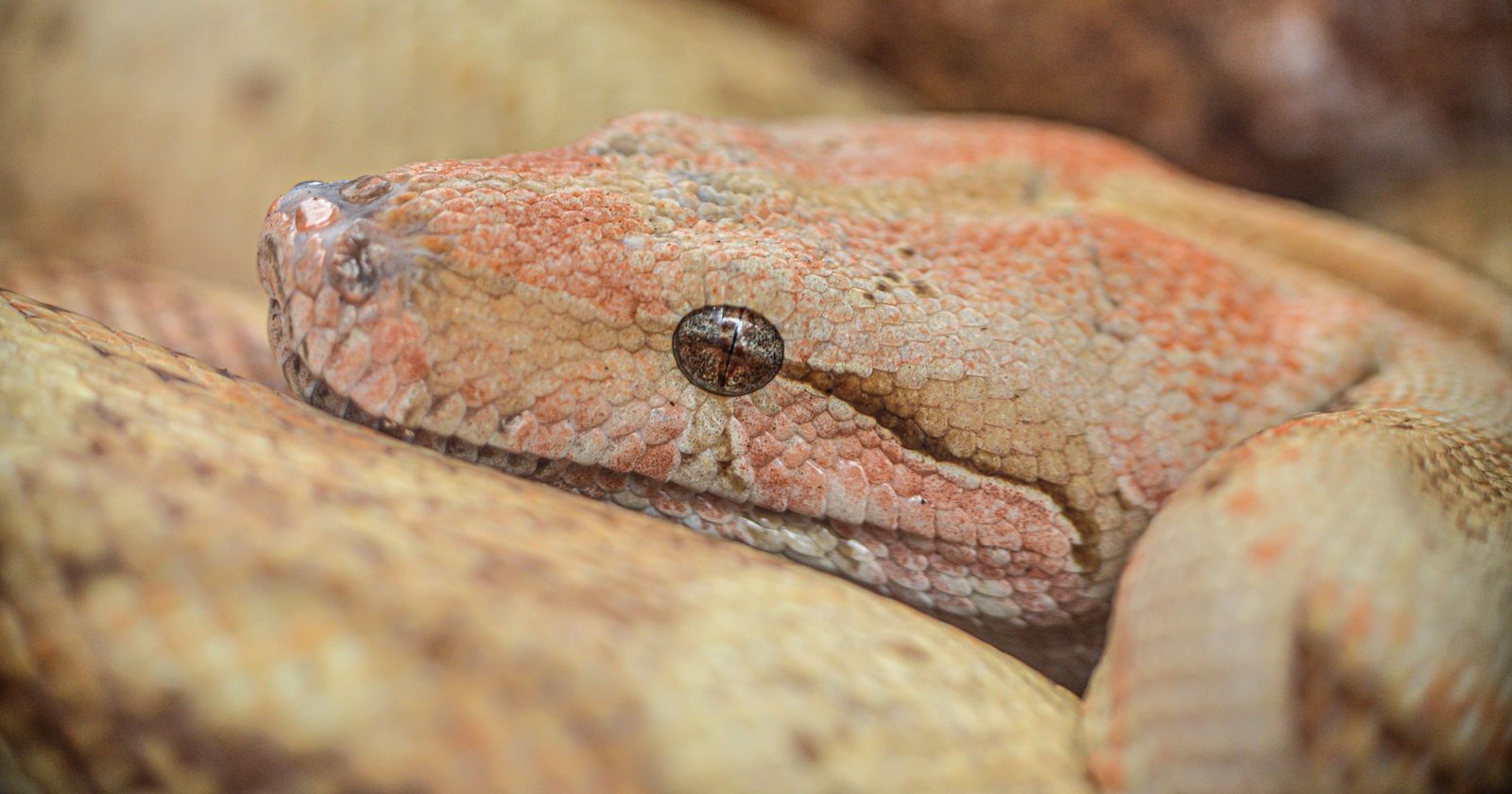
Ask most people to picture a snake shutting its eyes and they’ll imagine something like a cat drifting off, lids sliding down over the pupils. It never happens. A snake has nothing to close. There are no movable eyelids anywhere on its face, so no blink, no wink, nothing.
When a snake sleeps, its eyes stay open, because there is no other option.
So how does an animal with no lids keep its eyes wet, clean, and undamaged? The answer sits in plain sight on the front of every snake’s face: a single clear scale covering each eye, replaced every time the snake sheds its skin.
What you’re actually looking at when a snake looks at you
Each eye sits behind a clear, fixed scale called the spectacle (also known as the brille, German for glasses, or the eye cap). It is see-through and permanent. As the wildlife expert Andrew Durso puts it on his blog, snakes have “a single, fused, clear layer of skin over their eye, called a spectacle or brille.” Durso even says a snake’s eyes are closed all the time, a line that oversimplifies things. For almost all snakes, though, that’s the useful way to think about it: the lids are permanently shut, and see-through.
The covering is skin doing the job of a window. As Durso describes it, snakes’ spectacles are “transparent, like a window in their skin, allowing them to see out through their always-closed eyelids.” The lid didn’t disappear. It went clear.
Why a fused scale beats a moving lid
The spectacle isn’t a separate part bolted onto the eye. It forms in the embryo, when the upper and lower eyelids fuse together and turn clear, losing the glands and muscles a working lid would need. A veterinary review notes that snakes and many lizards have completely fused eyelids that make up a transparent spectacle, built from the same tissue that would otherwise become eyelids. It counts as a modified scale, not a separate organ. It’s part of the skin.
And because it’s part of the skin, it sheds and regrows every time the rest of the snake does. The layer over the eye never stays permanently scratched or clouded, because the snake replaces it on the same schedule as its whole outer surface. Adult snakes usually shed between two and six times a year, and young ones far more often as they grow.
Behind the scale, the eye still needs to move and stay moist, and it manages both. The spectacle isn’t stuck to the eyeball. A fluid-filled gap sits between them, so the eye rotates freely behind its fixed window. The tears that fill that gap come from a gland behind the eye and drain through a duct into the mouth. The same veterinary review notes that the fluid drains to the roof of the mouth via the lacrimal duct, and that this winding drainage route can leave some snakes prone to blockages.
The cloudy-eye phase, explained
If you’ve ever seen a snake with milky, blue-grey eyes, you were watching the shed cycle in progress. Before the old skin comes off, fluid builds up between the old and new layers, scattering light and clouding the eye over. Veterinarian Heidi Hammel describes it plainly: “the eyes become cloudy or opaque, often a blue-grey color. We say that the snake is ‘in blue’ at that time.”
Then it clears, and the clearing signals that shedding is near. Hammel notes: “A few days later, the eyes will clear up again. This is normal and means shedding is imminent (usually within 24-72 hours).” The eye cap comes away as part of the shed, and a fresh clear one is already waiting underneath.
The cost of an eye you can never close
A fixed clear scale solves the moisture-and-protection problem but creates a new one: the snake can’t wipe, squint, or blink away a speck of dust. What it can apparently do is control the blood supply to the eye’s window.
The spectacle has its own blood vessels, which is unusual. Researchers Kevin van Doorn and Jacob Sivak presented, in a 2013 study, evidence that snakes regulate that blood flow. In undisturbed coachwhip snakes, blood pulsed through the spectacle for about a minute at a time before pausing. When a threat appeared, the flow nearly shut off, which looks a lot like the snake clearing its own view at the moment vision matters most.
The eye caps can also cause trouble for a snake’s keeper. Sometimes a cap fails to come off with the rest of the shed and stays stuck to the eye, and the urge to pick it off is one to resist. Hammel’s advice is blunt: “Avoid DIY removal of stuck shed—especially eye caps. Improper handling can cause corneal damage or infection.” We’re not veterinarians, but a stuck eye cap is a case for someone who is.
What we keep coming back to is how evolution got here. Faced with the eyelid’s job of keeping an eye wet and shielded, snakes didn’t keep the obvious feature and refine it. They fused the lids shut, made them clear, and folded the whole thing into the skin so it renews on the same cycle as everything else. The blink got solved by deleting the blink. And the part that’s easy to miss: the window over a snake’s eye isn’t really a fixture. It’s a scale, and like every other scale it wears out and gets replaced, good as new, several times a year.