
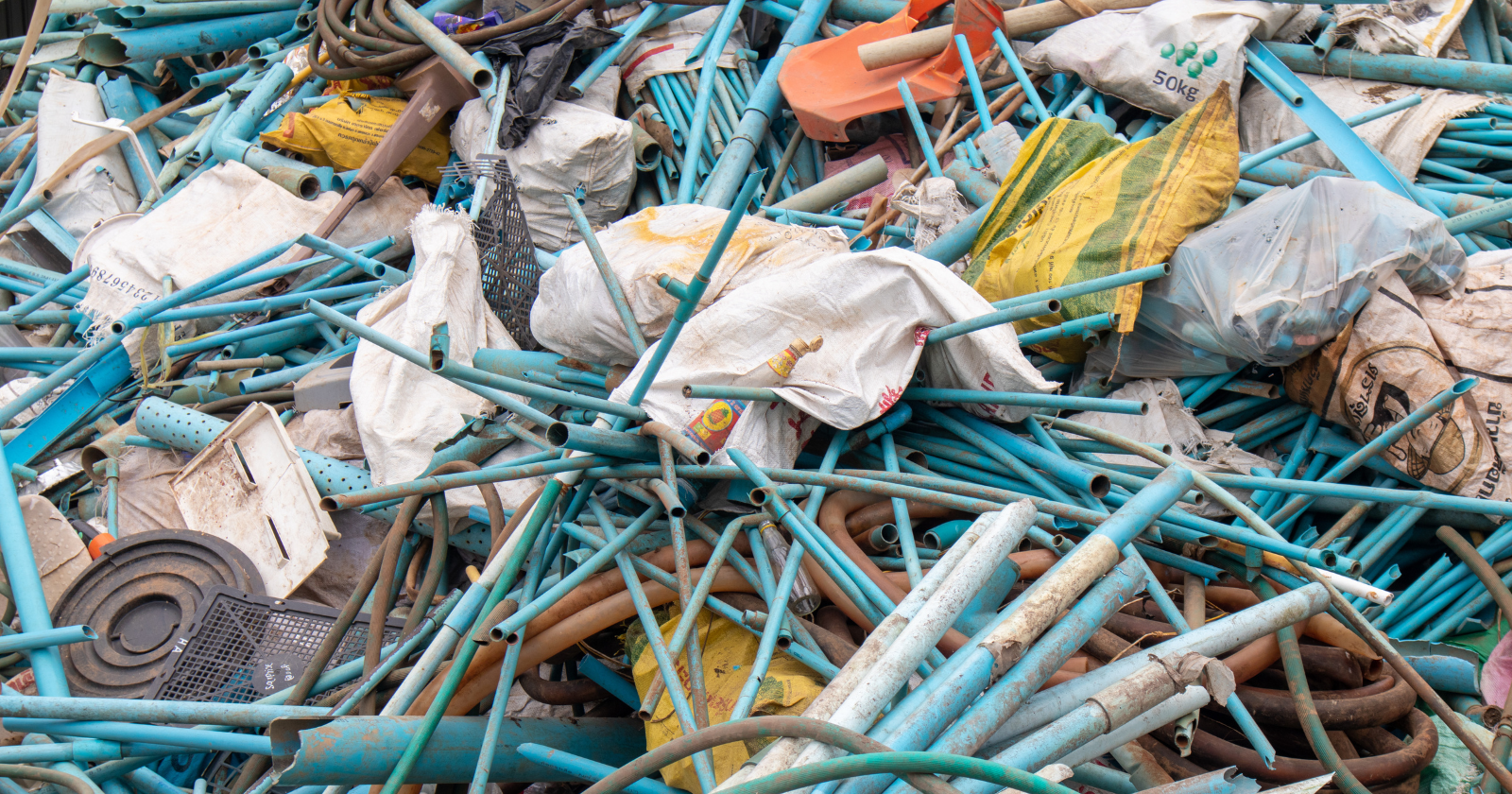
The world makes about 60 million tonnes of PVC a year, and very little of it comes back around. In the United States, EPA data show that less than 5,000 tons of the 840,000 tons of PVC entering the municipal solid-waste stream in 2018 was recycled — well under 1 percent.
So why does PVC defeat the usual recycling methods so completely, and what did a team at Virginia Tech do about it?
The short version: they stopped trying to melt and remold it, and turned it into oil instead.
Why PVC beats the three standard moves
Most plastic recycling still relies on mechanical recycling: sort plastics by type, clean and shred them, then melt the material and form it into something new. PVC makes that process unusually difficult, and much of the reason comes down to its chemistry. Roughly 57 percent of pure PVC’s weight is chlorine, chemically bound into the polymer chain rather than sitting loosely on top. That chlorine is a major complication.
Heat PVC and it begins to release hydrogen chloride, a highly corrosive gas. Improper thermal treatment can also produce chlorinated organic pollutants and other hazardous byproducts. On top of that, manufacturers formulate PVC with very different combinations of plasticizers, stabilizers, mineral fillers and other additives depending on what the finished product needs to do. A PVC pipe and a PVC raincoat may share the same polymer backbone while containing very different additive packages.
That variation matters when the products become waste. Pure, collected and well-sorted PVC can be recycled successfully, but mixed PVC streams are much more difficult to process. So PVC is recyclable, but getting a clean enough and chemically compatible stream to recycle well is the difficult part.
What the Virginia Tech route actually does
The method, published in Nature in August 2026 skips sorting, melting and remolding entirely. Instead of fighting the chlorine with heat, it dissolves the plastic and pulls the chlorine out chemically.
The reaction is gentler than you might expect for something breaking apart a stubborn plastic. The dissolved PVC is treated with two chemicals, aluminum trichloride and alpha-olefins, and heated to 158 degrees Fahrenheit, about 70 Celsius, for three hours. Under those conditions three things happen at once, as the Nature paper describes it: the chlorine is stripped off.
The chlorine removal is close to total. The process removes more than 99.98 percent of the chlorine. Leftover chlorine is exactly what would make the product corrosive and useless. Strip it out cleanly and the thing that made PVC a recycling headache stops being an obstacle.
Why the product is worth more than the waste
What comes out is not a lower-grade plastic pellet. It is a thick amber oil, called a polyalphaolefin, or PAO. That family of synthetic oils is already what goes into a lot of premium engine and gearbox lubricants. The recycled oil’s thickness, friction and wear resistance are comparable to commercial PAO products, according to the study write-up. The oil meant to keep metal parts from grinding themselves down performs in line with the material engineers already trust.
“Lubricants are the silent hero out there,” one of the authors, Guioliang “Greg” Liu, said. “We often don’t recognize they exist, but they are out there working quietly.” Turning the world’s most-avoided plastic into one of its most essential fluids is a neat inversion, and it changes the economics too. Recycling usually asks you to take a valuable material and accept a cheaper version of it. This does the opposite.
The claim Liu is willing to make plainly is a careful one. “Number one, we have proved that it is feasible to use plastic waste to make high-performance lubricants,” he told PopSci. He also frames the appeal in market terms: “these lubricants are green, and they can meet the emerging needs for sustainability by the market,” he added.
The scale check
What the team has is a lab-scale proof of concept, and a mild bench reaction is a long way from a working plant. The gap between a beaker that behaves and a facility processing tonnes of mixed, contaminated waste is where most promising recycling chemistry stalls.
The researchers did try to map that gap. They ran the numbers on a hypothetical 50,000-tonne-per-year plant and found a 22.8 percent return on $84 million in build costs, with the investment paid back in under five years. On paper that looks workable.
A tiny recycling rate on 60 million tonnes a year leaves an enormous amount of PVC with nowhere useful to go. Our read is that a route running this cool, stripping chlorine almost completely, and producing something more valuable than the input is a promising direction rather than a solved problem. The chemistry is elegant and the product is real. Whether it survives contact with a truck full of dirty pipe offcuts is the question the next few years will settle.