

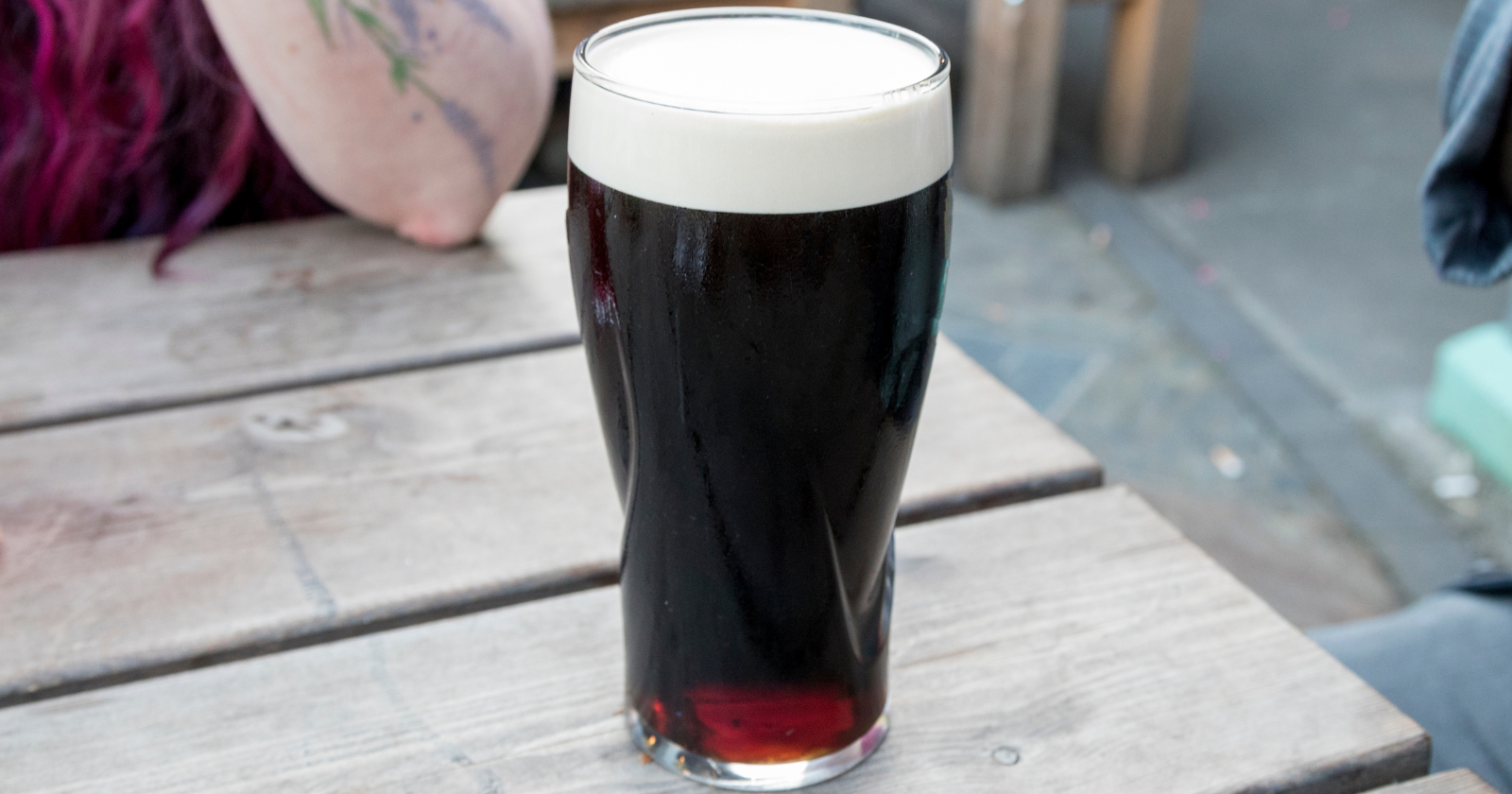
Watch a fresh pour of Guinness stout settle and you will swear the bubbles are moving the wrong way. They stream downwards, hugging the side of the glass, sinking toward the base while the head builds on top.
The usual response is that your eyes are being fooled. Bubbles are lighter than the liquid around them, the thinking goes, so they cannot possibly go down, and what you are seeing must be some illusion of the dark, swirling surface.
It is a reasonable thing to believe. It is also wrong.
The bubbles really are going down. And the reason is a circulating flow in the beer whose direction depends strongly on the shape of the glass.
The claim people dismiss
The instinct to call it an illusion has real physics behind it. A gas bubble in a liquid is buoyant, so on its own it rises. If you accept that, sinking bubbles look impossible, and the easy explanation is that the brain is misreading a dark, moving surface. The puzzle has nagged at people for exactly that reason. As the University of Limerick team put it in their paper, “the sinking bubbles of Guinness and other stout beers have intrigued beer drinking physicists and their students for some time.”
What sets this apart from a genuine optical illusion is that individual bubbles near the wall can actually be observed moving downwards. Experiments have directly measured that motion. The effect is real. The question was what was doing the pushing.
The experiment
In 2012, University of Limerick researchers Eugene Benilov, Cathal Cummins and William Lee posted a paper bluntly titled “Why do bubbles in Guinness sink?” It was later published in the American Journal of Physics in early 2013. Using computer simulations and an experiment, they went after the cause, not just the sighting.
Benilov clearly enjoyed the strangeness of it. He remarked that “in one’s everyday life, one rarely comes across such a counterintuitive phenomenon.” That is why the puzzle stuck around. Anyone can see it, and it defies the one fact about bubbles everyone thinks they know.
A traditional pint glass narrows toward the base. That downward taper helps set up a circulating current in the settling liquid: fluid sinks along the sloping wall and rises back up through the middle. The tiny bubbles near the wall get caught in that downward flow and carried under. They are still buoyant, still trying to rise, but the downward liquid flow can move faster than the bubbles rise relative to it, so down they go. In the model’s words, “if it narrows downwards (as the traditional stout glass, the pint, does), the flow is directed downwards near the wall and upwards in the interior and sinking bubbles will be observed.”
The neat test of the idea is to flip the geometry. The authors simulated a container that widens toward the base, and the circulation reverses. The model predicts that “if the container widens downwards, the flow is opposite to that described above and only rising bubbles will be seen.” Same basic system, opposite result, because the walls lean the other way.
Later experiments added more detail. A 2019 study in Scientific Reports found that rising bubbles leave a relatively bubble-free, denser layer of liquid near the inclined wall. That liquid falls while the bubble-rich interior rises, producing the circulation and the familiar downward-moving cascade.
Why stout and not lager
If the glass helps drive the current, why don’t you see bubbles sinking in ordinary lager poured into the same shape? The answer is bubble size.
Draught stout contains dissolved nitrogen as well as carbon dioxide and produces much smaller bubbles than ordinary carbonated drinks. Guinness bubbles are roughly a tenth the diameter of typical bubbles in carbonated beverages.
Size matters because larger bubbles rise much faster. The carbon dioxide bubbles in lager, champagne and carbonated water are generally too large to be trapped by the gentle downward convection. The much smaller bubbles in stout rise slowly enough for the liquid flow to carry them down near the wall. A review of foaming in stout beers by William Lee and a colleague describes how dissolved nitrogen helps give stout its distinctive small bubbles and persistent creamy head. There are plenty of them to watch, too. Guinness Master Brewer Fergal Murray has put the count at 300 million bubbles in a single pint.
What we take from it
What stays with us is how much the container matters. We are trained to think a liquid does what its own properties dictate, so the natural place to look for an answer is inside the beer, the gas and the density. The twist is that the glass geometry helps steer the fluid, while the unusually small bubbles in stout make it possible for that flow to carry them downward.
It is also, unusually for physics, something you can watch at the bar with no equipment. Pour a stout, let it settle in the classic tapering pint, and bubbles near the wall slide downward.