

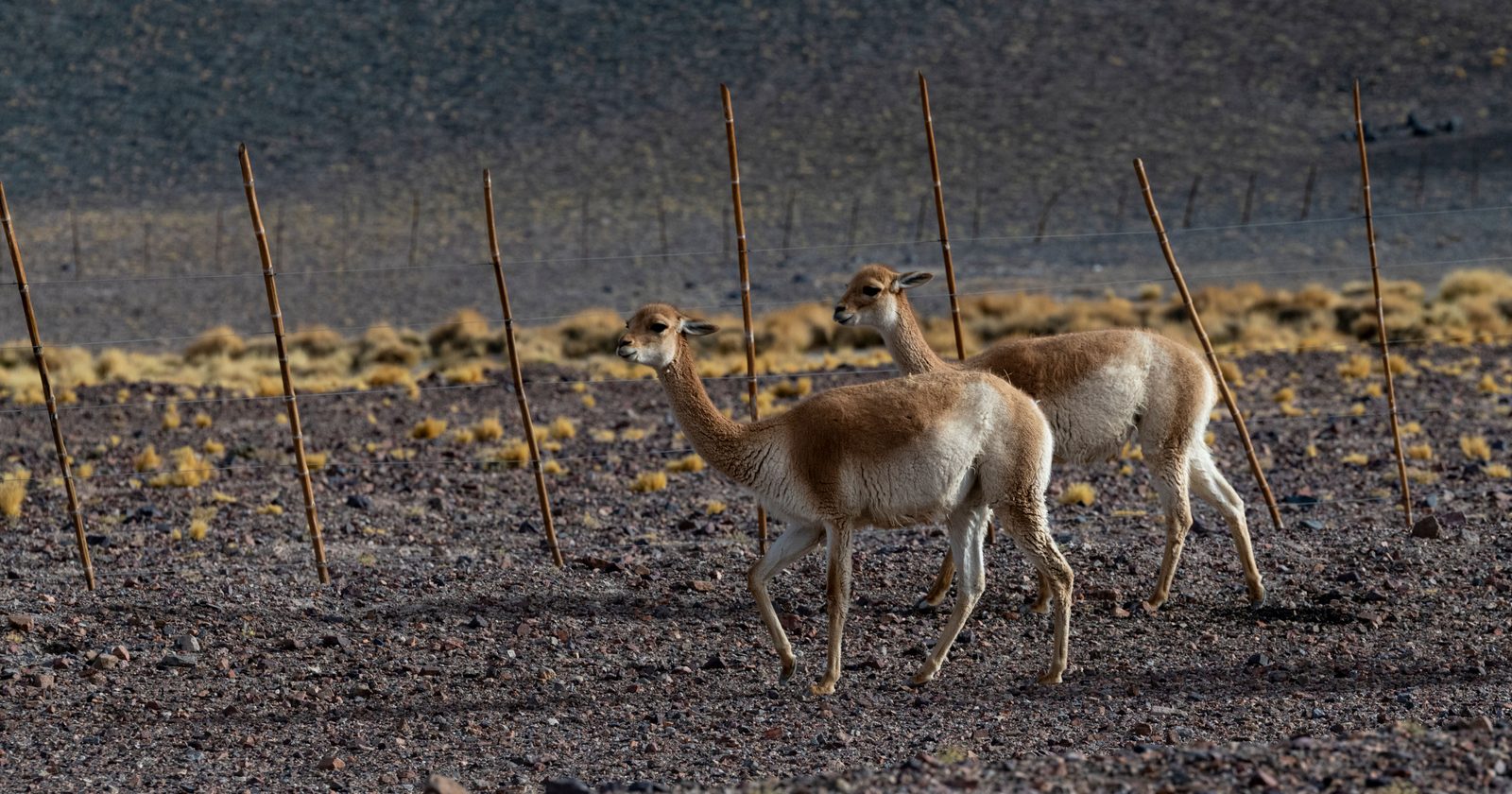
Ask most people where the priciest wool in the world comes from, and they picture a farm. Some pampered, carefully bred herd, kept warm and well-fed, sheared on a schedule.
The intuition is that luxury follows control: the more valuable the fiber, the more managed the animal producing it.
For the finest natural animal fiber in commercial use, that intuition is exactly backwards.
The fiber is vicuña, and it comes from a wild Andean animal you cannot really farm at all. The vicuña is a small, delicate wild relative of the llama and alpaca. It lives on the high plains of Peru, Bolivia, Argentina and Chile, in thin air roughly 3,000 to 5,000 metres up. Its southern range runs all the way down into the Atacama region of northern Chile.
The story of how it went from near-extinction to a genuine conservation success is, at its core, an argument about what makes an animal worth keeping alive.
Why the farmed-luxury assumption falls apart
The vicuña resists domestication in a way that has frustrated would-be breeders for centuries. Attempts to raise it in captivity have never produced a real farmed industry the way sheep, cashmere goats and alpacas did. So the fiber has to be taken from wild animals, and the method for doing that is old.
Under the Inca, vicuñas were considered sacred. They were rounded up in a communal drive, sheared, and released back to the mountains. That round-up, the chaccu, is the model modern conservation programs revived: catch the living animal, shear it, and let it go. When Spanish colonization broke the old system, the round-up gave way to something simpler and far more destructive. Hunters just shot the animals for their wool. As Mongabay reported, that method persisted until the 1960s, when by most accounts only around 10,000 vicuñas were left.
Where the scarcity really comes from
The price is not marketing. It follows from the physical facts of the fiber and the animal. A single vicuña fiber is about 12 microns across, finer than the best cashmere at roughly 15 microns and much finer than merino, which usually runs around 18 to 22. That fineness is what makes the cloth feel the way it does, and it’s why the fiber costs what it does.
Then there’s the yield. A wild vicuña can only be shorn once every two to three years, because it needs the fleece to survive the cold. Each shearing produces only a couple of hundred grams of usable fiber.
Tiny animals, tiny amounts, spaced years apart, taken only from wild herds you have to catch first. The scarcity isn’t manufactured. It’s built into the animal.
The near-collapse, and getting the number right
The popular version of this story often puts the low point at “a few thousand,” and you’ll see the figure of about 6,000 repeated in a lot of places. That figure isn’t invented, but it sits at the low end. The most authoritative accounts land higher.
A genetics review led by Juan Carlos Marín states that only 6,000 to 10,000 remained at the 1960s low, and several academic accounts cite roughly 10,000. So “a few thousand” understates it. The animal was in serious trouble, but the most-cited number is closer to ten thousand than to three.
The size of the hole matters because it’s what makes the climb out of it look impressive. And the climb was impressive.
How the recovery actually happened
The turnaround was not luck. The Andean countries set up national reserves and brought the species under CITES, the international treaty that controls wildlife trade. Conservation groups helped fund the work. According to the same Marín review, those parks, the convention and NGO money pushed the population past 200,000 within four decades, later tied to community plans that linked conservation to local income.
Where numbers stand now depends on who is counting. Marín and colleagues put the current total at roughly 460,000 to 520,000, about a 50-fold rise from the low. Other widely-cited figures land around 350,000. The species was moved to the IUCN’s Least Concern category in 2008, a formal sign that the emergency was over.
Why the live animal became worth more than the dead one
Here is the economic flip at the heart of the recovery, and how we’d read the evidence. For centuries the incentive ran the wrong way. A vicuña was worth a single payout of its wool, and the fastest way to collect was to kill it. Community-based shearing reversed that. If you can catch, shear and release the same animal every few years, a living vicuña becomes a renewable asset, and its neighbours have a reason to guard it against poachers.
A 2018 report from the International Trade Centre, a joint agency of the World Trade Organization and the United Nations, put the logic plainly, writing that the model favoured conservation, “since a live vicuña came to be worth five times the value of a poached one.” That is the intended incentive, not a guaranteed outcome everywhere, but it captures why the recovery held.
The story doesn’t end tidily. Poaching has surged again in places. Conservation authorities reported that over 5,000 vicuñas were killed for their fur across the range in the years to 2015, figures the same account calls probable underestimates.
One driver, as independent researcher Gabriela Lichtenstein put it, is that “with limited support and incentive to develop legal vicuña use, there is sometimes more financial gain from illegal use.” When the legal, live-shearing route doesn’t pay the community enough, the old math creeps back.
How much reaches those communities is genuinely contested. Bonacic, who doubts the current system delivers a fair share, told Mongabay flatly, “I wouldn’t consider vicuñas a good example of fair trade.” He also argues the recovered numbers, impressive as they sound, fall short of what the Andes once held, saying, “It’s true that populations are large, but they’re far less than the 7 to 8 million that we should have”, a figure he offers as an estimate of what could be, not an established baseline.
What we take from all of it is narrower and, we think, harder to argue with. The vicuña didn’t recover because people were told to love it. It recovered because the incentives changed. Once a shorn, living animal was worth more to the people living alongside it than a poached carcass was to a hunter, the arithmetic that had nearly wiped it out began working the other way. The unfinished part is making sure the people doing the guarding get a fair cut of what the world pays for the finest wool there is.