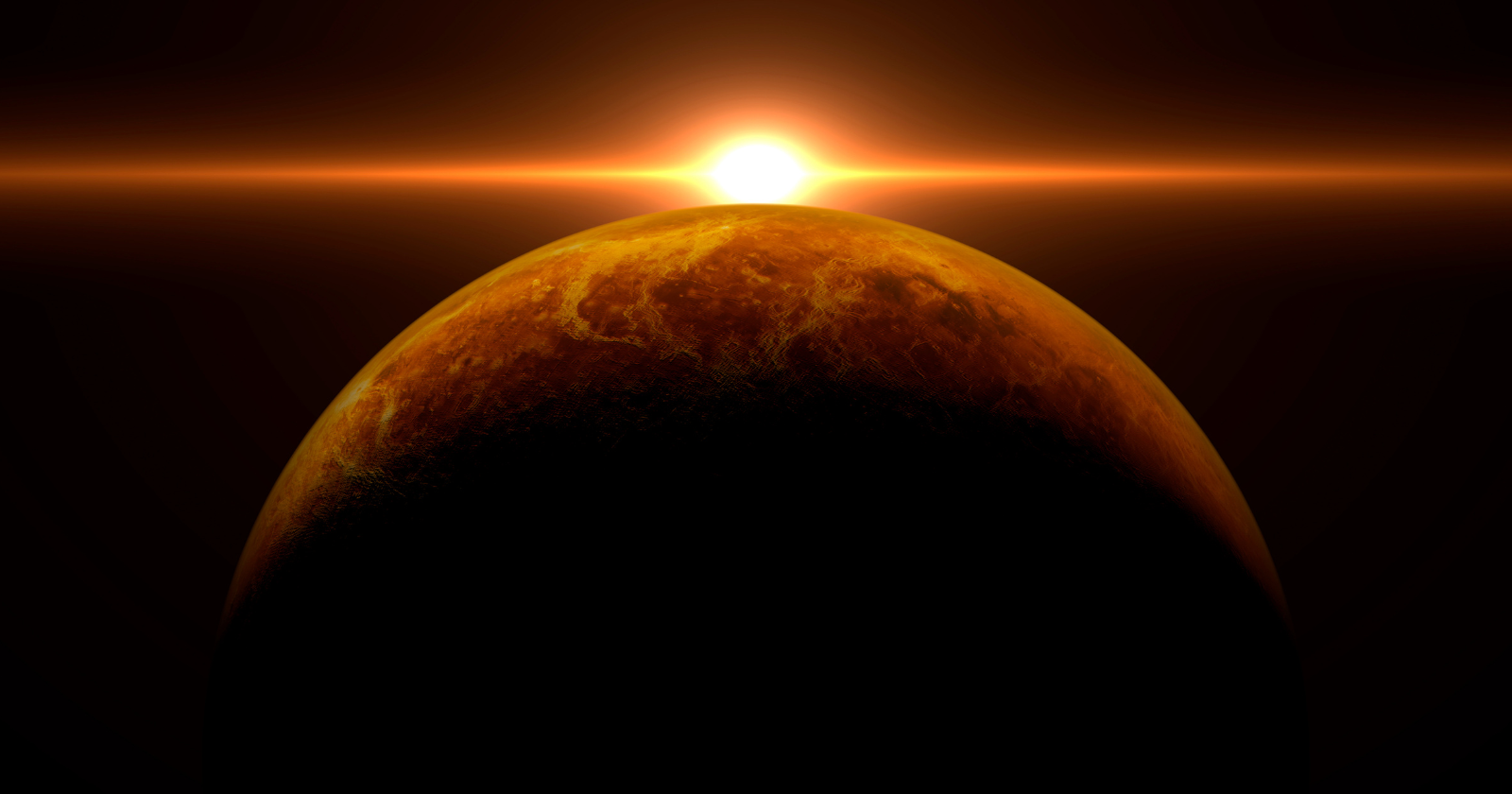
When the Soviet Venera 13 lander touched down on Venus in 1982, it lasted 127 minutes before the planet killed it. The heat and pressure at the surface destroy hardware, and every successful Soviet lander sent there operated for no more than a few hours.
Venus is hostile, but unevenly hostile. The surface is a furnace. Fifty kilometres straight up, the same planet has temperature and pressure conditions that are oddly Earth-like.
We tend to treat Venus as a single dead world. It’s closer to two environments stacked on top of each other, and only one would crush and bake you on contact.
The surface: 467°C and the weight of a kilometre of ocean
Venus has an average surface temperature of about 467 degrees Celsius, which makes it the hottest planet in the solar system, hotter than Mercury despite sitting nearly twice as far from the Sun. It’s hot enough to melt lead.
For context, a normal home oven tops out around 250°C. Venus exceeds that by more than 200°C.
Heat is only half of what would ruin your day. The atmospheric pressure at the surface is about 93 times Earth’s at sea level. NASA describes that as roughly what you’d feel more than 3,000 feet, or 930 metres, underwater.
You would be baked and crushed simultaneously, in an atmosphere that is 96% carbon dioxide.
Why it got this way, not distance from the Sun
The intuitive explanation for a scorching planet is proximity to the Sun. But for Venus, that’s not really it.
The heat comes from a runaway greenhouse effect: a thick carbon dioxide atmosphere that traps heat, so the whole planet cooks. A solar day on Venus runs about 117 Earth days, but surface temperatures barely vary between day and night.
The part I find hard to shake is this. Venus may not have started out this way. NASA climate modeling led by Michael Way at the Goddard Institute for Space Studies suggests the planet may have held a shallow liquid-water ocean and temperate surface conditions for up to two billion years of its early history. Way’s framing is careful: “these results show ancient Venus may have been a very different place than it is today,” he said.
That early-habitable-Venus idea is contested, and it’s easy to run with further than the evidence supports. This is climate modeling, not a rock sample. A University of Chicago team found Venus has likely been uninhabitable for at least 70% of its history, while a later Nature Astronomy study argued its dry interior is consistent with liquid water never condensing on the surface.
The planet’s early history remains unresolved.
Fifty kilometres up: where pressure and temperature feel like home
At about 50 kilometres above the surface, inside the global sulfuric-acid cloud deck, NASA gives temperatures of 30 to 70 degrees Celsius and pressure close to Earth’s surface. Put those numbers next to the surface figures and the contrast is genuinely strange. The ground is 467°C and 90 atmospheres. Fifty kilometres of vertical distance turns that into 30–70°C at roughly sea-level pressure.
By temperature and pressure alone, that narrow band is arguably the most Earth-like environment anywhere off Earth. Not Mars, with its thin air and killing cold. Not the Moon. A layer of cloud on the planet we usually describe as hell. That’s why NASA Langley’s HAVOC airship concept proposed operating about 50 kilometres above Venus. You wouldn’t land there. You’d float.
What the cloud layer would actually be like
Earth-like pressure and temperature are not the same as survivable conditions. The zone lies inside clouds of sulfuric acid extending roughly 45 to 70 kilometres above the surface. A cabin would not need to resist a huge pressure difference, but the outside atmosphere is unbreathable and the droplets are highly corrosive. An unprotected human at 50 kilometres would still die, just for different reasons than at the surface.
The mild temperature and pressure are also why some scientists keep raising the possibility of microbial life in those clouds. NASA notes the conditions at that altitude could accommodate Earthly life, such as hardy “extremophile” microbes that thrive in acidic, extreme places on Earth. This is an open question rather than a finding. It’s a reason to look, not evidence of anything living.
Venus isn’t one environment. The lead-melting furnace under a kilometre’s worth of atmospheric weight is real, and it’s the surface. But the Earth-like pressure and temperature above it are real too, in a layer of acid cloud fifty kilometres above the only ground the planet has.