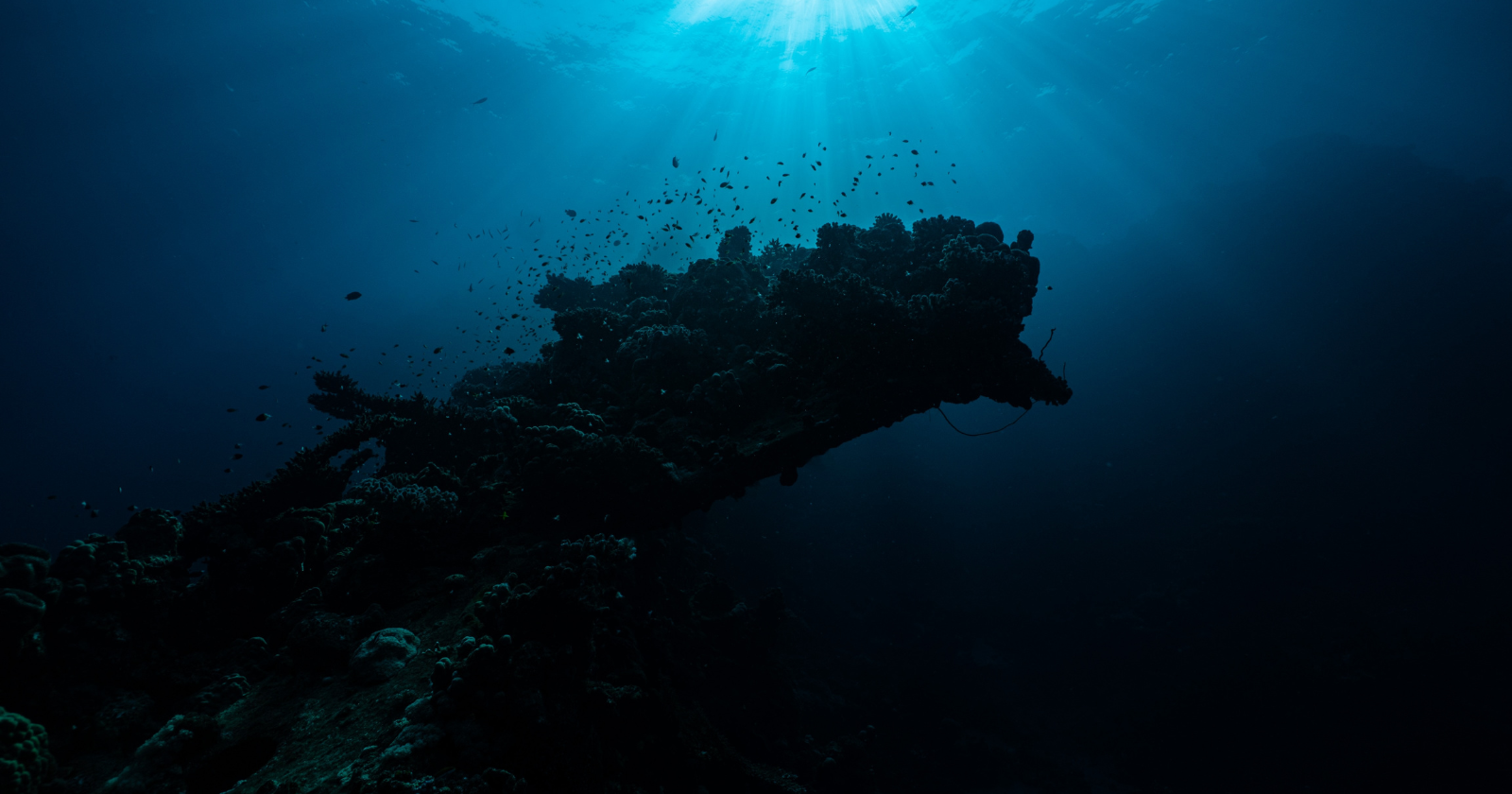
The deep ocean is not a small unexplored corner of Earth. It begins only a few hundred metres below the surface and contains most of the planet’s habitable space. Yet we have mapped less than a third of the seafloor to modern standards and directly observed only a minute fraction of it. Here are 20 facts that show how large, strange and incompletely understood that world remains.
1. Less than a third of the seafloor has been mapped to modern standards
The figure is improving, but slowly. In April 2026, the Nippon Foundation-GEBCO Seabed 2030 Project announced that 28.7% of the world’s ocean floor had been mapped to the modern resolution standards used by the project. That leaves more than 70% still represented mainly by lower-resolution measurements, including estimates inferred from satellites rather than direct sonar surveys.
2. Humans have visually observed less than 0.001% of the deep seafloor
Mapping the shape of the seabed is not the same as actually seeing it. A 2025 study estimated that people have visually observed less than 0.001% of the seafloor below 200 metres. The total area seen was roughly comparable to the size of a small US state, spread across a deep-ocean floor covering most of the planet.
3. The deep ocean begins at around 200 metres
There is no wall or sharp border, but scientists generally define the deep ocean as beginning at about 200 metres below the surface. This is where sunlight starts declining rapidly, photosynthesis becomes increasingly difficult and the water becomes colder, darker and more pressurised.
4. Pressure at the deepest point is roughly 1,000 times sea-level pressure
Water pressure increases by approximately one atmosphere for every 10 metres of depth. Near the bottom of the Mariana Trench, it reaches roughly eight tons of force per square inch, about a thousand times normal atmospheric pressure. Deep-diving vehicles therefore need extremely strong pressure hulls, commonly built in near-spherical shapes that distribute the force as evenly as possible.
5. The Challenger Deep could swallow Everest with room to spare
The deepest measured part of the ocean is the Challenger Deep, with an estimated depth of about 10,935 metres. Mount Everest’s officially agreed height is 8,848.86 metres. If Everest stood on the bottom of the Challenger Deep, its summit would remain approximately 2.1 kilometres beneath the sea surface.
6. Hydrothermal vents were not discovered until 1977
Scientists found the first known deep-sea hydrothermal vents near the Galápagos Rift in 1977. Water emerging from some vents can reach temperatures above 400°C. It does not boil in the ordinary way because the enormous surrounding pressure raises water’s boiling point.
7. Entire ecosystems can be powered without sunlight
Hydrothermal-vent food webs do not depend primarily on photosynthesis. At their base are microorganisms that use energy released by chemical reactions to manufacture organic matter, a process called chemosynthesis. Some vent microbes, for example, obtain energy by oxidising hydrogen sulphide carried in the hot fluid rising from beneath the seafloor.
8. The deep ocean is the largest living space on Earth
By volume, nothing else on the planet approaches it. NOAA describes the deep ocean as “the largest living space on Earth”. Most of the space in which terrestrial life could conceivably exist is therefore not forest, grassland or shallow reef, but cold, dark seawater extending thousands of metres below the surface.
9. Bioluminescence is extraordinarily common
Producing light is not an exotic exception in the ocean. An analysis of animals observed by the Monterey Bay Aquarium Research Institute found that 76% of creatures in the water column and 45% of those observed on the seafloor could produce their own light.
Deep-sea animals use bioluminescence in different ways: attracting prey, finding mates, startling predators, communicating and disguising their silhouettes against the faint light above.
10. Sunlight never reaches the midnight zone
The bathypelagic, commonly called the midnight zone, extends from approximately 1,000 to 4,000 metres. NOAA classifies water below 1,000 metres as part of the aphotic zone, where sunlight does not penetrate. Any visible flashes at these depths come from animals, microorganisms, research vehicles or other non-solar sources.
11. Giant squid were photographed alive in their habitat only in 2004
Dead and damaged giant squid had been examined long before scientists managed to observe one alive in the deep sea. The first photographs of a living giant squid in its natural habitat were taken by Japanese researchers in 2004. The first video of one alive at the surface followed in 2006, and the first video recorded in its natural deep-water habitat was captured in 2012.
The longest giant squid ever recorded measured almost 13 metres, although much of that length consisted of its two extended feeding tentacles.
12. Enormous waves can move beneath an almost calm surface
The ocean contains waves within the water column as well as on its surface. Oceanic Rossby waves, for example, can extend horizontally for hundreds of kilometres. NOAA notes that a Rossby wave producing only about 10 centimetres of movement at the surface may cause more than 91 metres of vertical movement in the thermocline below.
Internal waves and other deep-water motions help mix heat, oxygen and nutrients through the ocean, making the depths far less motionless than they appear from above.
13. A dead whale can feed an ecosystem for decades
When a whale carcass reaches the seafloor, it creates what scientists call a whale fall. Sharks, hagfish and other scavengers first remove the soft tissue. Smaller organisms then consume scraps and enrich the surrounding sediment, while bacteria and specialised animals exploit fats stored in the bones.
Depending on the whale’s size, depth and local conditions, a whale fall can support deep-sea communities for years or decades. In an environment where food usually arrives as scattered particles, a single carcass represents an enormous and unusually concentrated supply of energy.
14. Seafloor sediment preserves records of ancient climates
Sediment settles onto the seabed in successive layers, carrying mineral grains, pollen, dust, chemicals and the remains of microscopic organisms. When scientists extract sediment cores, those layers can be read as a record of changing ocean and atmospheric conditions.
The US Geological Survey describes sediment records as “the most commonly studied paleoclimate archive”. Marine cores have helped researchers reconstruct changes in temperature, ice cover, ocean circulation and biological productivity extending far beyond the period covered by written history.
15. The ocean has absorbed more than 90% of the planet’s excess heat
Greenhouse gases reduce the amount of heat escaping from Earth, but most of the resulting energy has not remained in the atmosphere. The Intergovernmental Panel on Climate Change concluded that the global ocean has absorbed more than 90% of the excess heat in the climate system since 1970.
This heat uptake has slowed atmospheric warming, but it has also warmed the ocean, raised sea level through thermal expansion, intensified marine heatwaves and altered marine habitats. The ocean is buffering climate change rather than making its added energy disappear.
Final words
The deep ocean is not an unknown region on the distant edge of the world. It lies beneath routes crossed every day by ships, aircraft and communications cables, yet most of it remains unmapped at useful resolution and almost none of its floor has been directly observed. That combination of proximity and ignorance may be its strangest feature of all: the largest habitat on Earth is also one of the places we have barely begun to see.