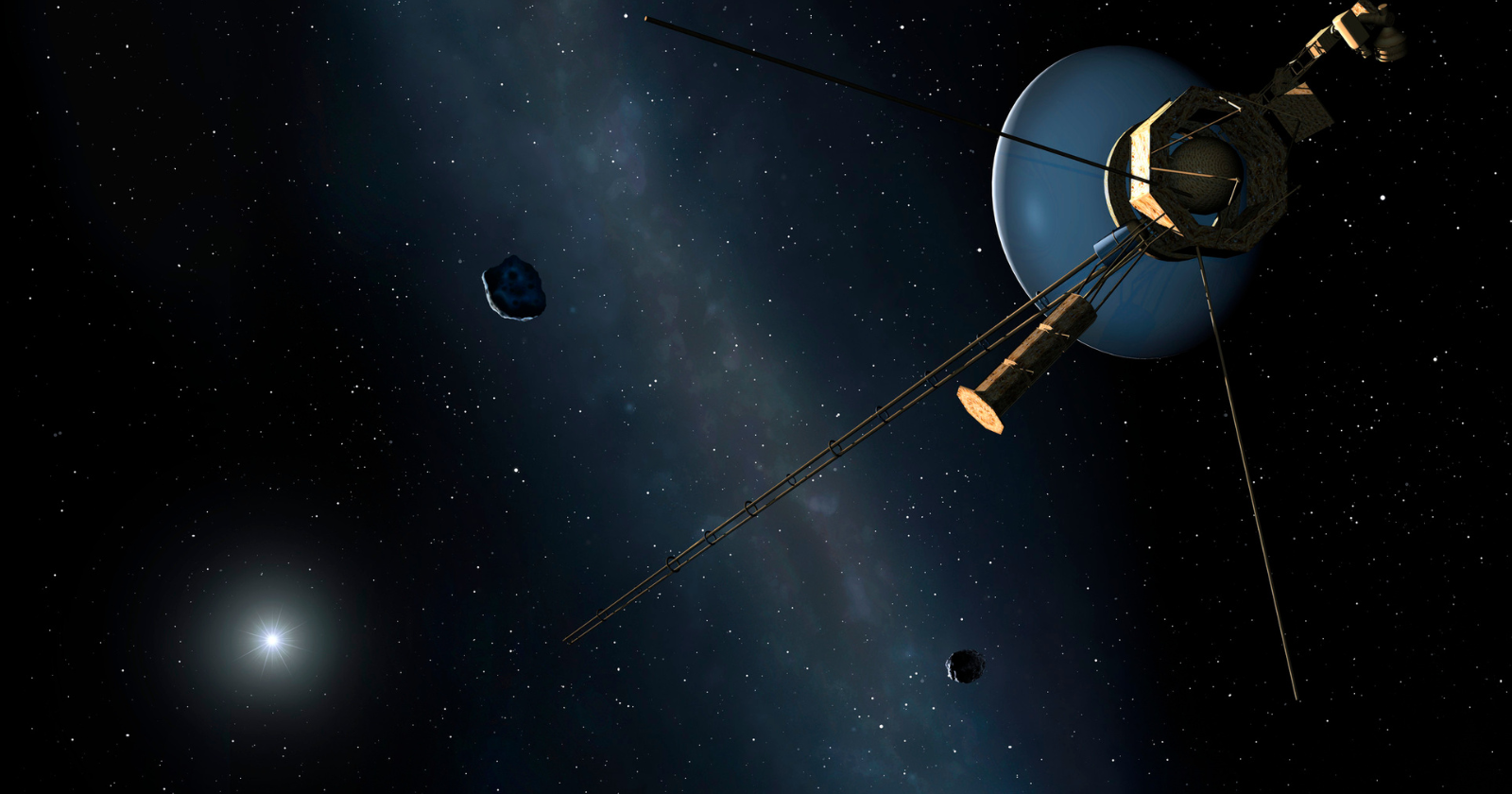
Picture something the size of a small car, thrown out into the dark at more than ten miles a second, with almost nothing to slow it down. Not for a day, not for a decade. Almost half a century of nonstop motion at a speed no ordinary bullet could match.
Now ask how far a thing like that would get. The answer is stranger than it sounds: it still has not traveled a single light-year from home. Not even close.
That thing is real. It is NASA’s Voyager 1, launched Sept. 5, 1977, and it is the farthest human-made object there is. The gap between how fast it moves and how little ground it has covered is, I think, the best thing Voyager can teach anyone about the size of space.
How fast is it actually going?
Fast enough that “faster than a speeding bullet” undersells it. NASA lists Voyager 1 at about 38,000 mph, roughly 17 kilometers every second relative to the Sun. A rifle round leaves the barrel at maybe half a mile a second. Voyager is doing more than ten miles a second and has been doing roughly that since the 1970s.
In the time it took you to read the above three sentences, the spacecraft has probably moved more than 100 miles.
It does not tire, slow at a red light, or refuel. It just keeps going at a pace that would carry it around the Earth in under forty minutes.
Why doesn’t it quickly slow down?
This is the part people find hard to believe, and it comes down to one fact: space is almost perfectly empty.
On Earth, everything slows because everything drags. Air pushes back, roads grip, water resists. Out past the planets there is essentially none of that. Gravity still changes Voyager’s motion, but there is almost no drag steadily bleeding away its speed.
No major propulsion burn is needed to keep it moving. Its last planetary encounter was the Saturn flyby on Nov. 12, 1980, and it has been coasting outward ever since, escaping at about 3.5 AU per year. Saturn’s gravity assist gave it its final big shove, and near-empty space lets it keep coasting. No fuel is needed to stay fast. Its hydrazine is used for attitude control, including keeping the antenna pointed home; its instruments are powered by radioisotope thermoelectric generators.
So why has it barely moved?
Here is the whole puzzle in one number. After nearly fifty years at that speed, Voyager 1 is now more than 170 astronomical units from Earth, over 25 billion kilometers away. That sounds enormous, and by any human measure it is. It crossed out of the Sun’s heliosphere and into interstellar space on Aug. 25, 2012, and it remains the most distant thing our species has ever made.
And yet a light-year, the distance light covers in a year, is about 9.46 trillion kilometers. Do the division and Voyager has covered roughly one three-hundred-and-seventieth of that.
There is a NASA comparison I keep coming back to because it makes the scale land. Shrink the distance from the Sun to the next star system down to a meter stick, and Voyager 1 would be sitting at about half a millimeter along it, having gone roughly 0.06% of the way. Its speed is genuinely staggering. Space is just far bigger than that speed.
How long would a real light-year take?
At its current pace, covering a single light-year would take Voyager 1 roughly 18,000 years. Not a typo. Eighteen thousand years to do what light does in twelve months.
The nearest star system, Alpha Centauri, is a little over four light-years out. If Voyager were aimed straight at it, which it is not, the same NASA book chapter estimates the crossing would take nearly 75,000 years. Its actual next brush with another star is closer in time. In the year 40,272 it will pass within 1.7 light-years of a star called AC +79 3888, in the constellation Ursa Minor. Every one of these numbers dwarfs the whole span of recorded human history.
What the mismatch really shows
What strikes me about all this is that Voyager is not a story about a slow spacecraft. It is extraordinarily fast by human standards, and it will keep being fast long after everyone reading this is gone. The gap between its speed and its distance is not a flaw in the machine. It is a measurement of the emptiness it is crossing.
The gaps between stars are so wide that even something moving ten miles a second, nonstop, for tens of thousands of years, barely dents them. The mission is still returning data from beyond the heliosphere, and as Linda Spilker of NASA’s Jet Propulsion Laboratory put it, “Today, as both Voyagers explore interstellar space, they are providing humanity with observations of uncharted territory.”
On Nov. 18, 2026, Voyager 1 is expected to reach a quiet milestone: becoming the first human-made object a full light-day from Earth. A light-day. After nearly fifty years. Light itself makes that crossing in 24 hours.
Hold those two facts next to each other and you get the truest sense of scale astronomy can offer: our farthest reach, measured against a distance light shrugs off in a day.