

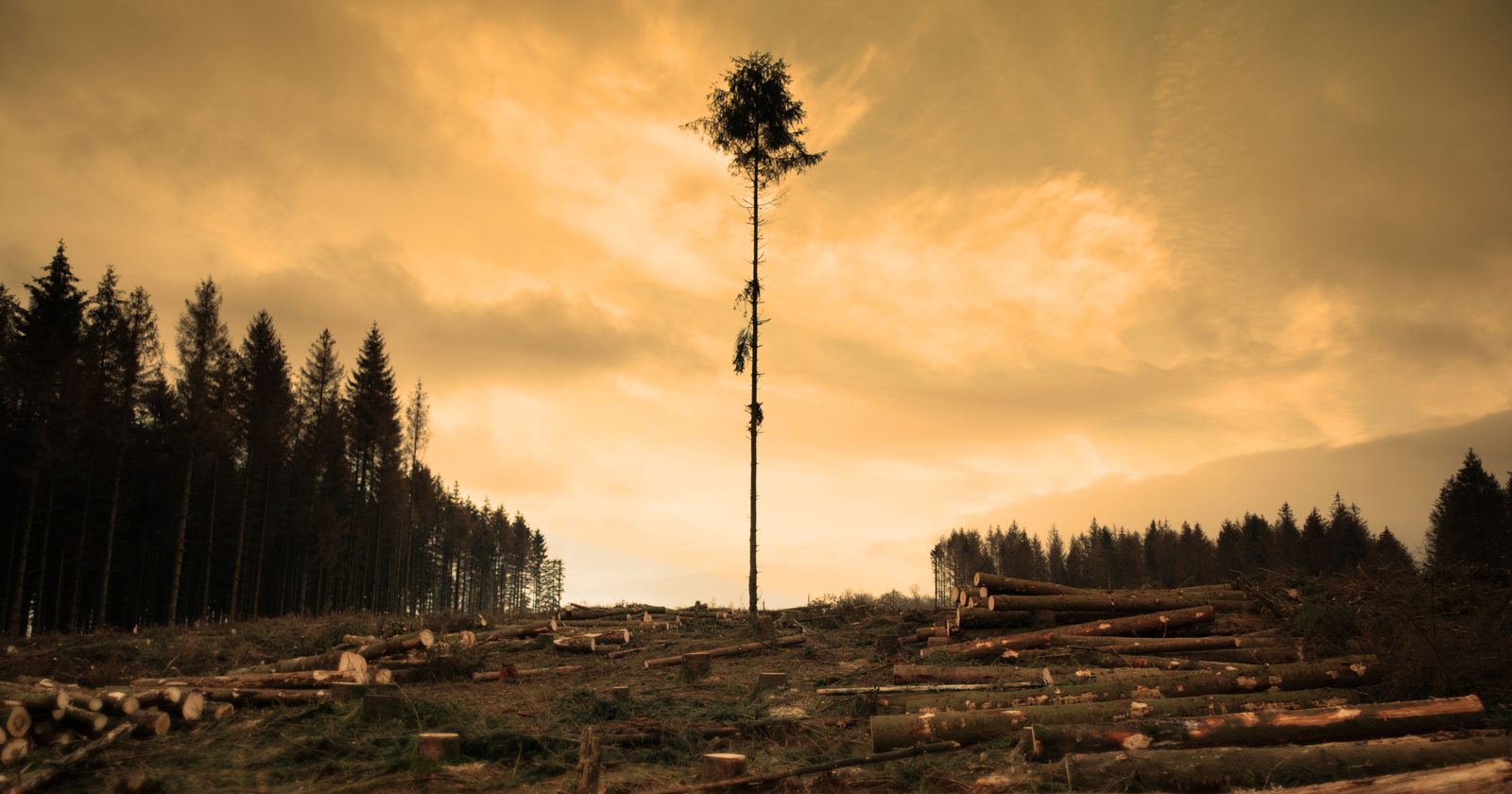
There’s a particular kind of tree we’ve all driven past without a second thought. It stands alone at the edge of a field or a cleared lot. Full crown, good colour, the last one left after the others came down. It reads as a survivor. Something about a single big tree holding its ground looks like strength, like self-sufficiency.
The catch is that a tree can look healthy long after real trouble has set in, especially underground where you can’t see it. The crown stays green for a while on stored resources and old growth. But the world the tree was built for has changed. Cut away its neighbours and you haven’t just given it more light and room. You may have cut the plumbing it shared with them, stripped the shelter that let it grow the shape it grew, and started to unravel a fungal web its roots spent decades building. The tree looks fine because trees are slow.
We’re not plant scientists, and this is reflection on published forestry research rather than a diagnosis of any particular tree. The studies below are specific findings from specific sites, not universal rules, and a green crown near you might mean nothing is wrong at all. If you’re worried about a real tree, a qualified arborist is the person to ask.
Still feeding the stump
Many trees fuse their roots together underground where they touch. Once fused, they can pass water and nutrients between each other. So when the saw comes through, the stump left behind doesn’t always die. Its living neighbours can keep it alive.
Researchers at Auckland University of Technology found this in a leafless kauri stump in New Zealand. They measured how sap moved in the stump and in the trees around it. The stump’s water movement ran opposite to its neighbours’, which is what you’d expect if grafted roots were feeding water into it. As co-author Sebastian Leuzinger put it: “It was odd, because even though the stump didn’t have any foliage, it was alive.”
For the stump, the arrangement makes sense. Leuzinger noted that “For the stump, the advantages are obvious— it would be dead without the grafts, because it doesn’t have any green tissue of its own.” Why the green trees keep spending on a leafless neighbour is more of an open question. One idea is that the shared root system may have been worth more to the whole group than any single trunk. Leuzinger has said the finding, if confirmed, would “completely revise our view of how forests work,” though that’s one researcher’s reading of his own work, not settled science.
This isn’t a quirk of one tree species. Researchers say fused roots have been seen in more than 150 tree species, with resources tending to flow from living stumps to their grafted neighbours. If our roadside survivor grew alongside its own kind and their roots had knitted together over the years, felling didn’t cleanly end that relationship. The survivor may still be tied to a stump it can’t see, half of a partnership whose other half is now just wood.
The shelter that left with the neighbour
The second stress is wind, and it’s less obvious than it sounds. A tree deep in a dense stand grows up sheltered. Its neighbours break the wind, so it never has much reason to build a thick, tapered trunk or a wide anchoring root system. It grows tall and slim, spending on height because height is what wins the race for light. That body works beautifully as long as the crowd stays.
Take the crowd away and the calculation changes overnight. Clearing raises the risk of trees blowing over, because it suddenly exposes trees that grew up protected. The tall, slim trees built for life in the middle are among the most vulnerable, since the taller a tree is relative to its width, the more likely it is to be damaged.
The lone survivor is carrying a body designed for a wind load it now has no help with. Given time, a tree can respond, laying down structural roots and thickening its stem where the strain falls. But that takes years, and the exposure is immediate. For a stretch after its neighbours go, the tree is running its old structure against new weather.
The frayed network underground
The third change is the one you’d never guess from the surface. Tree roots don’t work alone. They team up with fungi in the soil, trading sugars for water and minerals in a relationship both sides depend on. Those fungi live off the carbon that living trees pass down through their roots. Cut a forest into pieces and you don’t just remove trees, you create edges, and the soil life at an edge is a different thing from the soil life deep inside.
Boston University researchers tested soil DNA across forest edges and interiors in Massachusetts and reported the shift in PNAS. Lead author Chikae Tatsumi summed it up: “We found that urbanization and forest edge effects break down the mutualism between fungi and trees.” Senior author Jennifer Bhatnagar goes further, suggesting that “that level of disturbance is so disruptive to the belowground community that it can basically switch from a beneficial community for plants and animals to a very negative one”.
As for scale, over 25 percent of the land in the Northeast United States is close enough to a boundary to count as forest edge, so this is not a rare condition.
A tree that spent its life buried inside a stand had its roots plugged into that interior fungal community. Isolate it, leave it on a fresh edge, and the partnership it relied on may start to fray beneath it while the crown above still looks entirely well.
How we’d read the lone tree now
None of this means the solitary tree is doomed. Trees adapt, edges settle, and plenty of isolated trees go on to live long, wide-crowned lives that a crowded forest would never have allowed. Our read is narrower than doom. A newly isolated tree is one whose visible condition is running ahead of its underground reality. The green is real, but it’s partly a lag, not a verdict.