

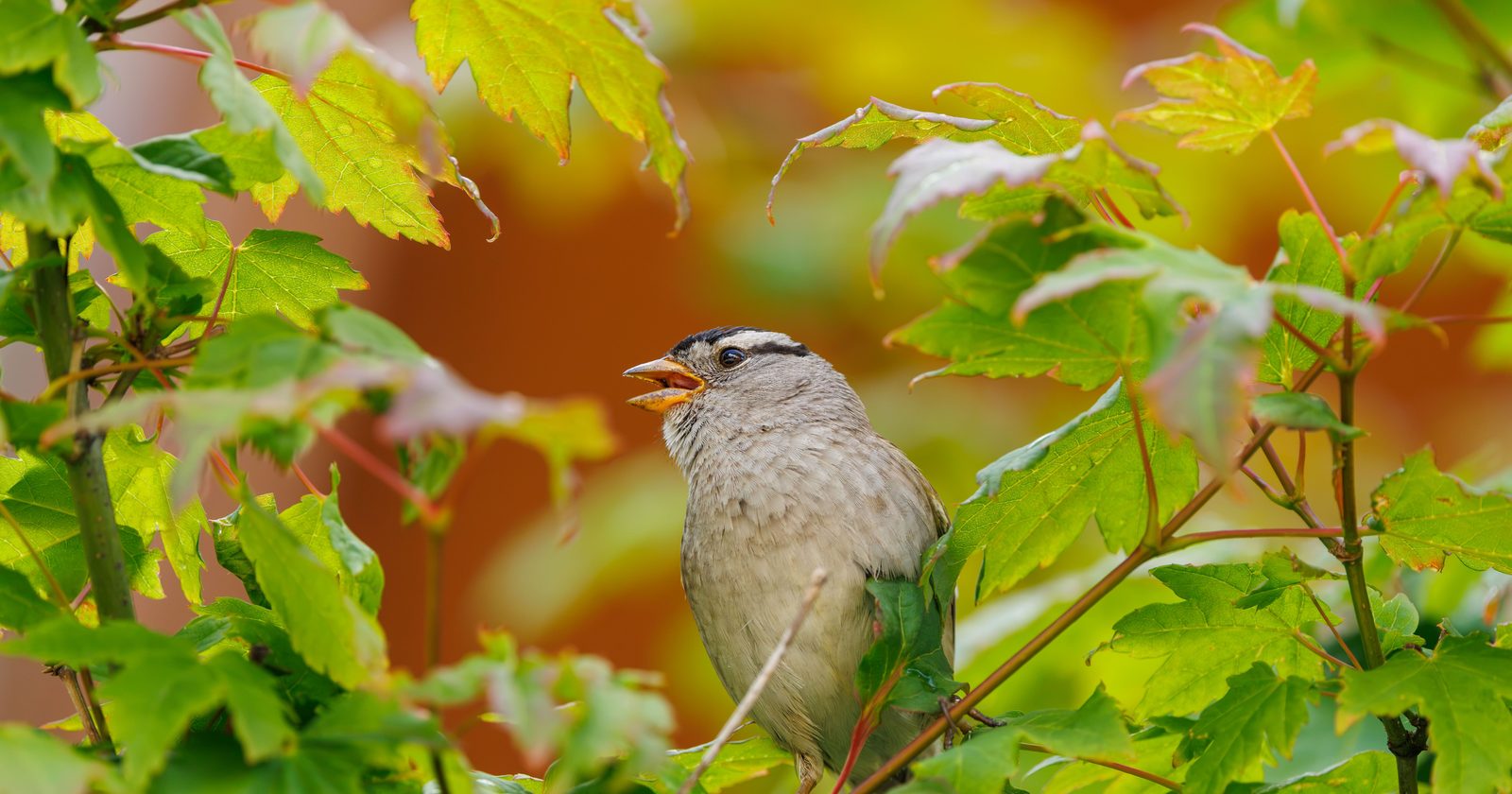
In the spring of 2020, San Francisco went quiet. The parks were closed, the roads through them empty, and the low mechanical hum that had covered the city for decades drained away. Into that gap, a small gray-and-brown bird with a bold black-and-white striped head began to sing. It sang more softly than its kind had in years. And that quieter song reached other birds much further away than a louder one would have.
That is the heart of one of the most talked-about pieces of pandemic science, and it only makes sense if you picture two versions of the same city: the loud one the sparrows had adapted to, and the sudden quiet one that let them change their tune.
The loud city the sparrows had learned to shout over
White-crowned sparrows have sung in and around San Francisco for a very long time, and in recent history they have been singing over us. As traffic and other city noise built up through the twentieth century, the birds faced a basic problem: a rival or a mate couldn’t pick out their song from the background rumble. Low engine noise is especially good at drowning out low song.
The same research group that ran the 2020 study had already shown how the birds coped. In earlier work with George Mason’s David Luther, they found that city sparrows shifted their songs to a higher pitch to be heard above the city. That narrowed the range of notes they used and cost them some vocal quality. It worked, but it made the songs thinner and less impressive.
There is a plain trade-off underneath all this. Elizabeth Derryberry, a behavioral ecologist at the University of Tennessee, Knoxville who has studied these birds for years, put it bluntly to National Geographic: “You can’t yell far and have a lot of information.” Shouting to be heard costs you both distance and detail. For decades, the city birds had been paying that cost.
The spring the noise emptied out
Then the shelter-in-place orders arrived and the traffic vanished. On the Golden Gate Bridge, vehicle crossings during the spring 2020 shutdown fell to a level not seen since 1954. Across the region, noise levels dropped by about half after the statewide order took hold. In sound terms, the city had rewound half a century in a matter of weeks.
Derryberry had been studying these sparrows for close to two decades and had recordings going back years. She recognized the shutdown for what it was: an experiment no one could have set up on purpose. Her colleague Jennifer Phillips, then at California Polytechnic State University, went out and recorded sparrows at the same city and rural sites in April and May 2020, biking into closed parks to reach them. The team then compared the new songs with the old ones.
They expected a small change. As Derryberry told CBC: “We suspected that we would hear them change their song in some ways, that they would get a little quieter as the noise levels dropped.” A little quieter. That was the prediction.
What actually changed in the song
The birds did far more than ease off a notch. The team’s paper, “Singing in a silent spring,” published in Science in September 2020, reported that city male sparrows sang almost a third softer on average once the noise fell. Free of the need to climb over traffic, they also dropped back to lower notes, widening their range and bringing back the fuller, richer songs the loud years had squeezed out.
The surprise was what the softer songs could do. Because the background noise had fallen even faster than the birds’ own volume, each song met far less interference on its way through the air. Derryberry described the result to Smithsonian: “We were shocked to find that, even though they’re softer, their songs are transmitting at twice the distance, almost three times.”
The paradox, and why people thought the birds got louder
A quieter singer heard from further away sounds like a contradiction. It isn’t. Loudness and reach are not the same thing when there is a wall of noise in between. Take the wall away and a soft song travels; leave it up and even a loud one gets swallowed within a few meters. That is the earlier trade-off running in reverse.
It also explains a common impression from that spring, when many people were sure their neighborhoods had suddenly filled with louder, more numerous birds. As Derryberry told CBC: “The birds may sound louder, but in fact, they’re much quieter.” If each song reaches twice as far, it fills a larger area, so any given listener is now within earshot of four times more birds than usual. Fewer decibels, more sparrows you can hear.
For the birds, the payoff is real. A song that carries further and holds more information is a better signal to a mate or a rival. Derryberry sees an upside for the humans listening too. As she told CBC: “That communication distance is doubled, which is great for the birds and, I think, great for us too.”
What we take from an experiment nobody could have staged
This is one study, built on one unrepeatable spring in one bird population, so we read it as a striking clue rather than a settled rule about how all wildlife responds when we go quiet. What it suggests, fairly cleanly, is that some of the harm cities do to birdsong may not be permanent. Given a genuinely quieter world, at least these sparrows recovered a fuller song within weeks, not generations.
That points at a loss most of us never think to notice. Lauryn Benedict, a behavioral ecologist at the University of Northern Colorado who was not part of the study, argues that our everyday noise is probably costing us something. As she told Popular Science: “We’re losing some of the beauty and diversity in birdsong by creating so much background noise that they’re forced to scream over it.” The pandemic quiet handed some of that beauty back, briefly.