

Open your eyes in a swimming pool and everything goes blurry. Most of us assume that’s simply what human eyes do underwater.
In 1999, a Swedish vision scientist watched a group of children who didn’t seem to have that problem.
Children of the sea
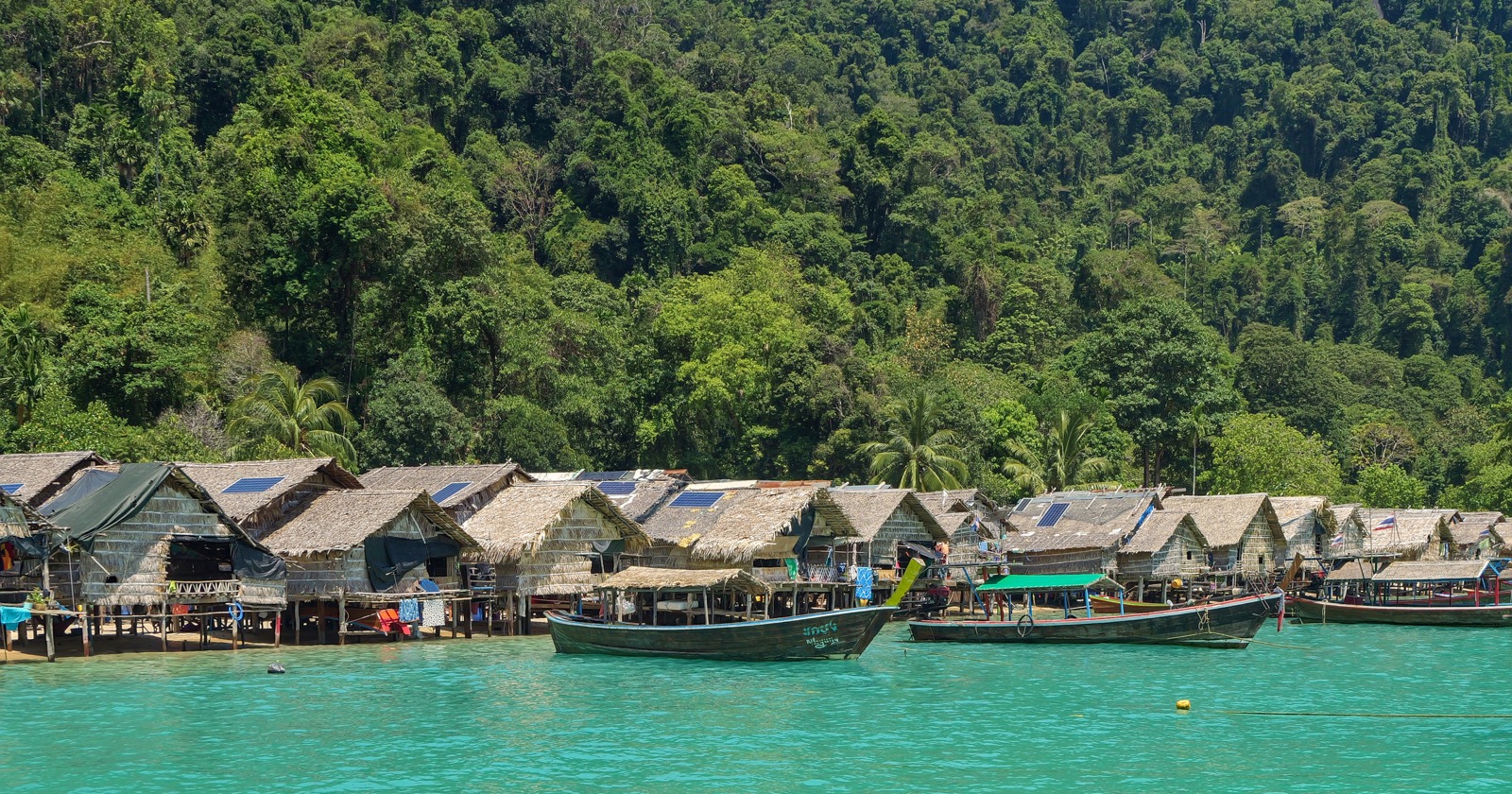
The Moken live along the Andaman coast of Thailand and Myanmar, and until recently many of them spent most of the year on boats. The families on Thailand’s Surin Islands lived in houses on stilts, and at high tide, according to Lund University, their children dived straight from them, down three or four metres, with no mask or goggles. They came back up with clams, shells and sea cucumbers.
The scientist was Anna Gislén, of Lund University. She has said the children were picking up food lying metres below anything she could see herself, and kept their eyes wide open the whole way down. Were they seeing something she couldn’t, or just good at finding things by feel?
First, why the rest of us see so badly underwater. On land, most of the eye’s focusing is done not by the lens but by the curved front of the cornea, where light passes from air into tissue. Water and the cornea bend light by almost the same amount, so once your face goes under, that surface stops working.
The eye loses about two-thirds of its focusing power. A diving mask fixes this by trapping a pocket of air in front of the cornea. The Moken children didn’t have one.
Squinting from the inside
In a 2003 study in Current Biology, Gislén’s team tested six Moken children aged 8 to 13 and 28 European children aged 7 to 14 who were on holiday nearby. Each child put their face in the water against a support that held their eyes at a fixed distance from a panel of stripes, and said whether the stripes ran up and down or side to side. The stripes got finer until they couldn’t tell.
The Moken children could make out stripes more than twice as fine: 6.06 cycles per degree, against 2.95 for the Europeans. (Cycles per degree is the standard way to measure how fine a pattern the eye can pick apart.)
On land, though, the two groups tested the same. Their corneas had the same curvature, and their eyes had the same basic focus and the same range of focusing. Whatever the Moken children were doing underwater, they were doing it with ordinary eyes.
What they did was squint from the inside. In dim conditions a pupil normally widens to let in more light. Underwater, the Moken children’s pupils did the opposite, shrinking to about 1.96 millimetres while the European children’s stayed at about 2.5. A smaller pupil makes each blurred point on the retina smaller, so the image is less smeared. By the authors’ calculation, that explains a large part of the advantage.
The rest came from accommodation, the muscle work that reshapes the lens when you read small print up close. The Moken children were doing it as hard as a human eye can, at about 15 to 16 dioptres.
Can it be taught?
The 2003 paper left three possibilities open: practice, genes, or a side effect of the diving reflex. Gislén’s later work ruled out the reflex: untrained European children put their faces in the water too, and their pupils didn’t narrow. That left learning or genes. So she tried teaching it.
The training study, published in Vision Research in 2006, worked with four girls in Lund, one aged 13 and three aged 9. Over 33 days they had 11 sessions in an indoor pool, diving down to judge stripes at the edge of what they could see, hearing how they did, and trying again.
After a month, their underwater acuity had risen from 2.63 to 3.35 cycles per degree, a 27 percent gain. Then the training stopped. When they were retested on day 149, without having been underwater in between, they had climbed to 4.14, 57 percent above where they started.
Not every girl learned at the same pace. One, called subject D in the paper, had barely improved by day 33. By day 149 she had almost caught up with the others.
The real comparison came eight months after the last session, in an outdoor pool in bright sunshine. The girls averaged 8.01 cycles per degree, against the Moken children’s 6.06, and their pupils narrowed to about 1.9 millimetres. The difference wasn’t statistically significant. In the authors’ words, the trained children “equaled or surpassed” the Moken.
What the studies don’t say
This is where the popular version tends to run ahead of the papers.
A widely shared 2016 BBC Future feature says Gislén trained European children on holiday in Thailand and children in Sweden, and that both groups matched the Moken after a month. The paper describes something narrower. The European children in Thailand were only given a contrast test on land. Only four girls were trained, all in Lund. And they matched the Moken eight months after their month of training, not at the end of it.
Even that match comes with caveats the authors raise themselves. The final test was run in much brighter light than the training, and the Moken figure came from a separate study three years earlier, not a side-by-side test. The girls may also have done well partly because they had spent so long looking at exactly this kind of blurred stripe.
And despite what some articles say, the Moken don’t see “like dolphins”. When their eyes were measured on land, nothing about them stood out.
Nor does the training result settle the learned-or-genetic question for good. It shows the skill can be learned, which argues against a purely genetic explanation, but it doesn’t rule out a genetic contribution. Gislén’s thesis calls the skill “most likely learned”, and goes no further. Both studies also tested only children. The lens stiffens with age, and neither study trained an adult.
The childhood it depends on
If the skill is learned, it depends on the childhood that teaches it. That childhood is changing.
In December 2004, the Indian Ocean tsunami destroyed much of the Moken homeland on the Surin Islands. Park authorities then merged the two Surin Moken villages into one, at Ao Bon Yai on the southern island, inside the national park. Life there has become tied more to the land, and to the tourists who visit the park, than to months at sea.
The BBC reported that in unpublished follow-up work, the Moken children from the original study, by then in their late teens, could still see clearly underwater. Gislén was less hopeful about the ones who came after. “They just don’t spend as much time in the sea anymore,” she said, “so I doubt that any of the children that grow up these days in the tribe have this extraordinary vision.”
Whether any Moken children today still have it hasn’t been published.
