
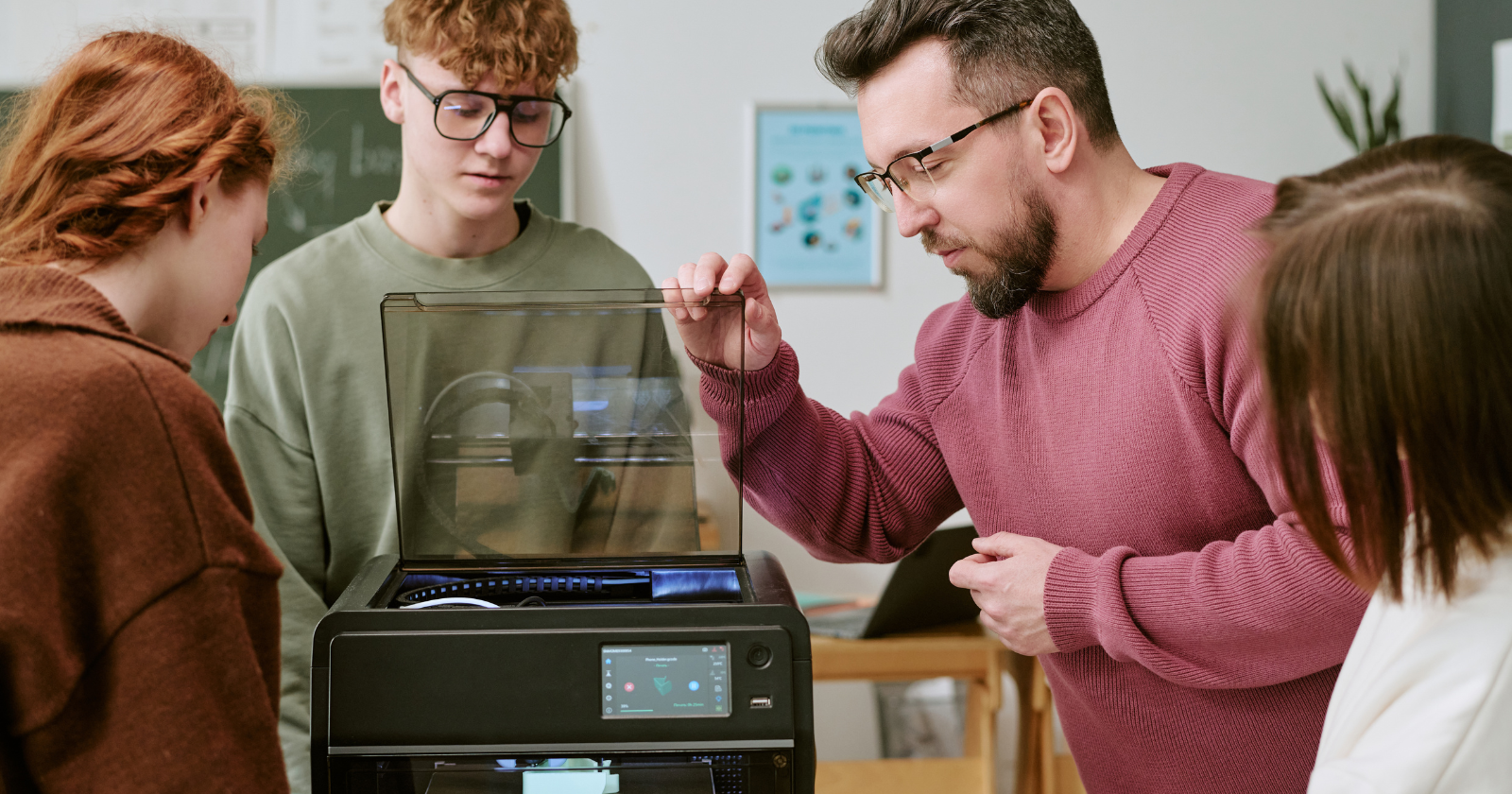
Benjamin Davis, a 16-year-old sophomore at Bishop Feehan High School in Attleboro, Massachusetts, spent much of the past two school years building a machine in his family’s home in Wrentham that turns plastic waste into fresh filament for 3D printers. In May 2025, the project carried him to the 75th Regeneron International Science and Engineering Fair in Columbus, Ohio, where he became the first Bishop Feehan student to win a national ISEF award.
Davis entered a project titled “Pultrusion and Extrusion to Recycle Filament,” which placed first in the Engineering Technology: Statics and Dynamics category before judges selected it for one of the fair’s two Regeneron Young Scientist Awards, each worth $75,000. That prize is the fair’s second-highest individual honor, after the $100,000 George D. Yancopoulos Innovator Award, and according to the fair’s own grand awards announcement, it went to only two students among the nearly 1,700 who competed in 2025.
How pultrusion and extrusion combine to remake old filament
The device is a desktop-scale recycling system that Davis describes as combining electrical, mechanical and chemical engineering into one process. Extrusion, the more familiar half of the design, melts shredded or ground plastic and pushes it through a heated die to form a continuous strand of filament. Davis paired that step with pultrusion, a technique more commonly associated with pulling continuous fiber through resin to make rigid composite parts, in an attempt to produce filament that holds its shape and strength better than output from simpler home recyclers.
In a Society for Science interview published after the fair, Davis said his system runs roughly 45 percent more efficiently than comparable home recycling machines while producing higher-quality filament, and that it costs about 90 percent less to build than commercial recycling units aimed at makerspaces and small manufacturers. He also designed the interface to be usable by people with no engineering background, a detail he and his school have both pointed to as central to the project’s practical appeal.
Targeting the waste that home 3D printing leaves behind
The problem Davis set out to address is specific to additive manufacturing rather than plastic waste in general. Regeneron ISEF’s announcement cites a figure Davis used in his research: up to 67 percent of the filament used in a typical 3D printing project can end up as waste, in the form of failed prints, support structures, and the purge material printers extrude before a job to clear old filament from the nozzle. His machine is built to take in that purge waste alongside discarded PET plastic, such as bottle material, and convert both into filament that can go back into a printer rather than into the trash.
It’s a tool scaled to the volume and material types generated inside a single workshop, classroom or small print farm — a considerably narrower problem than the plastic waste crisis covered elsewhere on this site. Davis has not claimed otherwise.
From a home workshop to the world’s largest pre-college science fair
Regeneron ISEF is run by the Society for Science and describes itself as the largest international pre-college science competition. The 2025 edition drew entrants from 49 U.S. states and more than 60 countries, regions and territories, competing for a combined prize pool exceeding $9 million, according to the fair’s official media kit. Davis’s project was one of nearly 1,700 evaluated by teams of judges across dozens of category groupings before category winners were considered for the fair’s grand awards, including the Young Scientist Award he received.
The judging criteria the Society for Science publishes for Regeneron ISEF center on creativity, innovative thinking and the rigor of the scientific or engineering process behind a project. Independent lab testing of a device’s performance claims isn’t part of that evaluation. Davis’s efficiency and cost figures come from his own research. They have not been through third-party verification, certification testing, or peer review in an engineering journal.
What Davis says comes next for the design
Davis told the Society for Science he is already working on a successor machine capable of producing high-temperature composite filaments, a step up from the recycled PET and purge-waste filament his award-winning prototype handles. He also said he plans to keep refining what he calls his extrusion-pultrusion machine specifically to make it more efficient and, eventually, commercially viable — language that signals the current version is still a prototype.
Of the fair itself, Davis said simply that it was “probably one of the best weeks of my life,” a reaction echoed by Bishop Feehan, where president Tim Sullivan credited the win to Davis’s talent and where science teacher Kelly Gomez mentored the project. The school’s own announcement frames the award as a first for its science program, a distinction separate from, and smaller in scope than, the national recognition Davis received from Regeneron ISEF itself.
A prize-winning prototype, not a plastic-waste fix
The gap between a $75,000 student engineering award and a deployed recycling solution is worth keeping in view. Davis’s machine has demonstrated, in a competition setting, that a homemade device can process 3D-printing waste into usable filament more cheaply and, by his own measurements, more efficiently than some existing home recyclers. It has not been through the durability testing, safety certification, manufacturing scale-up, or independent performance validation that would let it move into classrooms, makerspaces or small businesses as an off-the-shelf product.
The award confirms something narrower, and still notable: a high school sophomore working largely on his own identified a real inefficiency in a fast-growing hobby and industrial practice, built working hardware around it, and persuaded a national panel of judges that his engineering process held up. Whether that prototype becomes a commercial device depends on the same steps that stand between most award-winning student inventions and store shelves, a distinction Davis’s own comments about future versions suggest he understands.