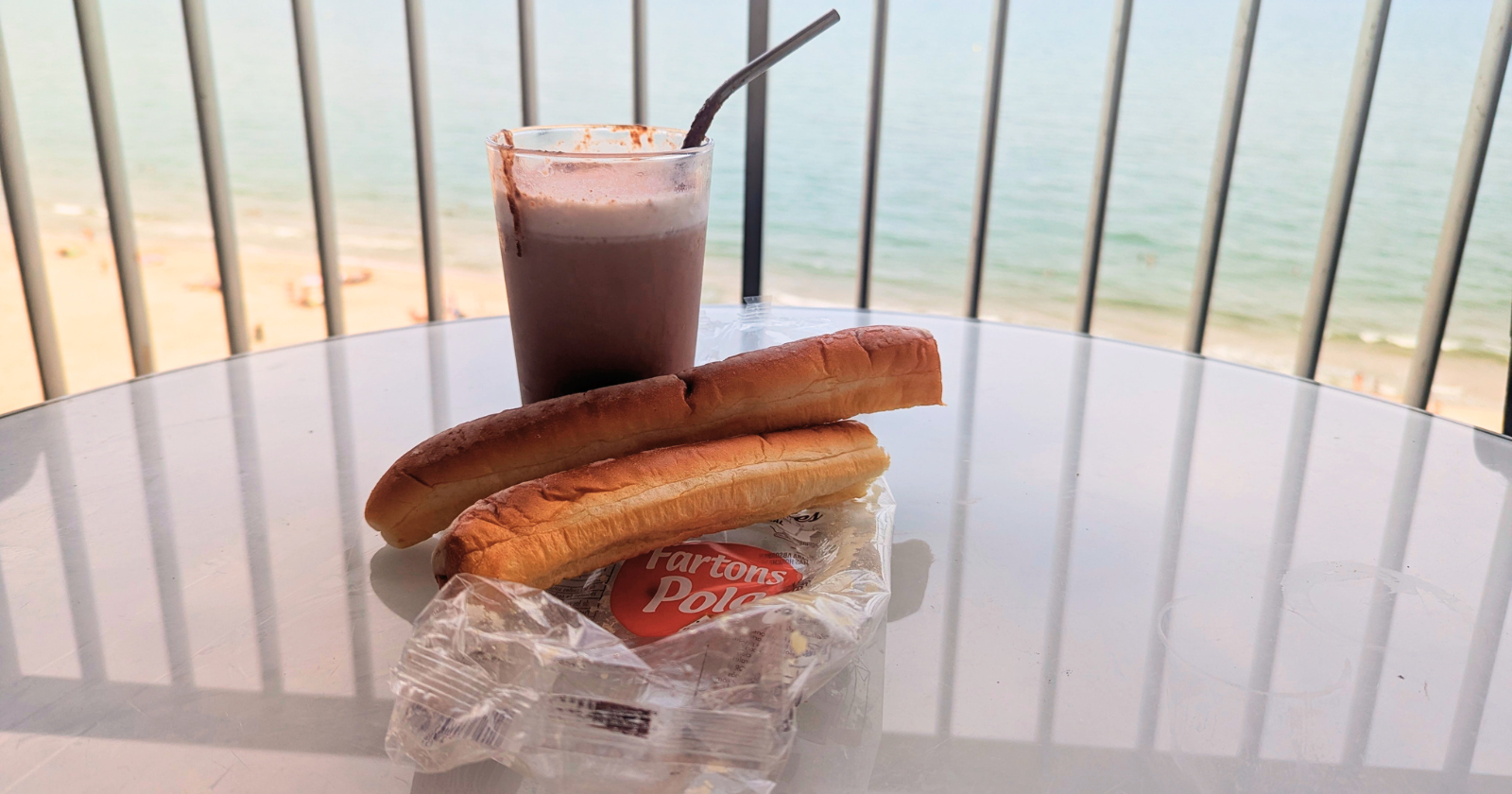
Ali orders horchata and fartons without checking the price or hesitating over the menu. We’re in the small seaside village of Les Palmeres, her home, and the woman behind the counter seems to already know what she wants before she says it.
I ask if she’s going to feel bad about it later — the sugar, the calories, whatever silent tally people keep about dessert.
She shrugs.
This one doesn’t need defending, she tells me.
Horchata with fartons isn’t a random sweet that happened to be nearby. It’s Valencia. It’s her childhood. It’s a memory she’s choosing on purpose, not a snack she’s settling for. If someone offered her an average dessert an hour later — perfectly fine, entirely forgettable — she’d probably pass.
Then she says the thing that stays with me for the rest of the trip: she thinks about people in almost exactly the same way.
The difference between wanting something and just accepting it
Ali doesn’t avoid dessert. She doesn’t perform any of the usual guilt rituals around it either — no promises to run it off, no announcing that she’s “being bad.” What she does is quieter and more specific: she decides, in advance, whether something is actually worth the choice.
Most of what we eat isn’t chosen so much as encountered. Someone brings pastries into the office. A dessert menu gets passed around the table. We eat it because declining feels like more effort than eating, not because we wanted it before it arrived. It’s fine. It’s also rarely memorable — ask yourself what you ate at your desk last Tuesday and see how far you get.
Horchata with fartons — cold tiger-nut milk with long, sugar-glazed pastries built specifically for dunking — belongs to the other category: the kind of pleasure you can still taste hours later, because it was never really about the sugar.
None of this means every treat has to mean something. Sometimes ice cream is just ice cream, eaten on a hot day for no better reason than the heat, and that’s completely fine too.
Ali’s theory isn’t that pleasure has to be sacred. It’s narrower than that and more useful:
Pleasure is worth choosing, but not every available pleasure is worth the choice.
Ten friendships, not fifty
A couple of days later, in a different conversation, Ali brings up people.
She would rather keep ten friendships that still have something moving through them than fifty relationships she maintains mostly out of politeness — answering because ignoring would be rude, meeting up because too much time has passed to cancel now, trading updates about jobs and partners and new cities without feeling any closer once the conversation ends.
The anthropologist Robin Dunbar has spent three decades arguing that human social capacity is layered rather than flat: something like 150 people we can maintain any real relationship with at all, a smaller circle of good friends inside that, and only a handful we’re ever truly close to. Whatever the exact numbers, the shape of his argument lines up with Ali’s instinct almost exactly — attention is finite, and spreading it evenly across everyone we’ve ever met leaves very little for anyone in particular.
Eating something meaningful on purpose and eating something average out of habit are not the same experience, even when they look alike from the outside. Relationships split along the same line. Some continue because they still have substance — a long silence doesn’t erase the ease between you, and picking the conversation back up doesn’t require performing a closeness you don’t currently feel. Others survive only because ending them, or even letting them go quiet, feels ruder than keeping them limping along.
People are not desserts
Ali knows this comparison only goes so far, and so do I.
People are obviously not desserts, and friendships cannot be divided into “good” and “bad” as easily as food.
Still, the comparison reveals something important about how we use our time.
Many of us continue relationships because they once mattered. We reply to messages because we feel guilty. We meet people because enough time has passed and it seems rude not to. We exchange updates about work, travel, relationships, and mutual acquaintances without feeling genuinely closer afterwards.
Nothing is necessarily wrong with these conversations. They may even be pleasant.
But pleasant is not always meaningful.
As we grow older, maintaining every relationship becomes impossible. There are only so many messages we can answer thoughtfully, so many people we can regularly meet, and so much emotional energy we can distribute.
When we try to keep everybody, we may end up giving very little of ourselves to anyone.
We answer late. We postpone plans. We feel guilty for not being more available. Even the people we love most may receive a tired version of our attention because we are trying to preserve too many connections at once.
Ali’s theory does not suggest that we should suddenly remove people from our lives. It is not about creating a strict social hierarchy or deciding that some people are not “worth it.”
It is about noticing the difference between connection and maintenance.
Some relationships continue because both people remain curious about each other. Even after a long silence, the conversation has depth. You can return without performing closeness because the closeness is still there.
Other relationships survive mostly through habit.
We keep them active because letting them become distant feels uncomfortable, even when neither person is receiving much from the connection.
Selectivity is not cruelty
There’s something uncomfortable about admitting we prefer some relationships to others. We’re raised to be open, friendly, available to anyone who wants to talk. Being selective can sound arrogant, as if we’ve decided certain people or conversations are beneath us.
But attention is limited, whether we admit it or not. Choosing where to place it doesn’t mean believing some people are worth more as human beings. It means recognizing that not everyone becomes equally important in one particular life — and that two kind, interesting people can simply fail to build a meaningful connection with each other, without either of them being at fault.
Selectivity can also mean accepting that friendships take different shapes.
Not every connection needs frequent contact.
Not every old friendship needs reviving.
Not every pleasant acquaintance has to become intimate.
Sometimes respecting a relationship means letting it stay what it naturally is, instead of forcing it closer than it wants to go.
What an average “yes” actually costs
Ali’s theory made me think beyond sweets and friendships.
We often treat opportunities in the same way. We accept projects that are mildly interesting, plans we do not particularly want, and invitations we are afraid to decline.
Individually, none of these choices feels significant. Together, they occupy a large part of our life.
The real cost of an average choice is not always the choice itself. It is the space it takes away from something we might have cared about more.
An average dessert may reduce our appetite for the one we truly wanted.
An average conversation may use the only free evening we could have spent with a close friend—or alone.
An acceptable project may leave us too exhausted to work on the idea that genuinely excites us.
This does not mean life should consist only of extraordinary experiences. Much of life is ordinary, and ordinary moments can become meaningful through repetition, familiarity, and care.
The problem is not ordinariness.
The problem is automatic acceptance.
There is a difference between choosing a quiet, ordinary experience because it gives us comfort and accepting something we barely want because saying no requires more awareness.
What are your fartons?
Since hearing Ali’s theory, I have started wondering which experiences in my own life are equivalent to horchata with fartons.
Which things do I choose because I genuinely love them, not because they are available?
Which relationships leave me feeling more like myself after the conversation?
Which opportunities would I still want if nobody else knew I had accepted them?
And which parts of my life am I maintaining mainly because I have not stopped to ask whether I still want them?
Perhaps growing older is partly about learning that we cannot taste everything, know everyone deeply, accept every opportunity, and preserve every previous version of our life.
At some point we have to get selective — not because pleasure is dangerous or people are disposable, but because our appetite, our time, and our attention were never unlimited to begin with.
Ali will eat the fartons. She just wants to make sure they’re the ones she actually loves.