
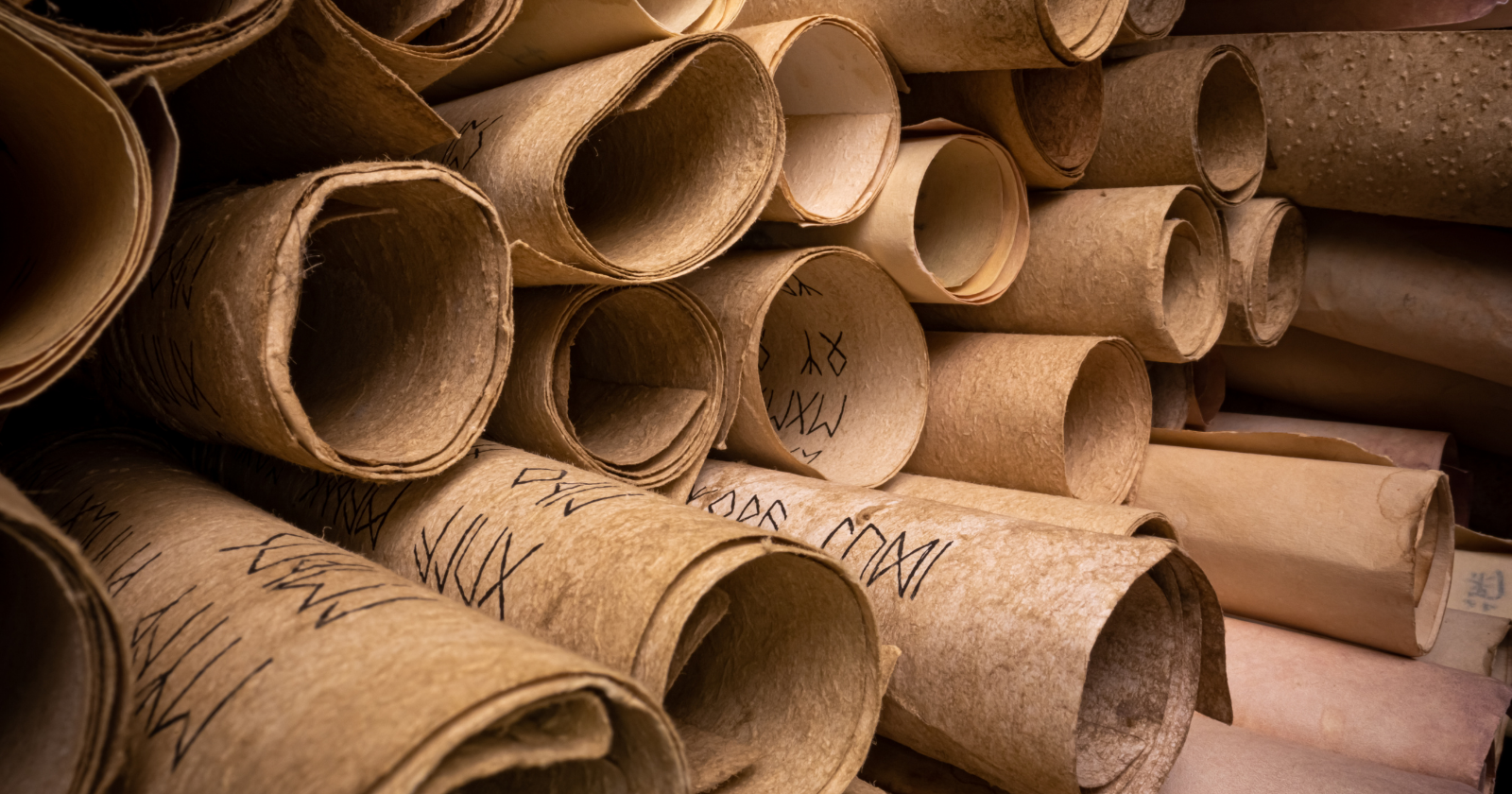
In the 1750s, workers digging through volcanic rock at Herculaneum pulled hundreds of carbonised papyrus rolls out of what had once been a private library. Antonio Piaggio and the scholars who followed him spent decades trying to get inside them. Some scrolls were sliced in half. Others were coated in mercury vapour or peeled apart with knives, unravelling into fragments or crumbling to black dust. Piaggio’s own unrolling machine saved some texts by teasing scrolls open a sliver at a time, but it destroyed others in the process. For roughly two and a half centuries after the scrolls resurfaced in the 1750s, reading one of them meant risking its physical destruction.
That changed on 25 June 2026, when the Vesuvius Challenge announced that a scroll known as PHerc. 1667 had been read from end to end without being unrolled, cut or touched at all.
What was actually achieved
PHerc. 1667 was scanned intact, still rolled, using X-ray imaging from the European Synchrotron Radiation Facility in Grenoble. Machine-learning models trained to pick out the faint trace of carbon ink against carbonised papyrus then mapped its surfaces in the scan data and rendered them as flat, readable pages, a process the Vesuvius Challenge calls virtual unwrapping.
According to the team, the result was a continuous text rather than isolated words or patches. The scroll was identified as a philosophical treatise on ethics, written in Greek and dated on handwriting grounds to the second or third century BCE. It discusses human nature, impulse and moral progress, and refers to Aristocreon, a nephew of the Stoic philosopher Chrysippus. Researchers, including papyrologist Federica Nicolardi, have suggested Chrysippus himself may be the author, though the title and attribution were lost with the rest of the scroll’s opening and the team has been careful to describe this as a working hypothesis rather than a settled fact, as Smithsonian Magazine reported.
This is a different order of result from the Vesuvius Challenge’s much-publicised 2023 Grand Prize. That earlier milestone, worth $700,000, recovered around 2,000 characters from patches of a different scroll, alongside a separate $40,000 award for the first single word recovered (“purple”) and a $60,000 prize for identifying a scroll’s title. Those were real firsts in their own right, but they were fragments. PHerc. 1667 is, according to the Vesuvius Challenge, the first time a Herculaneum scroll has been read in full, from its outer wrap to its innermost windings.
A second scroll, PHerc. 139, also yielded a title and author line during the same round of work: Philodemus, On Gods, Book 8, which tells scholars the treatise ran to at least eight books.
Who did it
The reading is credited to the Vesuvius Challenge, a crowdsourced computer-vision competition founded in 2023 by tech entrepreneurs Nat Friedman and Daniel Gross, building on more than a decade of scanning and software work by University of Kentucky computer scientist Brent Seales and his EduceLab. Seales had spent years arguing that ink invisible to the eye could still be detected inside a sealed scroll by its subtle effect on X-ray scans; the competition opened that idea to thousands of outside contributors with prize money attached.
A number of the people credited on PHerc. 1667 started out as contestants rather than professional papyrologists or computer scientists. Giorgio Angelotti, who led the project team, and Sean Johnson, now on the Vesuvius Challenge’s technical staff, are both described by the organisers as former contestants who worked their way into the core effort. The papyrology side of the project was led by Nicolardi and Claudio Vergara, working with the Biblioteca Nazionale di Napoli, which holds the physical scrolls, and with classicist Thomas Coward at the University of Bristol.
“For nearly two millennia, many of these texts have been physically preserved but intellectually inaccessible,” Seales said in a statement carried by the University of Kentucky. “Today, we are finally able to read them.” Nicolardi called it “the return of a philosophical voice.”
Why a full scroll is a different problem to a few lines
Getting a handful of characters out of a scan is a segmentation problem: find a patch of surface, follow it, spot the ink. Getting an entire scroll requires that same process to hold up continuously across a spiral that can run many metres when unrolled, through layers that have collapsed, cracked and fused against each other inside the carbonised roll. A single gap or misread surface in the middle of a scroll can break the text that follows it. The Vesuvius Challenge’s approach combined higher-resolution scanning with machine-learning segmentation tools built up over three years of competition entries, refined by successive contestants, not a single research group.
The team also used the improved imaging to check its own earlier work. A higher-resolution scan of PHerc. Paris 4, the scroll behind the 2023 Grand Prize, reproduced that reading “one-to-one” against direct ink visibility in the new 3D X-ray data, according to the Vesuvius Challenge. That cross-check matters for a field where a wrong guess dressed up as a reading could otherwise go unchallenged for years.
Roughly 800 to 1,100 scrolls survive from the Herculaneum library, along with an unknown number still buried at the site. Most remain unopened and unscanned. The Vesuvius Challenge has said it is now offering $1 million to the first team that reads a second complete scroll within a year, alongside smaller prizes for specific technical steps along the way.
What the library might still hold
The villa where the scrolls were found is generally attributed to the family of Julius Caesar’s father-in-law, and the collection recovered so far leans heavily toward Epicurean philosophy, much of it copied out by the philosopher Philodemus or his circle. Whether the deeper, unopened parts of the library hold lost works of history, drama or other philosophy that ancient writers describe but that have not survived elsewhere is not yet known, and the Vesuvius Challenge has not claimed otherwise. What has changed with PHerc. 1667 is narrower and more concrete: a method that can take a scroll too fragile to touch and return its text in full, without a blade or a vapour bath anywhere near it.
Federica Nicolardi’s team is now working through the remaining unread portions of PHerc. 172, another scroll scanned in the same batch, with partial results already published on the Vesuvius Challenge site.