

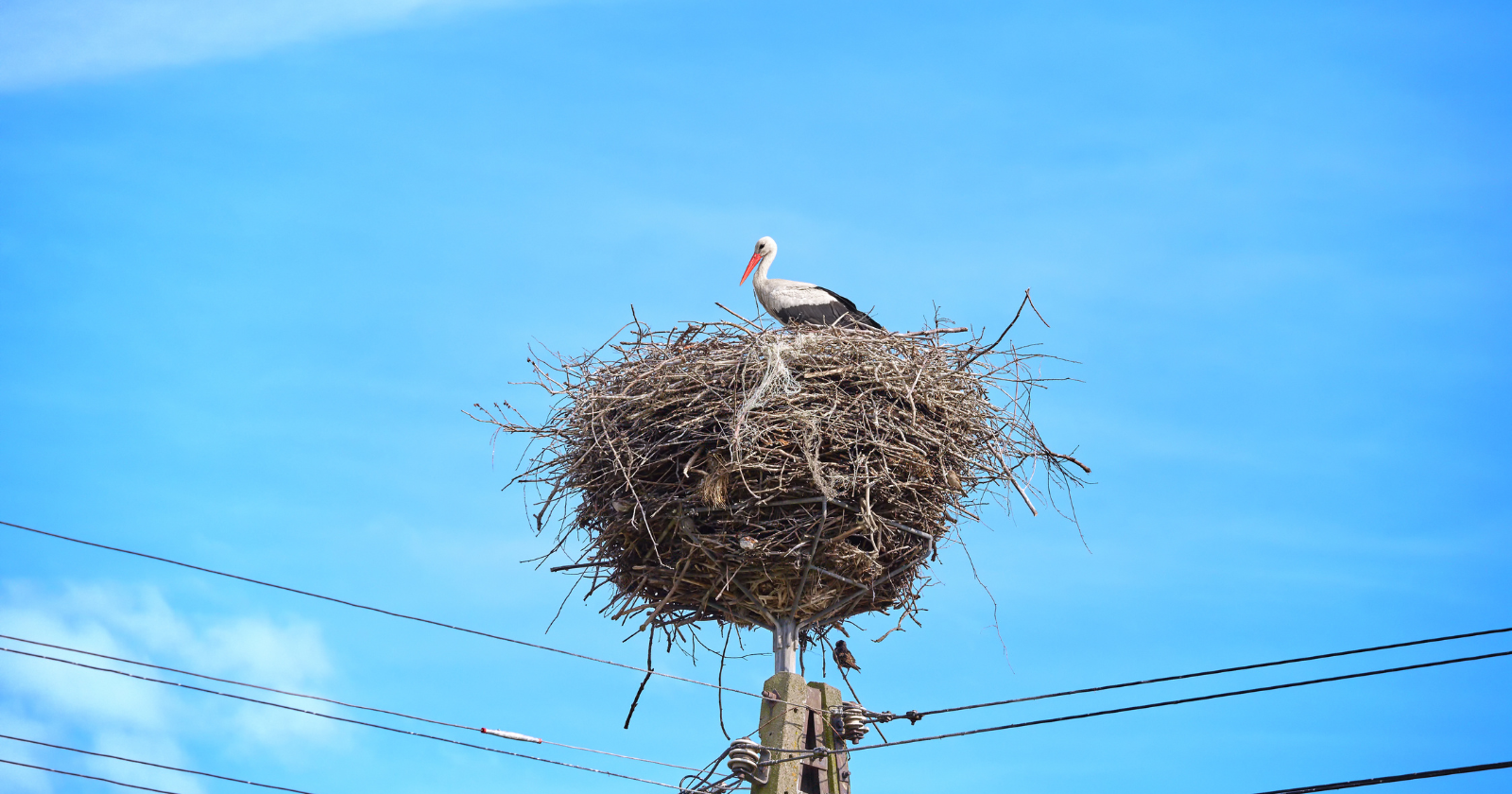
Between 2016 and 2019, crews maintaining a stretch of Spain’s high-voltage transmission network pulled 839 white stork nests off the tops of steel pylons, according to a peer-reviewed study of the work. The nests came off 1,196 pylons carrying 475 kilometers of transmission lines through the southwestern provinces of Huelva and Seville, and the removals were anything but evenly spread: just 134 pylons, roughly 11 percent of the total — measured across the full 2015–2019 study window — accounted for essentially all of the activity, with one tower alone shedding nine nests over the four years nest counts were recorded (2016–2019).
The figures come from a study on conflict-prone pylon use published in November 2022 in the journal Diversity by researchers Evan M. Burdett, Roberto Muriel, Virginia Morandini, Mahmood Kolnegari and Miguel Ferrer. The team analyzed nest-removal records collected by the grid operator Red Eléctrica de España (REE), which funded the work through a technical support project, across eight transmission lines running at 220 to 400 kilovolts.
The paper’s authors describe a management program that has run continuously for years. Annual intervention rates on the studied pylons ran between 6 and 8 percent each year, and on the pylons that did draw repeat attention, the average was 2.4 nests removed per problem tower over the study window. That concentration is the study’s central finding: the data show stork nesting clustering hard on a small, identifiable subset of structures, not spreading evenly across a transmission corridor as a uniform hazard.
Why utilities pull the nests down
White storks build some of the largest bird nests in Europe, structures that can eventually weigh between roughly 70 and 1,400 kilograms as pairs return to reuse and enlarge them year after year. Perched atop a transmission tower, that mass and bulk create several distinct engineering problems. Nesting material can bridge conductors or grounded components and trigger short circuits. Droppings and “fecal streamers” released as adult birds take flight can accumulate on insulators and cause flashovers. And the sheer weight of an established nest can alter a pylon’s load distribution and aerodynamics enough to raise structural-stability concerns for maintenance crews.
These are not hypothetical risks. The same research team notes that in neighboring Portugal, stork nesting has been linked to roughly half of all power outages recorded on some distribution networks, a figure that underscores why utilities across the Iberian Peninsula have invested in nest-management programs instead of simply tolerating the birds. A related long-term management study, published in the Journal of Environmental Management, examined how sustained intervention on Portugal’s transmission infrastructure has cut fault rates even as the storks’ use of pylons has tripled.
Removing an active nest requires more than clearing debris. Crews typically coordinate the work around the stork breeding calendar to avoid destroying eggs or chicks, and REE and comparable European grid operators have increasingly paired removal with preventive engineering: insulated conductor covers, bird diverters, and, in some cases, purpose-built nesting platforms erected on less sensitive structures nearby to give storks an alternative perch that does not endanger the line.
A species rewriting its own migration rules
The scale of the removal effort reflects a broader shift in white stork behavior across Spain. The species, once a strictly migratory bird that wintered in sub-Saharan Africa, has increasingly settled into year-round residency in Iberia over the past several decades. Researchers studying the trend have tied it in large part to the birds’ use of open-air landfills as a reliable, low-effort food source, a change documented in multiple studies including work published in Movement Ecology on landfill use by partially migratory stork populations and in Ornithological Applications on shifting nest distributions near landfill sites in central Spain. Separate modeling published in the same journal has found that stork numbers and range could contract sharply if landfill access were closed off, as European Union waste directives increasingly require.
That population growth and behavioral shift compound the pylon problem. More resident, non-migratory storks means more birds searching for elevated nest sites near reliable foraging grounds year-round, and transmission towers, tall, open, structurally stable and often positioned near the agricultural land and waste facilities storks favor, are attractive real estate. The Burdett et al. study set out specifically to identify what makes certain pylons disproportionately attractive, looking at factors such as tower height, conductor configuration, and proximity to foraging habitat, with the goal of letting grid operators predict conflict-prone structures in advance, ahead of any nest-by-nest reaction.
That predictive framing is the practical payoff the researchers point to. If a small fraction of pylons, on the order of one in ten, generates nearly all the nest-removal workload on a line, then utilities gain a much more efficient path to reducing conflict: install anti-nesting devices or alternative platforms on the specific towers likely to attract storks — a far more efficient target than treating every pylon along hundreds of kilometers of line as an equal risk. The authors frame this as a way to fold stork behavior into the siting and design of future transmission infrastructure alongside its ongoing maintenance.
Balancing a protected species against grid reliability
White storks are a protected species across the European Union, and the removal programs described in the study operate within that legal framework, not around it, generally timed to avoid active breeding attempts and often paired with mitigation meant to give displaced pairs somewhere else to nest. The tension the research documents, between a recovering, increasingly grid-adapted bird population and the operational demands of a high-voltage transmission network, is likely to persist as long as Iberian stork numbers keep climbing and landfill-driven residency patterns hold.
For now, the data from Huelva and Seville offer a concrete picture of what that tension looks like in practice: hundreds of nests removed over a few years, overwhelmingly concentrated on a small set of towers that keep drawing storks back, including at least one pylon that hosted nine separate nests before crews intervened.