

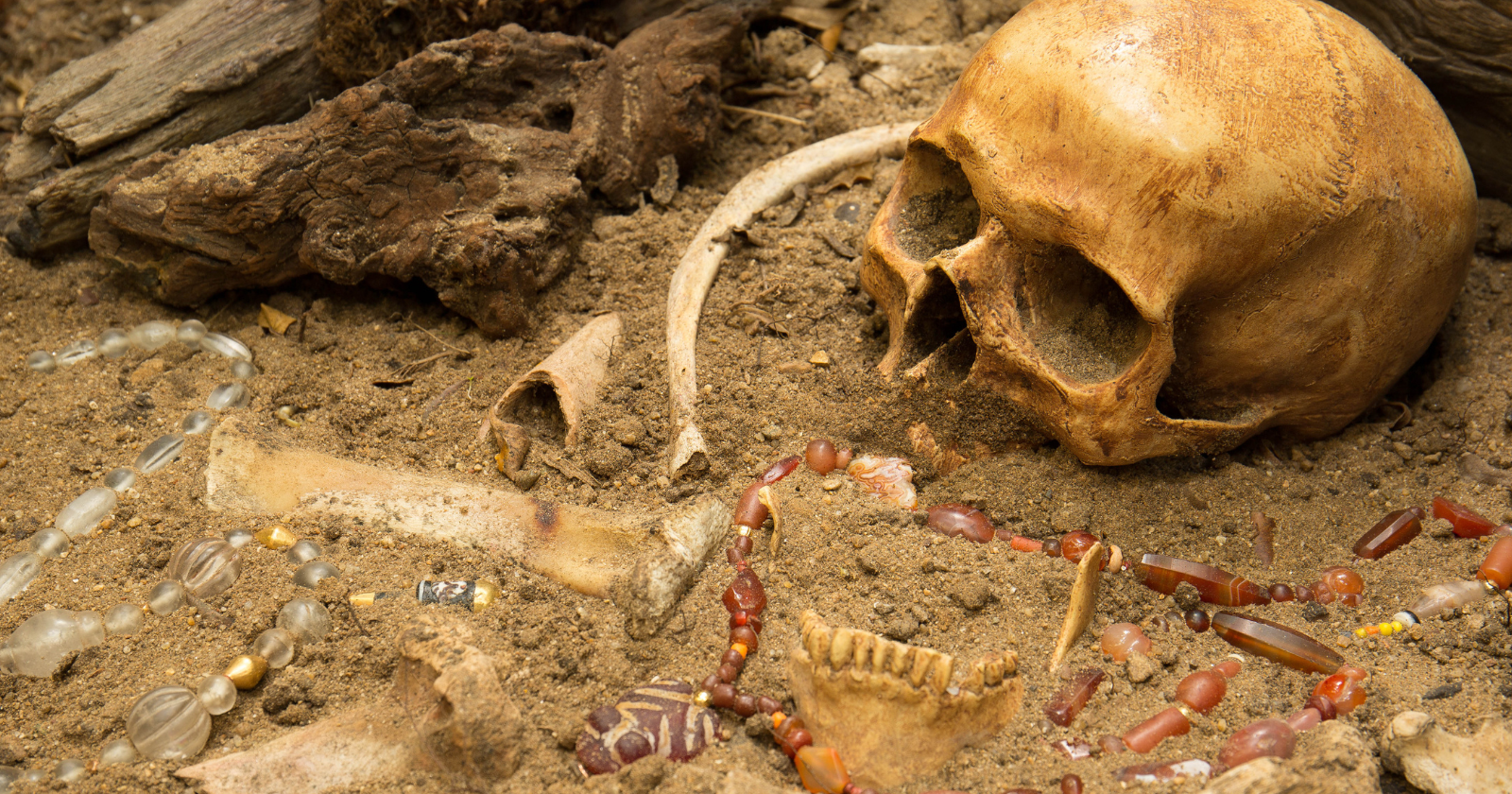
In 1963, archaeologists excavating the Romito Cave in Calabria, at the toe of southern Italy, uncovered a Paleolithic burial that has been reproduced in textbooks ever since: two individuals laid to rest together roughly 12,000 years ago, positioned so closely that one appears to be embracing the other. For decades, one of the two, the smaller of the pair, was widely assumed to have been a young man with a form of dwarfism, based on the shape and proportions of the skeleton. That assumption has now been overturned.
A team led by Daniel Fernandes of the University of Coimbra, working with Ron Pinhasi at the University of Vienna, Adrian Daly at the Liège University Hospital Centre and Alfredo Coppa at Sapienza University of Rome, extracted and sequenced ancient DNA from both skeletons. Their results, published in January as a research letter in the New England Journal of Medicine, found that both individuals were female, and that they were closely related, most likely mother and daughter.
What the DNA actually settled
Skeletal sex estimation from bone shape alone, particularly for individuals who died young or whose skeletons are incomplete, has always carried a margin of error, and the Romito 2 skeleton, the smaller one, sat close enough to that margin that the original “young male” reading was reasonable at the time. DNA analysis doesn’t carry that same ambiguity. It gave the research team two answers at once: the sex of both individuals, and, from the pattern of shared genetic markers, their family relationship.
The DNA also identified something the skeleton’s proportions had already suggested but couldn’t confirm on their own: a mutation in the NPR2 gene. In the younger of the two women, the mutation was present in both copies of the gene, a homozygous variant that causes acromesomelic dysplasia, Maroteaux type, a rare inherited disorder that produces severe short stature and shortened limbs, particularly in the forearms and lower legs. The older woman, her mother, carried one copy of the same mutation, a heterozygous form associated with milder short stature of its own.
A disorder still diagnosed today
Acromesomelic dysplasia, Maroteaux type remains a recognised diagnosis in modern clinical genetics, caused by mutations affecting the NPR2 gene’s role in regulating bone growth. Children born with it today are identified through much the same kind of genetic testing that identified it in a 12,000-year-old skeleton. What the Romito find adds is a data point on how far back the condition, and the pattern of a carrier parent passing a milder version to a child who inherits a full, more severe form, can be traced.
“By applying ancient DNA analysis, we can now identify specific mutations in prehistoric individuals,” Pinhasi said, according to the University of Vienna’s summary of the findings. Daly, whose own clinical work at the Liège University Hospital Centre involves rare growth disorders, put the significance more plainly in the same University of Vienna release: “Rare genetic diseases are not a modern phenomenon but have been present throughout human history.” In Liège’s own account of the work, Daly added more of the technical detail behind that finding, describing how the team identified “a homozygous variant of the NPR2 gene, a gene essential for bone growth” in the younger of the two women.
What the burial itself suggests
Wear patterns and diet analysis from the younger woman’s skeleton indicate she lived to late adolescence, and that her diet and nutritional condition were broadly comparable to those of other individuals found in the same cave, rather than showing signs of chronic deprivation. Coppa’s reading of that detail, given in Sapienza University’s account of the research, is that the group she lived among likely supported her mobility and access to food across a demanding hunter-gatherer existence, rather than her surviving at the margins of it. “We assume that her companions took good care of her, helping her to find food and supporting her mobility during periodic movements in a harsh and challenging environment,” he said.
That inference rests on skeletal and dietary evidence, not on direct testimony that obviously can’t exist for a burial this old, and it is worth holding lightly rather than treating as settled fact. But it is consistent with a small, growing body of Paleolithic evidence suggesting that visible physical difference did not automatically mean exclusion from a group’s daily life, at least not in every case archaeologists have been able to examine closely.
Why the misreading happened in the first place
It’s worth sitting with how long the original “young male” interpretation held, less as a critique of the 1963 excavation team, who worked with the tools available to them, than as a reminder of how much modern ancient-DNA analysis has changed what can be known about a burial found decades before the technique existed. Sex estimation from a disrupted or juvenile skeleton is genuinely difficult, and the growth disorder itself would have distorted some of the proportions researchers typically rely on to make that call.
What happened here is a much newer method getting pointed at a much older, already-famous find, and the result is narrower than a dramatic reinterpretation of the whole burial. It is a precise correction to two specific facts, sex and kinship, that had been reasonably guessed at decades ago and turned out to be wrong. The embrace itself, whatever it meant to the people who arranged it, stays exactly as it was found.
One burial, not a pattern
This single case has clear limits on what it can establish. One mother-daughter burial with a shared growth-disorder mutation tells us that the condition existed at least 12,000 years ago, and that at least one family group living through the last cold millennia of the Paleolithic included a member with visibly different proportions who appears to have lived into late adolescence without being abandoned. It does not tell us how common the condition was, how most Paleolithic communities treated visible disability generally, or whether Romito’s arrangement reflects an ordinary practice or an exceptional one. Ancient DNA is good at answering precise, narrow questions; broader claims about how prehistoric societies typically treated disability need many more burials analysed this closely before they can be made responsibly.
What the case does add, modestly and specifically, is a firm date. Acromesomelic dysplasia, Maroteaux type had been documented clinically for decades, but nobody had traced its presence this far back in time with molecular confirmation rather than inference from bone shape alone. That is a narrow contribution, but it’s a solid one, and it is the kind of finding ancient DNA is best suited to make: one well-supported fact about the past that wasn’t available before — modest, but solid.