

What we believe may carry the signature of where we are from. In a sweeping new study in PNAS Nexus, researchers used machine learning to show that values, from views on marriage to ideas about government, can identify a person’s nationality with striking accuracy.
Drawing on nearly 600 questions asked by the World Values Survey across 98 countries, the team distilled a 60 item inventory that not only predicted national origin with about 90 percent accuracy but also helped explain cultural divides in behavior, such as why Americans reported more COVID lockdown violations than Mexicans and why Indians reported more proenvironmental action than Americans.
Why this matters for cross cultural psychology
For decades, scholars have leaned on a few big ideas like individualism and power distance to compare cultures. The new work shows that a wider constellation of attitudes, including views on government and society, gender roles, and family, carry strong signal. The team argues that the machine derived list is not a replacement for classic frameworks. It is an empirical map that researchers and international business analysts can use to generate and test explanations when the old models fall short.
“Based on 594 attitudes, values, and beliefs included in the World Values Survey, a neural network could classify respondents’ nationalities with 90% accuracy in out-of-sample data.” Sheetal et al., PNAS Nexus
How the machine learning cultural values inventory was built
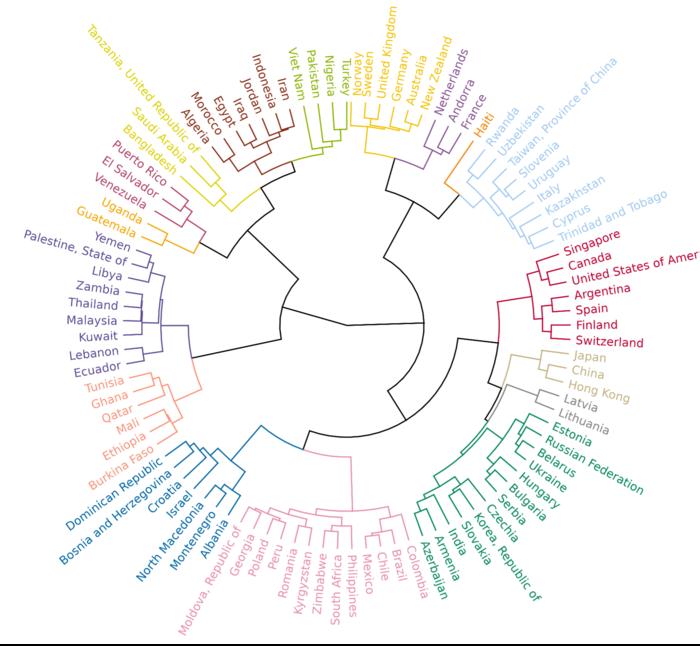
The authors assembled merged World Values Survey waves 1 through 6, spanning 1981 to 2014, with 348,532 respondents and hundreds of items per country. After careful cleaning, scaling, and imputation to handle missingness, they trained a multilayer perceptron to classify country from 594 attitudinal predictors. A permutation based importance analysis identified the top contributors, which they culled to a 60 item set without losing predictive power. Country level averages on these 60 signals naturally clustered familiar neighbors, but they also elevated themes that do not figure prominently in standard scales.
What topped the list
- Order versus freedom in government responsibility.
- Political agreement in marriage.
- Environmental concern about water and biodiversity.
- Parental duty and child rearing priorities such as determination, obedience, and thrift.
- Views on religion in public life and confidence in religious leaders.
From prediction to explanation
Prediction is useful, but explanation is the goal. The team validated the inventory in four follow up studies. In the United States and Mexico, one item that captured endorsement of religious influence on government explained differences in self reported lockdown violations above and beyond traditional culture scales. In the United States and India, perseverance related attitudes helped account for higher self reported proenvironmental behavior in India. These mediators align with documented debates over church and state during the early pandemic and with prior links between perseverance and sustained action.
To support replication, the authors posted code, materials, and country level scores on OSF, and they point readers to the World Values Survey for data access and background.
Key Findings
- Design: Neural network trained on 594 World Values Survey items across 98 countries, waves 1–6, 1981–2014.
- Sample: 348,532 respondents in the core training set; derived 60 item inventory that retained performance.
- Accuracy: About 90 percent out of sample nationality classification.
- Top signals: Government and society, family and marriage, gender roles, environmental concern, religion in public life.
- Follow ups: US vs Mexico lockdown behavior (Study 3a N=201, 3b N=605). US vs India proenvironmental behavior (Study 4a N=208, 4b N=356 valid after exclusions).
- Explanatory mediators: Christian nationalism for lockdown adherence, perseverance for environmental action.
- Resources: Open data and code on OSF; journal publication in PNAS Nexus.
- Limitations: Imputation for missing items, convenience samples in follow ups, factors beyond culture not controlled across countries.
Takeaway
A simple, data driven 60 item inventory derived from the World Values Survey can both distinguish national cultures with high accuracy and help explain specific behavioral gaps. It complements classic theories by surfacing overlooked dimensions such as church state views and perseverance that matter in real world outcomes.
Journal: PNAS Nexus
DOI: 10.1093/pnasnexus/pgaf229