
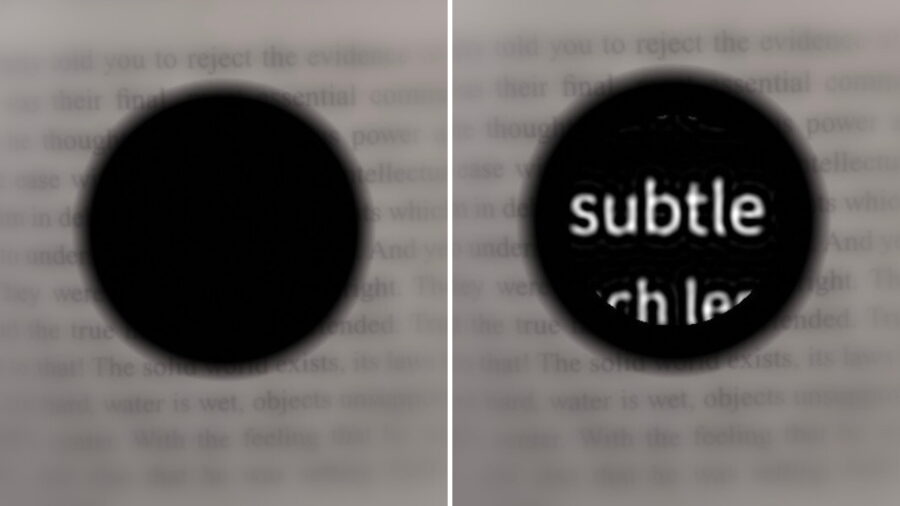
A wireless implant no bigger than a grain of rice has restored reading vision to people who had lost their central sight to macular degeneration, a condition that affects over 5 million people worldwide and ranks as the leading cause of irreversible blindness in older adults. In a clinical trial that wrapped up this month, 27 out of 32 participants could read books, food labels, and subway signs a year after receiving the device.
The results, published October 20 in the New England Journal of Medicine, mark the first time an eye prosthesis has restored what researchers call “form vision,” the ability to perceive shapes and patterns rather than just light sensitivity. Previous attempts at retinal implants gave patients little more than the ability to detect brightness.
“All previous attempts to provide vision with prosthetic devices resulted in basically light sensitivity, not really form vision,” said Daniel Palanker, a professor of ophthalmology at Stanford Medicine and co-senior author of the study. “We are the first to provide form vision.”
A 20-Year Vision
The device, called PRIMA, consists of two parts: a small camera mounted on a pair of glasses, and a 2-by-2-millimeter chip surgically placed under the retina. The camera captures images in real time and beams them via infrared light to the chip, which converts the light into electrical pulses that stimulate the remaining retinal neurons. Essentially, the chip replaces photoreceptors destroyed by disease.
Palanker first imagined such a system two decades ago while working with ophthalmic lasers. He realized the eye’s transparency could be an asset rather than an obstacle. By using infrared light, invisible to natural photoreceptors, the device allows patients to merge prosthetic central vision with whatever peripheral vision they have left. That dual capability helps with orientation and navigation in ways earlier implants could not.
“The device we imagined in 2005 now works in patients remarkably well.”
Because the chip is photovoltaic, it generates its own electrical current from light alone. No external power source. No cables snaking out of the eye. The simplicity of the design is part of what makes it work.
Reading in Black and White
The trial enrolled 38 patients over age 60 with geographic atrophy, an advanced form of age-related macular degeneration that gradually erodes central vision. All had vision worse than 20/320 in at least one eye. Four to five weeks after the chip was implanted, patients began training with the glasses. Some could make out patterns immediately. Others took months to reach peak performance, similar to the learning curve for cochlear implants.
Of the 32 patients who completed the year-long study, 26 showed clinically meaningful improvement, defined as the ability to read at least two additional lines on a standard eye chart. On average, participants improved by five lines. One patient improved by 12. With digital enhancements like zoom and contrast adjustment, some reached vision equivalent to 20/42.
“The fact that they see simultaneously prosthetic and peripheral vision is important because they can merge and use vision to its fullest.”
Two-thirds of participants reported medium to high satisfaction with the device, using it daily to read books and navigate public transit. Right now, the system provides only black-and-white vision with no grayscale, but Palanker is developing software to add shades of gray. Face recognition, he noted, is the second most requested feature after reading, and it requires grayscale to work well.
Nineteen participants experienced side effects, including high eye pressure, retinal tears, and bleeding under the retina. None were life-threatening, and nearly all resolved within two months.
Palanker is already engineering a next-generation chip with pixels as small as 20 microns, compared to the current 100 microns. That would pack 10,000 pixels onto each chip instead of 378, potentially giving patients 20/80 vision, or close to 20/20 with electronic zoom. He also wants to test the device for other types of blindness caused by lost photoreceptors.
“This is the first version of the chip, and resolution is relatively low,” Palanker said. “The next generation of the chip, with smaller pixels, will have better resolution and be paired with sleeker-looking glasses.”
New England Journal of Medicine: 10.1056/NEJMoa2501396
Discover more from NeuroEdge
Subscribe to get the latest posts sent to your email.