

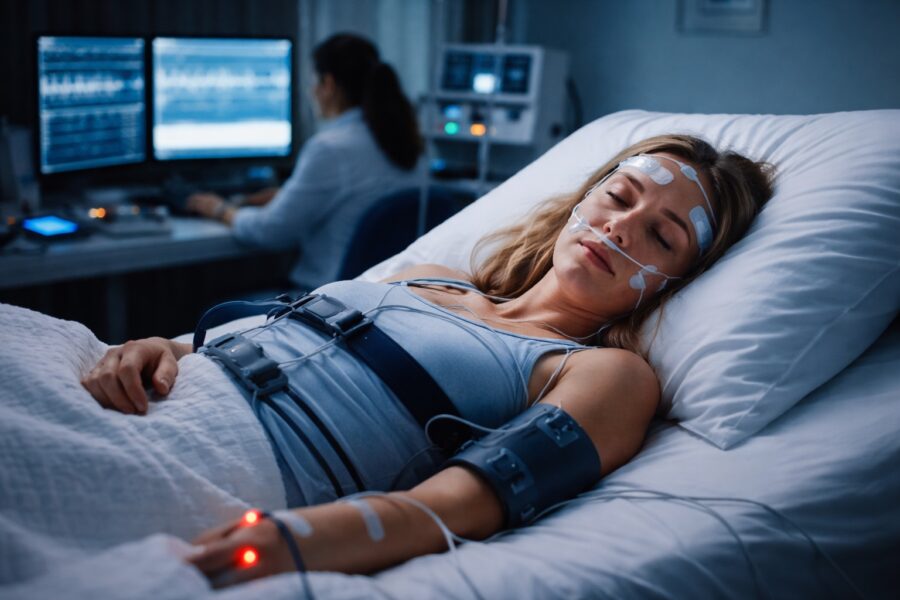
The next time someone hooks you up to a sleep study, those sensors tracking your brain waves and heartbeat may not just be looking for snoring problems. They could be capturing something far more revealing: a physiological signature that can forecast whether you’ll develop Parkinson’s disease, suffer a heart attack, or face dementia, sometimes years before any symptoms appear.
Stanford Medicine researchers built an AI system called SleepFM that analyzes a single night of polysomnography data and predicts risk for 130 different diseases. Published January 6 in Nature Medicine, the model was trained on nearly 600,000 hours of overnight recordings from roughly 65,000 people. Unlike traditional sleep analysis, which cherry-picks a handful of measurements to diagnose disorders like apnea, SleepFM devours everything: brain activity, heart rhythms, breathing patterns, muscle movements, eye tracking. The rest of that data usually sits ignored in medical files.
Most striking is the accuracy. For Parkinson’s disease, the model hit a concordance index of 0.89—meaning it correctly ranked who would develop the condition first about 89 percent of the time. Dementia scored 0.85. Heart attacks, 0.81. Even mortality from any cause reached 0.84. The concordance index measures predictive ranking, where 0.5 is random chance and 1.0 is perfect foresight.
Teaching Machines the Grammar of Sleep
The team treated sleep recordings like sentences in a language. They chopped each night into five-second segments and trained SleepFM to learn how different body systems coordinate—or fail to coordinate—over eight hours. It’s what AI researchers call a foundation model, the same architecture behind systems like ChatGPT, except this one learned physiology instead of words.
To sharpen the model’s understanding, the team would hide one data stream (say, heart rate) and challenge it to reconstruct the missing signal using everything else. This forced SleepFM to grasp how brain waves, breathing, and cardiac activity interlock during normal sleep. When those relationships broke down—a brain in deep sleep paired with a racing heart, for instance—the model flagged it as a warning sign.
“We record an amazing number of signals when we study sleep. It’s a kind of general physiology that we study for eight hours in a subject who’s completely captive. It’s very data rich,” Emmanuel Mignot explains.
After confirming SleepFM could handle standard tasks like identifying sleep stages, the researchers linked decades of electronic health records to the sleep data. They tested more than 1,000 disease categories. The model found meaningful patterns for 130 of them, spanning cancers, pregnancy complications, circulatory diseases, and mental health disorders.
When the Body’s Orchestra Plays Out of Tune
Different signals mattered for different diseases. Brain activity proved most predictive for neurological and psychiatric conditions. Heart signals dominated cardiovascular forecasts. Breathing patterns flagged respiratory and metabolic risks. But combining all streams together consistently outperformed any single measurement.
The model doesn’t yet explain its reasoning in clinical language, and the data came largely from people already referred for sleep studies rather than a general population sample. Still, the findings suggest sleep contains vastly more information about long-term health than medicine currently extracts. As wearables expand beyond step counting into continuous physiological monitoring, models like SleepFM could eventually translate nightly data into early warnings.
Sleep has long been treated as biological downtime. Turns out it might be one of the few windows when the body reveals what’s coming, without the noise of conscious movement or daily stress masking the signal.