

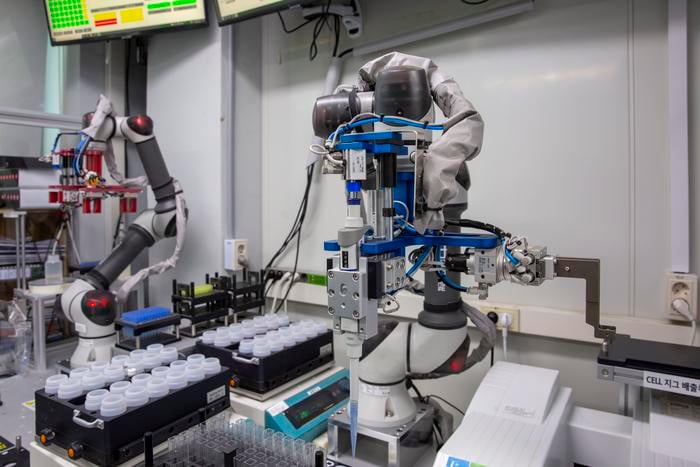
At around midnight in a laboratory in Daejeon, South Korea, two robotic arms are working through a queue of 96 experiments nobody asked them to start. One grips a pipette, delivers a precise shot of sodium borohydride into a reaction vessel, and moves on. The other lifts a small cuvette, slides it into a spectrometer, waits the requisite three seconds, and retrieves it again. Back and forth, tip to tip, sample to sample — no coffee, no fatigue, no one looking over their shoulder.
By morning, the shift is done. Ninety-six catalytic reactions evaluated, ranked, analysed. A task that would have taken a human researcher the better part of a month, finished while the team slept.
This is, depending on how you look at it, either a very efficient piece of laboratory engineering or a glimpse at how chemistry is going to be done from here on in. Ji Chan Park at the Korea Institute of Energy Research (KIER) and his colleagues think it might be both. Their fully automated platform, reported in the journal Chemical Science, is the latest attempt to solve one of materials science’s more stubborn problems: that finding a good catalyst is still, at heart, an enormously tedious business.
Catalysts are the unsung workhorse of modern industry. They participate in more than 90% of all chemical manufacturing processes — everything from pharmaceutical synthesis to fuel refining to the production of plastics. Yet developing a new one, or improving an existing one, still tends to require a researcher to make slight variations in composition, run the experiment, check the result, make another variation, run another experiment. Over and over again, for months. It is slow, it is costly, and it turns out the results can vary quite noticeably depending on who happens to be running the experiment that day.
That last problem is perhaps the more insidious one. When a reaction takes a pipetting step, and a timing judgment, and a human hand placing a sample at slightly different angles each time, variability creeps in. Published data becomes hard to compare across labs. Machine learning models trained on such data inherit the noise. The whole field, in a way, is built on a slightly wobbly foundation.
Park’s team set out to remove the wobble. Their platform uses two collaborative robotic arms positioned on opposite sides of a modular workbench, each assigned a distinct role in the workflow. The first handles UV-Vis spectroscopy — picking up cuvettes, positioning them, recording the absorption spectra that track how a reaction proceeds. The second manages the chemistry itself: adding reagents, swapping pipette tips, resetting sample trays when one batch finishes and another begins. Custom software ties the two together, running in parallel loops, generating real-time kinetic data that gets automatically processed and ranked without anyone touching a keyboard.
To test the system, the team used a benchmark reaction: the reduction of 4-nitrophenol (a common industrial pollutant) to 4-aminophenol (a useful pharmaceutical intermediate) in the presence of palladium-based catalysts. It’s a well-understood reaction with a clean spectroscopic signal — ideal, in other words, for validating whether an automated system is actually doing what it claims. They screened 24 catalyst variants, mostly palladium on activated charcoal with different metal additives at 10 mol% relative to Pd.
The numbers tell the core of the story. Humans doing this work manually can process roughly three samples a day; the robotic platform handled around a hundred. Where manual experiments produced results with a relative standard deviation of about 8.8%, the automated system brought that down to approximately 2%. The researchers also compared the variability of their platform directly against hand-conducted trials using the same commercial palladium catalyst — the robot’s reproducibility was markedly better, even accounting for a slightly lower average conversion in the automated runs. Precision, it turns out, matters more than raw throughput if you want data you can actually learn from.
“This study demonstrates that we can secure highly reliable data in high-throughput experimental environments, going beyond the full automation of catalyst performance evaluation,” says Park.
The chemistry itself yielded some instructive results, too. Among the 22 metal-modified variants, adding iron to the palladium produced the highest catalytic activity (89.8% conversion at 9 minutes). Copper, zinc, and tin also boosted performance considerably. Nickel and chromium, on the other hand, suppressed it. These aren’t entirely surprising findings for people working in this area, but what’s notable is how cleanly they emerged from the automated data — subtle kinetic differences that, in manual experiments, might have been buried in noise.
The team also tried to connect the experimental results to computational predictions, pulling electronic structure data from the Materials Project database and looking for correlations with DFT-calculated properties of different metal-palladium alloys. The correlations were, for the most part, rather weak. Formation energy of the alloys showed the strongest link (a correlation coefficient of -0.27), followed by the d-band centre and work function of the additive metals. Metals like iron, copper, and zinc performed better than the bulk calculations suggested; lanthanum and samarium, which looked promising on paper, underperformed in practice. Surface chemistry, nanoparticle effects, and synthesis-dependent behaviour — things that bulk calculations simply can’t capture — kept reasserting themselves.
This is perhaps the most honest finding in the paper, and (arguably) the most important. Computational screening is genuinely useful for narrowing down candidate materials before you start ordering chemicals. But it can’t replace the experiment. Nanoscale behaviour is genuinely different from bulk behaviour, and there’s currently no model sophisticated enough to predict exactly how a 20-nanometre palladium particle decorated with iron atoms will behave in solution. You have to test it.
Which is exactly what makes the robotic platform valuable — not as a replacement for thought, but as a way to test many more candidates, faster and with data you can trust. “Going forward, we will expand the application to a broader range of catalytic reactions and materials research, strengthen the linkage between theory and experiments, and ultimately advance toward AI-driven catalyst development,” says Park.
The vision here isn’t simply faster testing. It’s a closed loop: computational models narrow the search space, robotics validates the predictions, and the resulting high-fidelity datasets feed back into better models. Each cycle tightens the spiral. You start with thousands of possible catalysts and end, eventually, with a handful worth developing seriously — without a researcher spending three months pipetting in the dark.
Whether the chemistry world embraces this kind of infrastructure at scale remains to be seen. Robotic platforms aren’t cheap, they require upfront engineering investment, and not every catalytic reaction is as clean and spectroscopically tractable as the reduction of 4-nitrophenol. The messier, more industrially relevant transformations — methane conversion, nitrogen fixation, CO2 reduction — are considerably harder to instrument automatically. The KIER team acknowledges the platform’s modular design is built for expansion; how far it can go is, for now, an open question.
But the overnight run is already finished, the rankings already calculated, and somewhere in that ranked list of 24 palladium variants, the iron-modified catalyst sits at the top. The robots got there first.
Study link: https://pubs.rsc.org/en/content/articlelanding/2026/sc/d5sc06192j