
Palmer Luckey was asked on a podcast what he’d work on if he was starting from zero today, and his answer was divorce. Specifically, he said he’d try to end “the tragedy of divorce” with “oxytocin doping for marriage counseling.” Dose the couples who are coming apart with what he called the mammal pair bonding chemical, and keep them together, especially for the kids. The supporting case went roughly like this. We understand mammal pair bonding pretty well. If people think SSRIs are fine, then oxytocin doping to stay together is definitely fine. And anyway it’s totally unregulated, which is great.
My first reaction wasn’t about the chemistry at all. He seemed cocky explaining it, like someone used to optimising things without slowing down to feel them, and relationships aren’t that kind of problem. The pitch felt like snake oil to me. That’s an impression of how it was said, nothing more, and impressions are cheap, which is why I went looking at what’s actually been tested.
The other thing I keep snagging on is the direction of the whole idea. There are natural ways of connecting in a relationship, touch and time spent together, and two people deciding together to build those into their week seems like the right way to me. But I’d rather test that instinct against the papers than just assert it, so here’s where the evidence sits.
The strongest version of his case
It isn’t invented out of nothing, and it deserves to be put properly before it gets knocked around.
In 2009, Beate Ditzen and colleagues ran 47 couples through a double-blind trial. One intranasal dose before a conflict conversation. Oxytocin increased positive communication relative to negative behaviour during the argument, and lowered salivary cortisol afterwards compared with placebo. That is a controlled result in couples during an actual argument.
The animal work underneath it is famous for good reason. Insel and Shapiro found that oxytocin receptor maps differ between monogamous prairie voles and their non-monogamous relatives. Later work showed oxytocin infused into the brain helped female prairie voles form a preference for one partner. When anyone says mammal pair bonding chemical, this is the evidence they’re leaning on.
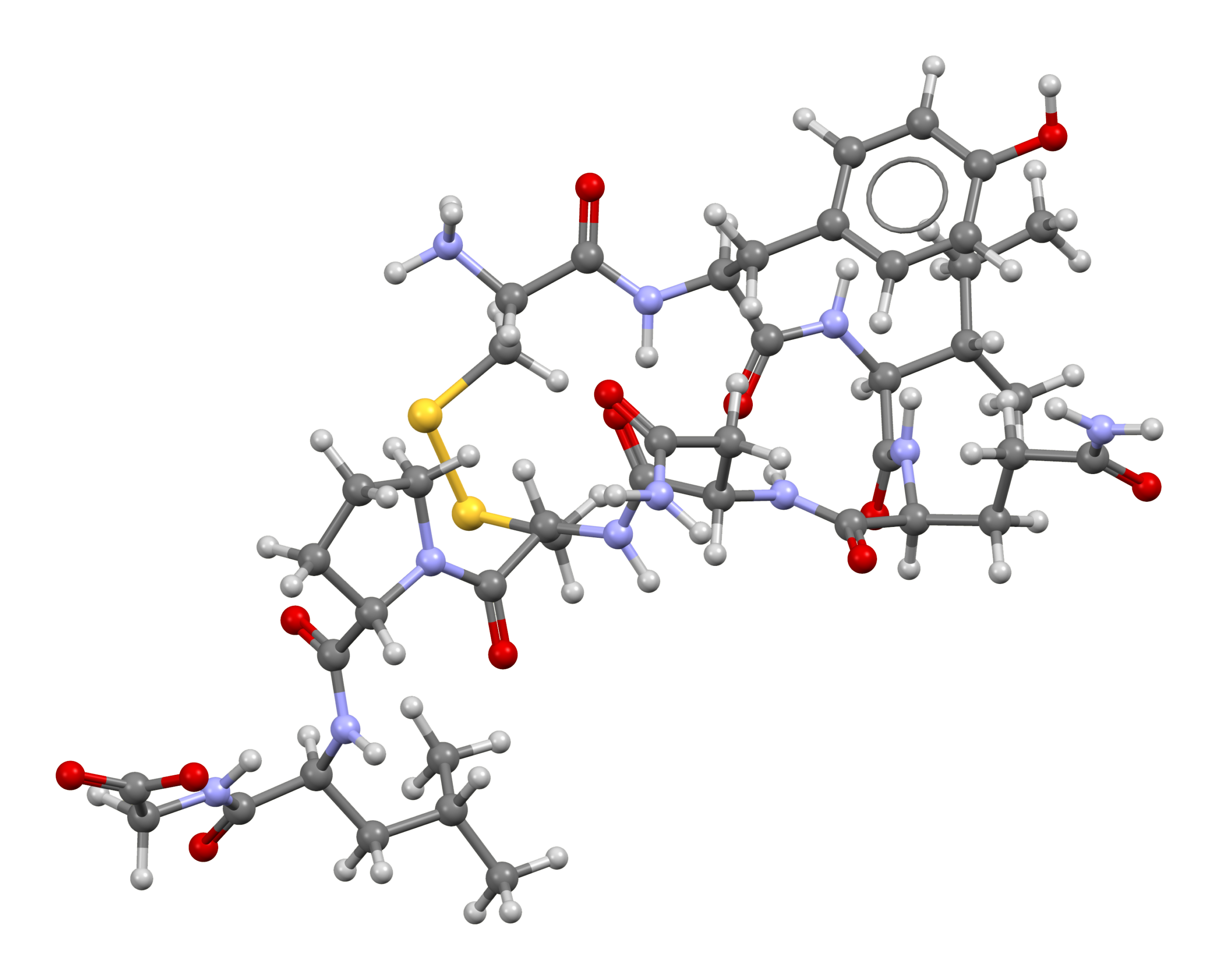
The self-reinforcing loop he mentioned is also real in one specific place. In labour, contractions trigger oxytocin release, which triggers stronger contractions. Milk let-down works the same way. Textbook positive feedback.
And on scheduling he’s technically right. Oxytocin isn’t a controlled substance. The Pitocin label on DailyMed lists DEA Schedule: None.
The open question is whether any of this carries a marriage.
What’s actually been measured in couples
No trial has ever measured whether oxytocin keeps a couple together. Not divorce, not separation, not whether the pair is still a pair a year later.
The longest controlled dosing in couples that exists is seven days. Published in JAMA Psychiatry this year with Ditzen among the authors, 80 couples dosed twice a day for a week alongside a partner appreciation task, with the data collected back in 2011 to 2013. The headline outcome was wound healing. It came in at P=.048, and the authors themselves say it was not consistently robust in sensitivity analyses, where it slid to P=.10.
That’s the ceiling. A week of dosing, and a wound-healing result that wobbled when the authors pushed on it.
The other couples trials are small and the biggest one is null. Flanagan and colleagues in 2022 gave a single 40 IU dose to 100 couples with alcohol use disorder and partner aggression, and found no statistically significant differences for any of the primary outcomes. An earlier study of 33 couples came out mixed, including some adverse attributions among the women.
Across everything that’s been run, what’s been measured is talk behaviour in a lab argument, saliva cortisol, cytokines, sexual function in 29 couples, pain during handholding. Nobody has measured the outcome Luckey wants to move. The nearest thing coming is a VA randomised trial of 120 couples in San Diego, oxytocin plus couple therapy for veterans with PTSD, funded through 2028 and still running. Not a divorce trial either.
The voles bonded anyway
In 2023, Devanand Manoli’s group at UCSF used CRISPR to delete the oxytocin receptor from prairie voles. The paper is titled “Oxytocin receptor is not required for social attachment in prairie voles.” The voles still formed partner preferences. They gave birth and raised pups.
The human literature has its own trouble. Walum, Waldman and Young wrote in 2016 that intranasal oxytocin studies are generally underpowered and that most published findings probably don’t represent true effects. The drug isn’t uniformly warm either. De Dreu’s work found oxytocin pushing in-group favouritism and some out-group derogation, which the authors said calls into question the idea of an indiscriminate love drug.
The word Luckey used was doping, which means an ongoing regimen rather than one spray before a hard conversation. The longest controlled dosing in couples is a week, and for longer, repeated dosing the clearest results come from animals. In mice, chronic nasal oxytocin produced a selective reduction of social behaviours along with fewer oxytocin receptors throughout the brain. In male prairie voles, chronic low-dose nasal oxytocin during development produced a deficit in partner preference behaviour.
Then there’s whether the spray reaches the brain at all. Leng and Ludwig called their 2016 paper “Intranasal Oxytocin: Myths and Delusions” and concluded that very little of what’s applied intranasally appears to reach the cerebrospinal fluid. Quintana’s group reviews converging evidence for nose-to-brain delivery and reads it the other way. The argument is live.
“Totally unregulated”
This one is just false as stated. Not scheduled doesn’t mean not regulated. Oxytocin injection is prescription only in the US. In Australia, Syntocinon is Schedule 4, Prescription Only Medicine. The only US nasal spray was discontinued in 1997 after the holder stopped marketing it, so there’s no FDA-approved oxytocin nasal spray on the American market. Luckey has since made the scheduling point himself on X, writing that oxytocin “is not illegal or even a controlled substance.”
Patricia Zettler, the John W. Bricker Professor of Law at Ohio State’s Moritz College of Law, told ScienceBlog that anything meeting the definition of a drug in the Federal Food, Drug, and Cosmetic Act is subject to the applicable FDA drug requirements, including approval, and that the legal definition of a drug covers products intended to address disease and “products intended to affect the structure or function of the body”. She was speaking generally about federal drug law, not about Luckey or his idea. That second part of the definition is broad, and it reaches plenty of things nobody would file under traditional disease treatment. On the research grade point, she said “A ‘research use only’ disclaimer isn’t a ‘get out of FDA free’ card”, and noted that research uses of drugs are regulated by the FDA as well.
Who those rules land on is a separate question. “FDA requirements generally apply to sellers, distributors, and manufacturers, and not to the individual people who use the products,” she said. She recently worked through the same legal questions in Science, in a piece focused on products marketed for longevity.
As for buying a kilogram on Sigma-Aldrich, the catalogue listing for oxytocin acetate salt goes up to 25 mg. One milligram, five, or twenty-five. Research grade, and the terms bar use in humans or animals. At the 25 mg price a kilogram would come to around $39 million, if it existed, which it doesn’t.
The ordinary routes, and how far they get you
Here’s where I have to be honest about my own preference.
There is some evidence for the natural, routine approach I described at the start. Holt-Lunstad and colleagues randomly assigned 34 married couples to a four-week warm touch intervention or a monitoring control. Salivary oxytocin was raised in the intervention group early and late, alpha amylase, a stress marker, was lower at the end in intervention husbands and wives relative to controls, and husbands in that group ended up with lower 24-hour systolic blood pressure. In a separate study, frequent hugs between partners were associated with higher oxytocin and lower blood pressure in premenopausal women.
But that’s 34 couples over four weeks, and one correlational study in women only. And measuring natural oxytocin is shaky in its own right. McCullough and colleagues found that commercial assays lack reliability on unextracted human samples and tag other molecules, producing wildly discrepant estimates.
So I can’t tell you hugging your partner is a proven oxytocin booster. Nobody has tested warm touch routines against separation either. The honest version is that these are small studies pointing the same direction as the thing most people already suspect about touch and attention, and that’s it.
What I’d want from the medicated side is boring and specific. Dose couples, follow them for two years, count who is still together. Until someone runs that, the leap from one lab argument in 2009 to saving a marriage is doing all the work in the proposal, and I’d rather a couple put that same faith into something they can do on a Tuesday night without a prescription.