

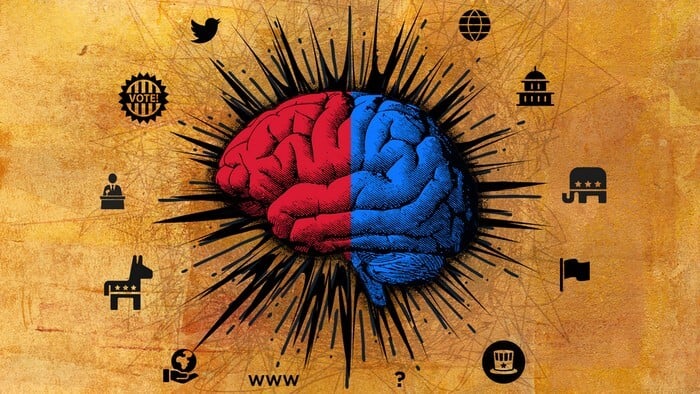
Brains on the far left and far right are not as different as you might assume. A new study from Brown University, published in the Journal of Personality and Social Psychology, finds that extreme liberals and ultra-conservatives process political information in strikingly similar ways. Using fMRI, skin conductance, and eye-tracking on 44 participants, the researchers showed that extremity itself, not ideology, drives these common brain patterns.
Brains in Sync Across the Spectrum
When participants watched a politically charged video, their brain responses told the story. People with extreme views, regardless of political alignment, displayed synchronized neural activity. Moderates, by contrast, showed more diverse and less predictable brain patterns.
“Both extreme liberals and extreme conservatives consumed the same political content, and even though they held vastly different beliefs, their brains appeared to process the information in a very similar manner,” said Oriel FeldmanHall, PhD, a professor of cognitive and psychological sciences at Brown University.
The synchronization was especially strong during segments with more heated or extreme language. Physiological arousal also played a role. Individuals with strong political views had heightened skin conductance responses, suggesting that emotion amplified their neural alignment.
The Role of Emotion and Belief Strength
The study suggests that what matters most is not what you believe, but how strongly you hold those beliefs and how emotionally reactive you are. Extremists, in short, feel more, and that emotional charge appears to unify their brain responses across party lines.
“Regardless of whether someone identified as extremely liberal or extremely conservative, their brain responded to political stimuli in similar ways,” said co-author Daantje de Bruin, MS. “This suggests that it’s not just what you believe, but how strongly you believe it and how emotionally reactive you are that shapes your perception of political reality.”
The findings lend scientific weight to the so-called horseshoe theory, which argues that political extremes resemble one another more than they resemble moderates. FeldmanHall noted that recognizing this shared experience could help reduce political dehumanization and open pathways to empathy. A small step, perhaps, but in today’s polarized climate, a notable one.
Limitations and Next Steps
The researchers caution against broad generalizations. The work relied on U.S.-based political content and self-reported ideology, meaning cultural or international variations remain unexplored. Future research may test whether this effect extends to other forms of extremism, from religious to social movements. For now at least, the U.S. brain scan data makes a clear point: extremity binds in unexpected ways.
