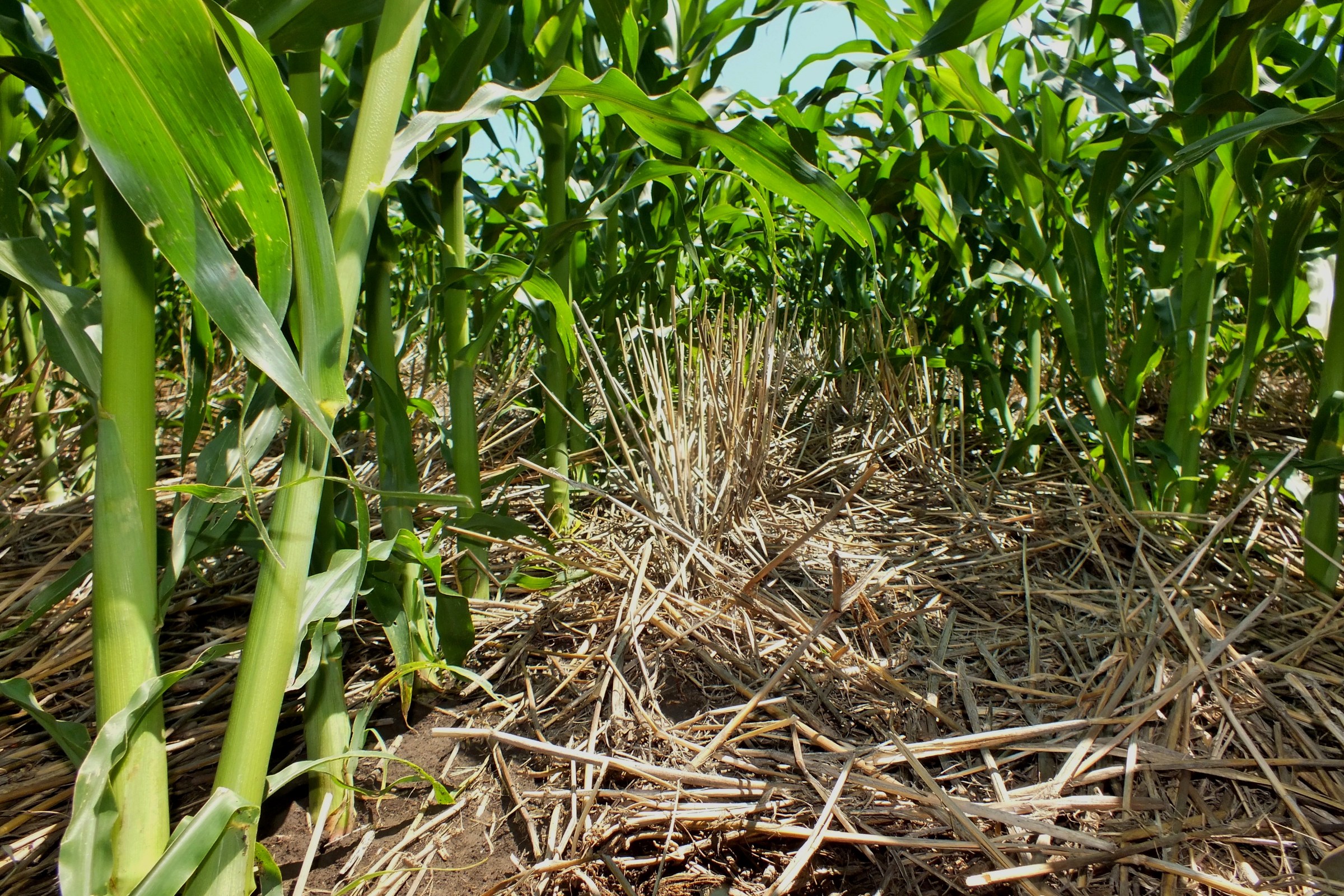
Does it pay to switch to regenerative farming? For a corn grower who sells at the elevator, the best evidence gives two different answers. The elevator is the local depot that buys grain by the truckload at whatever the market pays that day. Regenerative farming means practices such as giving up the plow and keeping the ground planted between cash crops, the corn or soybean grown to sell.
Giving up the plow raised net returns, the money left after costs, by $34 to $93 an acre for corn across three decades of randomized trials in Ohio and Michigan, a study funded by the US Department of Agriculture reported in July. Planting cover crops, the other practice at the center of regenerative farming, lost money in most of the farm budgets compiled by universities and grower groups. The exceptions came when grazing cattle closed the gap, or when a cost-share payment did, money from a program that covers part of the cost, and sometimes even then the sums fell short.
Last week’s piece on the 2018 corn study left growers who never go organic without an answer. The study found regenerative farms made 78 per cent more profit while growing 29 per cent less grain. Its own authors said part of the gain came from organic premiums, the higher price buyers pay for organic grain, and from selling grain direct to buyers. Andrew McGuire, an agronomist at Washington State University Extension who studies crops and soil and was the skeptic in that piece, wrote in an email on 8 October that this turns the profit story back into “the old organic vs conventional comparison”, and that “most conventional growers do not want to go organic, and it would wipe out premiums if they did.”
For a farm that will never earn a premium, regenerative farming comes down to two practices it can try and one add-on. No-till, the name for farming without a plow, means seeding straight into the stubble left from last year’s crop. Cover crops are plants such as cereal rye sown in the autumn and killed in spring before the cash crop goes in. Grazing, the add-on, puts cattle on those cover crops so the field earns from meat as well as grain. The three cost very different amounts.
No-till mostly saves money, because a farmer who stops plowing makes fewer passes across the field and puts fewer hours on the tractor. Yifei Zhang of North Dakota State University, Roderick Rejesus and colleagues published the trial figures online on 24 July 2026 in the Journal of Agricultural and Applied Economics. They compared randomized no-till plots with plots worked by a chisel plow, a tool that drags rows of metal prongs through the soil to loosen it. The trials ran at Hoytville and Wooster in Ohio from 1982 to 2012 and at Michigan’s Kellogg Biological Station from 1989 to 2020. No-till raised net returns by $34 to $93 an acre for corn and $30 to $86 for soybean, and operating costs fell at every site. “One consistent finding across all three study sites was the reduction in field-operation costs,” Zhang said. The paper priced field work at custom rates, the going rate for hiring the work done, a method that can overstate the savings.
Illinois farm records point the same way. The Precision Conservation Management program, run by Illinois Corn Growers, pooled ten years of records from high-productivity fields, about 7,445 of them in 2024 alone. Its 2025 data book reported that no-till corn left $347 an acre for the farmer and the landowner after costs, against $315 on fields tilled two or more times.
Fields given one light pass with a tillage tool did slightly better still, at $352, and the data book says one or two light tillage passes are “consistently the most profitable” while calling no-till “a rising star”. The data book calls no-till a “best bet” if an incentive program, one that pays farmers to adopt such practices, offers at least $5 an acre. The 1,534 no-till corn fields spent nothing on field work, against $43 on the most-tilled fields. These are records from farms that chose their own methods, so they show what no-till farms earned, not proof that no-till caused it.
One cost the trials did not directly measure, said Zhang, a senior research economist at North Dakota State’s Agricultural Risk Policy Center, is the transition itself. Inputs are the seed, fertilizer and other things a farmer buys to grow a crop. “Our estimates come from long-term field trials, where input management is generally closer to optimal than on commercial farms,” he said by email. “Therefore, I would expect returns on many farms to be somewhat lower, especially after accounting for transition costs, which we did not directly measure.” Well-managed farms in similar conditions “could achieve returns comparable to our estimates”, he said.
Even so, on most of the US cropland where farmers reported how they till, the ground is still worked. Just over a quarter was in no-till in 2022, according to the Census of Agriculture figure Zhang’s paper cites: 27.5 per cent, or, as he put it, 105.2 million of 382.4 million acres. The share rises to 34.9 per cent if only land harvested that year is counted, by his reading of the same census, and to 38.2 per cent on land where farmers reported how they tilled. For corn alone, he cited USDA survey data putting about 36 per cent of planted acres in no-till in 2021.
Zhang said that is because “no-till may not be economically suitable for every farm. Its performance depends on local soil and environmental conditions, and our study found considerable variation in economic returns across the three sites.” He added: “Farmers also face upfront costs and uncertainties when switching to a different management system.”
Cover crops cost money before they earn any. The farmer buys seed, pays to sow it in autumn, pays again to kill it in spring, usually with herbicide, and spends extra hours managing it. The soil stays covered through winter, which can, over years, build organic matter, the decayed plant material that makes soil dark and fertile. But the elevator pays no more for the grain. The Illinois Corn Growers program said its data “still can’t demonstrate a clear profit advantage”. Corn after a cover crop that lived through the winter returned $274 to $324 an acre against $347 with none. That counts no incentive payments.
Budgets drawn up in 2018 at Iowa State University’s Center for Agricultural and Rural Development found the same. The wider survey drew online responses from 11 states, and 79 of the more than 300 responses were usable for the budgets. Those 79 budget respondents had used cover crops for 3.94 years on average, and more than two-thirds of them farmed in Minnesota, Iowa or Illinois. The work was funded by the North Central Region SARE program. Corn after a herbicide-killed cover crop lost $20.76 an acre even with cost-share payments, and $46.09 without them. Soybean gained $25.13 with payments.
Averaged over a corn and soybean rotation, meaning corn one year and soybean the next, the loss was $11.78 an acre with cost-share and $42.92 without. A statewide Iowa survey by the same team found returns consistently negative for farmers who did not graze the cover crop or cut it for animal feed, and tended to be positive only for those who did and also received cost-share.
Satellite data point to one reason. Deines and colleagues, writing in Global Change Biology with funding from NASA Harvest and USDA NIFA, analyzed more than 90,000 fields in 2019 and 2020 across the Corn Belt, the Midwestern states that grow most US corn. Fields with three or more years of cover crops yielded 5.5 per cent less corn and 3.5 per cent less soybean, and only 0.6 per cent of corn observations showed a gain. The study covers two years and measures yield, not profit.
A smaller set of farm records agrees. The Soil Health Partnership, a National Corn Growers Association program, reported with the Environmental Defense Fund in 2021 on seven farms. Corn with conservation tillage alone, meaning the plow was used lightly or not at all, returned $377 an acre. Adding cover crops took it to $307, with recent adopters at $267 and experienced ones at $363. The report said “conservation practices do not pay for themselves in all situations.”
The positive numbers come from farmers who had already made it work. The Soil Health Institute, in a 2021 study paid for by Cargill, interviewed 100 farmers in nine states who had used no-till for 19 years on average and cover crops for nine. Corn net income was up $51.60 an acre and rose for 85 per cent of the corn growers.
The study excluded government payments and grazing and assumed a corn price of $4.20 a bushel, the standard unit for selling grain. It linked the biggest gains to non-GMO marketing, selling crops grown from seed that was not genetically modified, and it counted only successful adopters. A 2019 SARE bulletin drawn from a self-reported national survey shows the learning curve. Corn lost $31.36 an acre in the first year of cover crops and earned $17.90 by year five, with grazing adding $49.23 and incentive payments $50.
Asked what pays, McGuire pointed to the animals. “Grazing, at least right now, is probably the practice that pays and most likely to pay in other economic scenarios,” he said. “The economic benefits of ungrazed cover crops are difficult to pencil out and may only be positive in the long-term, especially for the more expensive mixtures used in regen ag.”
On giving up the plow, he said: “I think no-till can be profitable or at least break even in many situations but not all.” The lower fertilizer bills that helped drive the 2018 profit story are not a lever on their own, in his view: “Cutting fertilizer is not itself a practice, but the result of other practices.” He also set a higher bar than breaking even. “I think the extra management required to implement regenerative ag and cutting back inputs is going to require an economic benefit more than remaining equal with not doing it.”
One randomized trial shows what a bigger shift takes with no premium at all. Davis and colleagues reported in PLOS One in 2012 on a trial at Iowa State University’s Marsden Farm that ran from 2003 to 2011, funded by USDA NRI, the Leopold Center, the Iowa Soybean Association and The Organic Center. Once the trial had passed its start-up years, the longer rotations matched the standard two-year corn and soybean rotation on profit. Those rotations ran three and four years and added oats, alfalfa and manure to the usual corn and soybean sequence. All three systems returned between $913 and $965 a hectare, about two and a half acres, with no subsidies counted. Herbicide use fell 88 per cent. Labor rose by more than a third, and the system needs either cattle to eat the alfalfa or a buyer for the hay.
Sources:
- Zhang, Y., Rejesus, R.M. et al. (2026). Long-term economic returns to no-till adoption: evidence from field trials in the US Midwest. Journal of Agricultural and Applied Economics. https://doi.org/10.1017/aae.2026.10055
- Precision Conservation Management (2025). PCM Data Book 2025. Illinois Corn Growers.
- Plastina, A. et al. (2018). Annual Net Returns to Cover Crops in Iowa. Journal of Applied Farm Economics 2(2). https://ideas.repec.org/p/isu/genstf/201802280800001038.html
- Plastina, A. et al. (2018). Partial Budgets for Cover Crops in Midwest Row Crop Farming. Journal of the ASFMRA.
- Deines, J.M. et al. (2023). Recent cover crop adoption is associated with small maize and soybean yield losses in the United States. Global Change Biology. https://doi.org/10.1111/gcb.16489
- Soil Health Partnership, Environmental Defense Fund and K·Coe Isom (2021). Conservation’s Impact on the Farm Bottom Line.
- Soil Health Institute (2021). Economics of soil health systems on 100 farms. Funded by Cargill.
- SARE (2019). Cover Crop Economics. SARE Technical Bulletin.
- Davis, A.S. et al. (2012). Increasing cropping system diversity balances productivity, profitability and environmental health. PLOS One. https://doi.org/10.1371/journal.pone.0047149