

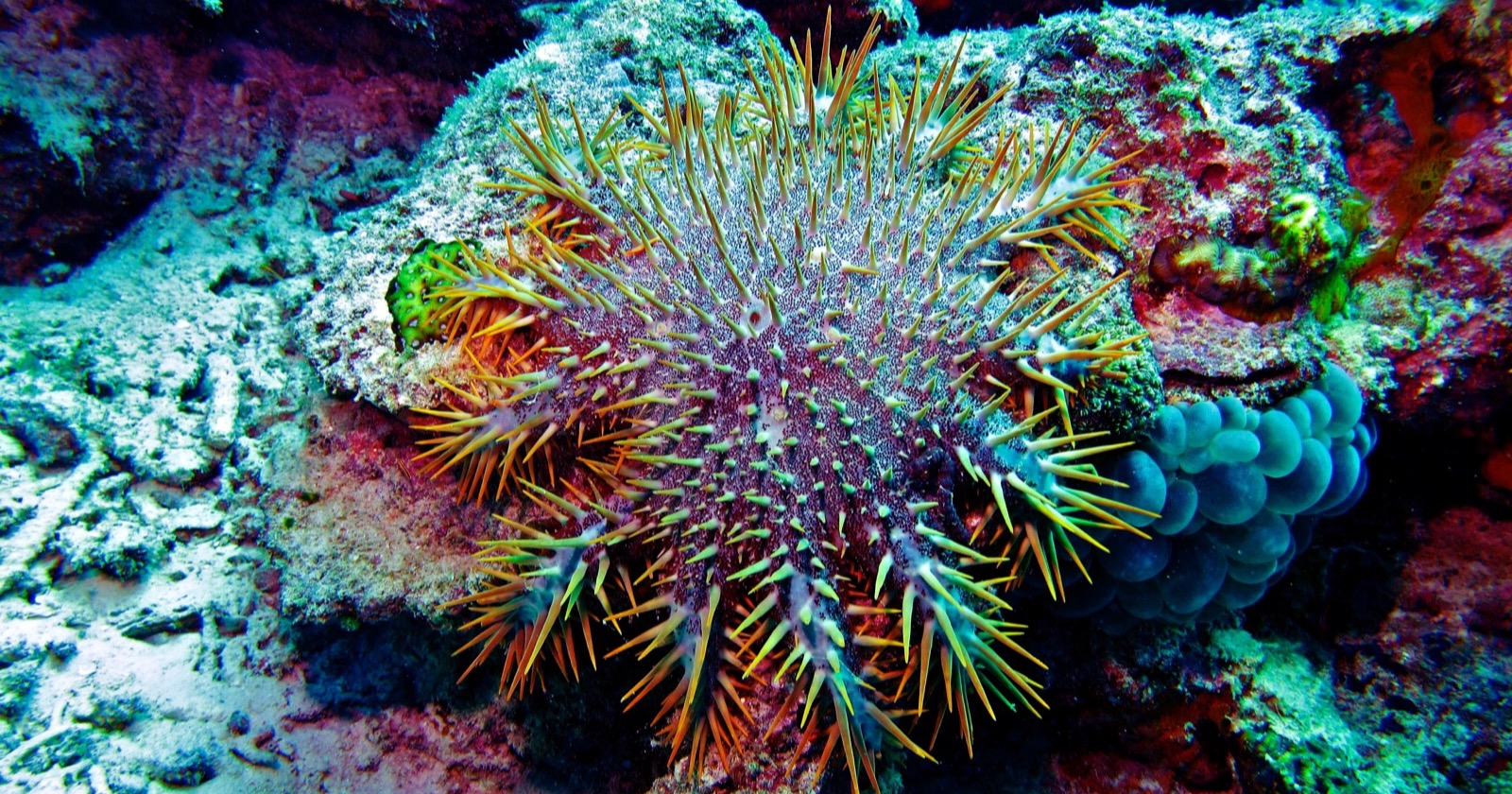
Crown-of-thorns seastars eat coral. On the Great Barrier Reef they are culled by the tens of thousands each year. Managers still cannot age a wild animal with any validated method, which is one reason the recruitment timing behind an outbreak is hard to reconstruct.
Sarah L. T. Kwong and colleagues at the Australian Institute of Marine Science and James Cook University built a DNA-methylation clock for Acanthaster cf. solaris and report it in Biology Letters on 9 September 2026. Trained on fifteen tank-reared animals of known age, the model missed true age by 0.31 years on average, plus or minus 0.22 years, in leave-one-out tests. A shorter clock of 14 sites is the version they offer for later assays. Both results come from captive animals between one and three and a half years old.
Invertebrate clocks stopped at arthropods
Epigenetic clocks estimate chronological age from DNA methylation, most often at cytosine-phosphate-guanine sites. They are well used in some vertebrates. In invertebrates they have been built for three arthropods: the European lobster Homarus gammarus, the jewel wasp Nasonia vitripennis, and the buff-tailed bumblebee Bombus terrestris. The wasp and lobster clocks use 5-methylcytosine. The bumblebee clock uses N6-methyladenine.
A 2025 perspective, which this paper cites, asked whether sparse methylation and divergent life histories make mammalian-style clocks a poor fit for invertebrates. Daphnia magna, in a separate 2025 study the authors also cite, showed no significant age association in genome-wide methylation. Vertebrate clocks already exist, including in cetaceans and fishes, which are deuterostomes. None had been published for a deuterostome invertebrate, the authors say. Some of those invertebrates, the authors note via their own 2025 methylome paper, carry intermediate genome-wide methylation rather than the sparse pattern the 2025 perspective worried about.
Crown-of-thorns seastars are echinoderms. They are also a management problem. Periodic population irruptions add to climate-driven coral loss across the Indo-West Pacific. After decades of study, the paper says, the mechanisms behind those irruptions remain poorly resolved. A central constraint has been the lack of a reliable way to age an animal. That limit has hampered efforts to reconstruct when a cohort settled, tie cohorts to the conditions that favour outbreaks, or refine the population models used to predict irruptions.
Size is a coarse age proxy at best. The authors give field rules of thumb for later testing, not as results of this clock. In ideal and stable environments an animal under 200 millimetres in diameter is probably younger than two years, and one over 350 millimetres is typically older than five. Those bounds are not what the model was trained on.
Known-age seastars from one facility
Twelve adults, six females and six males, were collected from mid-shelf reefs in the central Great Barrier Reef and spawned at the AIMS National Sea Simulator in December 2020 and December 2021. Offspring were settled and raised in aquaria. Diet shifted from crustose coralline algae to coral beginning at four months after settlement.
Tissue was taken at five ages: 1, 2, 2.5, 3 and 3.5 years, three animals at each age, fifteen samples in all. DNA came from snap-frozen pyloric caeca, extracted by a modified phenol-chloroform protocol and size-selected. Sequencing used Oxford Nanopore Native Barcoding Kit 24 V14 on a MinION Mk1C with R10.4.1 flow cells. Basecalling used Guppy v6.5.7 and a 5-methylcytosine model. Reads were mapped to the OKI-Apl_1.0 genome, accession GCF_001949145.1.
The methylation dataset was then filtered to sites common to every specimen with at least fivefold coverage. The DSS package fitted a linear model at each remaining site, with age as the explanatory variable, using methylated-read counts and total coverage so that variation in sequencing depth across samples was accounted for. Significance was a Wald test. Sites with a false-discovery rate below 0.05 were kept for the clock.
Leave-one-out cross-validation therefore has n equal to 15. Each animal is held out once. That is the whole of the leave-one-out test. There is no wild sample in the accuracy figures.
A genome-wide clock reduced to fourteen sites
Age-associated sites are sparse. Of 9,705,479 CpG dinucleotides in the reference genome, 1910 showed a significant age effect. That is 0.02 percent of the genome’s CpGs. In the jewel wasp, the authors note, a similarly small fraction of CpGs, 0.03 percent, was age-associated.
Fewer than 5 percent of those 1910 sites, 83 of them, fall in CpG islands. None were detected in ribosomal DNA. The team looked for both on purpose. Reduced-representation bisulfite sequencing, which enriches CpG-dense regions, is therefore unlikely to capture the signal here. So are rDNA-targeted clocks: those work in some vertebrate systems, and the lobster clock they cite is itself an rDNA clock, but none of the CoTS age sites landed in rDNA. The paper’s practical implication is that invertebrates with similar methylation landscapes may benefit from whole-genome approaches.
Elastic net regression on the 1910 sites, evaluated by nested leave-one-out, gave an R-squared of 0.86 between predicted and known age. Mean absolute error was 0.31 plus or minus 0.22 years. Alpha was set to 0.5. Lambda was chosen as the value within one standard error of the minimum from an inner tenfold cross-validation. A fivefold cross-validation, which holds out larger test chunks, gave 0.25 plus or minus 0.18 years on the test folds.
The authors translate 0.31 years as about 4 to 6 percent of an estimated lifespan of 5 to 8-plus years, and as within 9 percent of the oldest age they actually tested. The second comparison is the one this dataset can actually support. The oldest animals in the clock are 3.5 years old. The 8-plus-year end of the lifespan range is outside the training set.
The abstract and Table 1 present an optimized clock of 14 CpG sites, the ones selected in every one of the fifteen leave-one-out models, then fitted on the full dataset. Table 1 lists genomic positions, coefficients, and Pearson correlations with age, all negative and between minus 0.90 and minus 0.95. The model intercept is 4.5356384. Associated genes, where named, include a sodium-dependent phosphate transporter, a protein quaking-A-like, and several uncharacterized loci. That 14-site model is a resource for targeted assays such as multiplex bisulfite amplicon sequencing or Nanopore adaptive sequencing. Its accuracy was not the leave-one-out accuracy. That figure belongs to the cross-validated models built from the 1910 candidate sites.
Raw reads sit in the NCBI Sequence Read Archive under BioProject PRJNA1429840. Analysis scripts are on Zenodo.
The tank sample behind the 0.31 years
CoTS on the Great Barrier Reef settle in annual cohorts, the product of a well-defined summer spawning season. If a clock this tight held up in the wild, it could separate year classes. The paper says so as a conditional. The accuracy numbers are from animals reared in one facility, on one diet schedule, at five points that stop at 3.5 years.
Fivefold cross-validation looking comparable to leave-one-out, 0.25 against 0.31, is not a wild-animal result. It is another split of the same fifteen.
Exact ages of wild CoTS cannot be known. Size bands could be a first check. Animals reared on other diets, temperatures or pH, and older animals, would test whether the 1910 sites are age sites or tank sites. They call that a substantial but valuable investment.
That 0.31 years is a little under four months, and it is the average miss on fifteen captive animals, not a field specification.
The comparison that holds is the phylogenetic one. After lobster, wasp and bumblebee, a deuterostome invertebrate can carry a methylation age signal. The comparison that does not hold, yet, is tank versus reef.
On the reef, tens of thousands of seastars are removed in control programmes each year. An age profile of those carcasses would be useful if the clock survives the jump. This paper supplies the tank version, the 14 sites, the raw reads, and a clear limit: fifteen known-age animals, none of them wild, none of them older than three and a half years.
If those 14 sites still tell the age of a seastar taken off a living reef, the rest of this becomes a management tool. Until somebody runs that test, can a clock trained on fifteen tank animals separate one summer’s recruits from the next?