

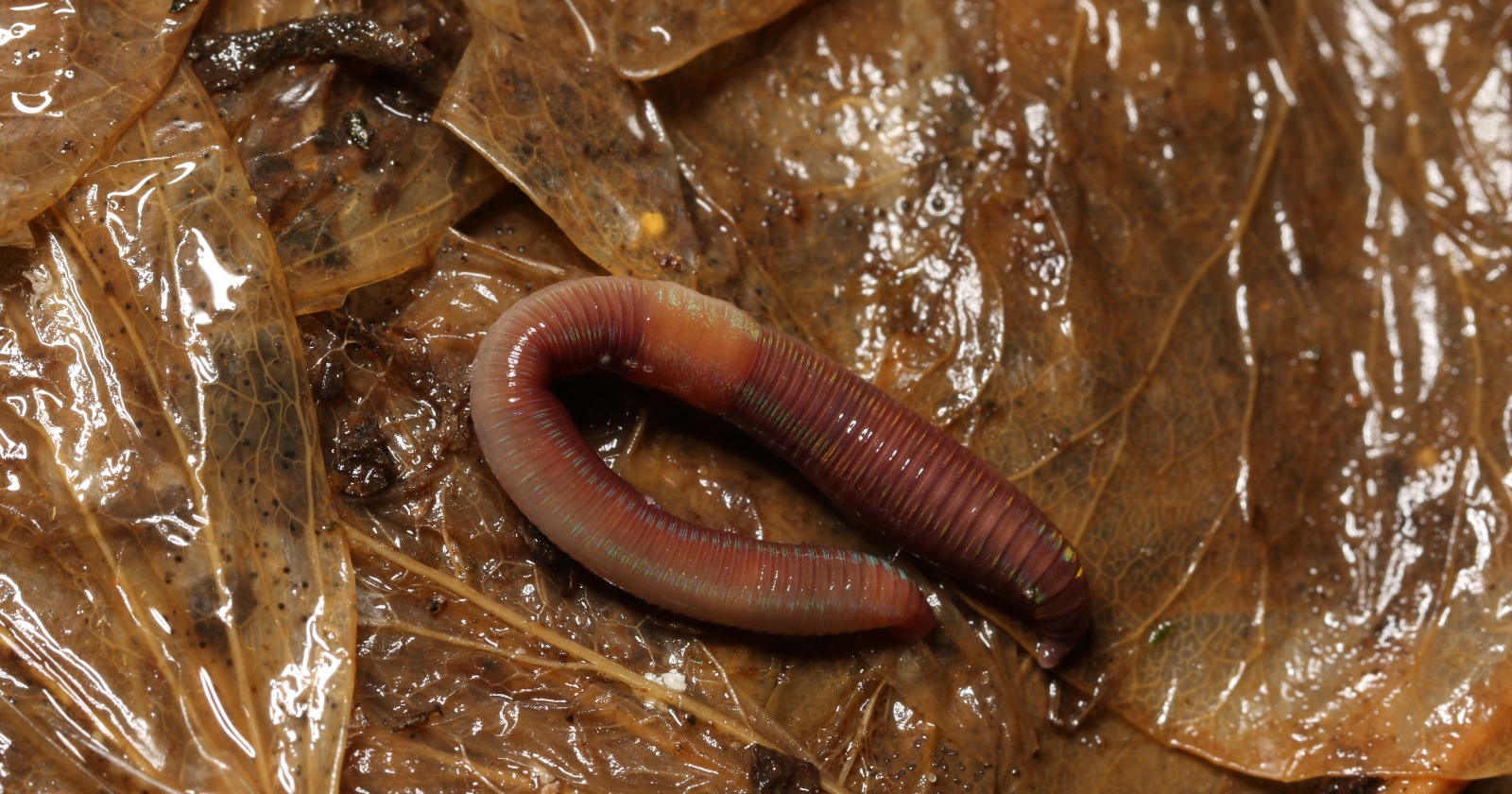
Researchers at the Max Planck Institute for Marine Microbiology report that gutless marine worms make an enzyme that breaks down the bioplastic their skin bacteria build up, a job that had only ever been demonstrated in bacteria and fungi, with two species of single-celled protist known to carry the sequence but never tested.
Sequences resembling that enzyme had already been annotated in animal genomes. Nobody had shown that any of them worked. The new result is the functional demonstration, plus a phylogeny that puts the enzyme in animals much further back than expected. The work appeared on 13 August 2026 in Nature Ecology & Evolution, by Caroline Zeidler, Nicole Dubilier, Maggie Sogin and colleagues in Bremen, and is open access.
The material at the centre of it is a family of polyesters called polyhydroxyalkanoates. Numerous bacteria and halophilic archaea build them as a carbon and energy reserve in a specific situation: carbon is available, but something else needed for growth, such as oxygen or nitrogen or phosphate, is running short. The polymer accumulates inside the cell as granules that can reach 90 percent of the microorganism’s dry weight, and it turns up in soils, activated sludge and marine sediment. The enzymes that cut it back apart are polyhydroxyalkanoate depolymerases, or PHADs.
A worm that lives off the bacteria under its skin
Gutless oligochaetes have no mouth and no digestive tract. They are thin, pale animals living in marine sand, and the Bremen institute describes the study’s species, Olavius algarvensis, as about two centimetres long. Their white colour comes from a dense layer of bacteria packed beneath the cuticle, and those bacteria are the animal’s entire food supply. The worm engulfs them in its own skin cells and digests them there.
The dominant partner is a sulfur-oxidising bacterium named Candidatus Thiosymbion algarvensis. It stores a mixed polymer of polyhydroxybutyrate, polyhydroxyvalerate and polyhydroxymethylvalerate, and the store is large: up to 42 percent of the carbon in the symbiont, and 14 percent of the carbon in worm and bacteria combined. Measured per animal, that comes to 0.7 micromoles of carbon.
Animals do make polyhydroxyalkanoates of their own, of a different kind. Theirs run to perhaps 30 to 200 units and are often bound to proteins or sitting in membranes, where they appear to play regulatory or structural roles. Nothing in that suggested an animal would carry the enzyme that dismantles the bacterial storage form.
How much of the polymer is out there in nature is poorly pinned down. Reported soil concentrations run from 1.2 to 4.3 micrograms of polymer carbon per gram, which works out to between 0.001 and 0.16 percent of soil organic carbon. Marine sediment estimates span nearly five orders of magnitude, from 2 to 60 nanograms per gram in the deep sea, through 140 in estuaries, to 140,000 in mangroves. Standard analytical methods were built for laboratory cultures, and the authors expect them to miss much of what occurs in the environment.
Inside the skin cells
The gene, phaZ, spans about 19,000 base pairs of the worm’s genome and is split into ten exons by nine introns, which is the signature of a eukaryotic gene rather than a stretch of bacterial DNA sitting in the assembly. The protein is 333 amino acids long. Its closest structurally characterised relative is a PHAD from the fungus Penicillium funiculosum, 318 amino acids and 31.2 percent identical, whose crystal structure has been solved. The catalytic triad and oxyanion hole, the parts that attack the polymer, sit in the same positions in both.
Transcripts turned up in 12 of 15 individual worms, and the protein itself was detected in eight proteome samples. Fluorescent probes against the messenger RNA put the signal in the epidermal cells directly beneath the cuticle, which is where the worm digests its bacteria. Probes against the symbiont’s own version of the enzyme lit up the bacterial layer above instead, with no overlap between the two.
Expressed in E. coli, the worm enzyme produced clearance zones on plates of denatured polymer after 24 hours, and mass spectrometry confirmed it was releasing hydroxybutyrate monomers. It broke down 11 percent of the polymer offered, against 14 percent for a well characterised bacterial enzyme from Paucimonas lemoignei run as a positive control, efficiencies the authors call similar.
The enzyme works only on polymer that has already been released and denatured. The worm cannot reach the store inside a living bacterium, because that would mean pushing an animal enzyme through a bacterial envelope, a process not known for any animal enzyme. The polymer becomes available once digestion has already broken the cell open, and not before.
Storage polymer and packaging plastic
Naturally occurring storage polymer and manufactured polyhydroxyalkanoate plastic are not the same thing, and the paper says so: the existing degradation literature works on industrial or experimental plastics that differ structurally from the natural version. The enzyme assays themselves used commercially sourced polyhydroxybutyrate and a polyhydroxybutyrate-polyhydroxyvalerate copolymer, so the tests measure what these enzymes do to a defined laboratory polymer, not what they would do to a finished compostable product.
Storage polyhydroxyalkanoates are still less than 4 percent of the global bioplastic market, so the polymer these enzymes were tested on is a small share of what is sold as bioplastic.
The authors’ own claim is narrower and hedged. Earthworms and other soil animals carrying these enzymes, they write, “may be able to contribute to the full degradation of sPHA-based plastics.” The nearest supporting precedent is earlier work showing earthworms partially degrading polylactic acid, a different material again.
The bacteria appear unable to spend what they store
All 15 Thiosymbion species the team examined carry a depolymerase of their own, but none was found to carry the machinery that comes next. Searching symbiont genomes and transcriptomes for the three enzymes known to oxidise the products of polymer breakdown, beta-hydroxybutyrate dehydrogenase, hydroxybutyrate-dimer hydrolase and 3-hydroxybutyryl-CoA dehydrogenase, turned up none of the three in any of the 15.
Eight of the ten host species with usable transcriptomes express the first of those enzymes. The pattern points to a division of labour in which the bacteria build and regulate the store while the animal collects the energy, and because the gap is uniform across the whole group, the authors read it as an early and durable feature of the partnership.
The gene shows up in sponges, earthworms and springtails
Beyond the gutless worms, database searches recovered 195 depolymerase sequences from 66 animal species across nine phyla, among them sponges, molluscs, annelids, arthropods, rotifers, echinoderms and chordates. Counting the gutless oligochaetes, 81 animal species now have one. The known protist tally went from two species to 18, across three major supergroups.
Three of those figures read differently in the paper’s abstract than in its results section: more than 66 animal species against a flat 66, 19 protist species against 18, and the symbiont’s 42 percent given there as a share of cellular carbon stores rather than of symbiont carbon. The figures in this article are the results-section ones. The abstract also calls the animals gut-bearing, when the set includes a sponge that has no gut.
Those are predictions from sequence, and the paper distinguishes them from the ones that were checked. Across the new set, the catalytic triad and oxyanion hole are fully conserved, at 100 percent coverage and 60 to 100 percent identity. The substrate-binding site, the part that grips the polymer, is a looser match at 52 to 93 percent coverage and 8 to 42 percent identity. About three-quarters of the animal sequences carry a signal peptide, which suggests they are secreted.
Four more enzymes were built and tested: one from the sponge Amphimedon queenslandica, one from the earthworm Lumbricus rubellus, and two from the springtail Folsomia candida. All four cut both the homopolymer and the copolymer down to monomers. That is four sequences out of 195, from three species out of 66: the enzyme family is demonstrated in a handful of widely separated lineages and inferred in the remainder. The team did rule out the likeliest false positives, showing by phylogeny that the sequences form their own clade apart from cutinases and lipases, which share the catalytic motif but cannot fully break the polymer down.
The animal-ancestor claim rests on a 43.8 percent bootstrap
The largest evolutionary inference in the paper is that the last common ancestor of animals already had this enzyme, which would make it roughly as old as animals. The supporting pattern is that protist sequences branch early relative to the animal ones, and that the only non-bilaterian sequence recovered, the sponge, sits deep in the tree.
Support for the node joining protists and animals is 43.8 percent. The authors state the figure and argue that the alternative, several independent origins of very similar enzymes, is less likely. Broader sampling of protists and early-branching animals is what would confirm it.
Two anomalies are recorded alongside. Depolymerase sequences from two bdelloid rotifers group with fungal and bacterial ones instead, which the authors attribute either to horizontal gene transfer, common in that group, or to contamination. Sequences from one predatory protist genus fall next to two animal subclades at 57.4 percent support, which is to say without any.
None of this establishes a rate. Degradation rates for the natural polymer in soil and water are, in the authors’ words, completely unknown. Earthworms swallow soil at the top of the concentration range quoted earlier, and springtails carry as many as 14 copies of the gene, F. candida among them. What happens to that carbon over a week with those animals in the soil?