

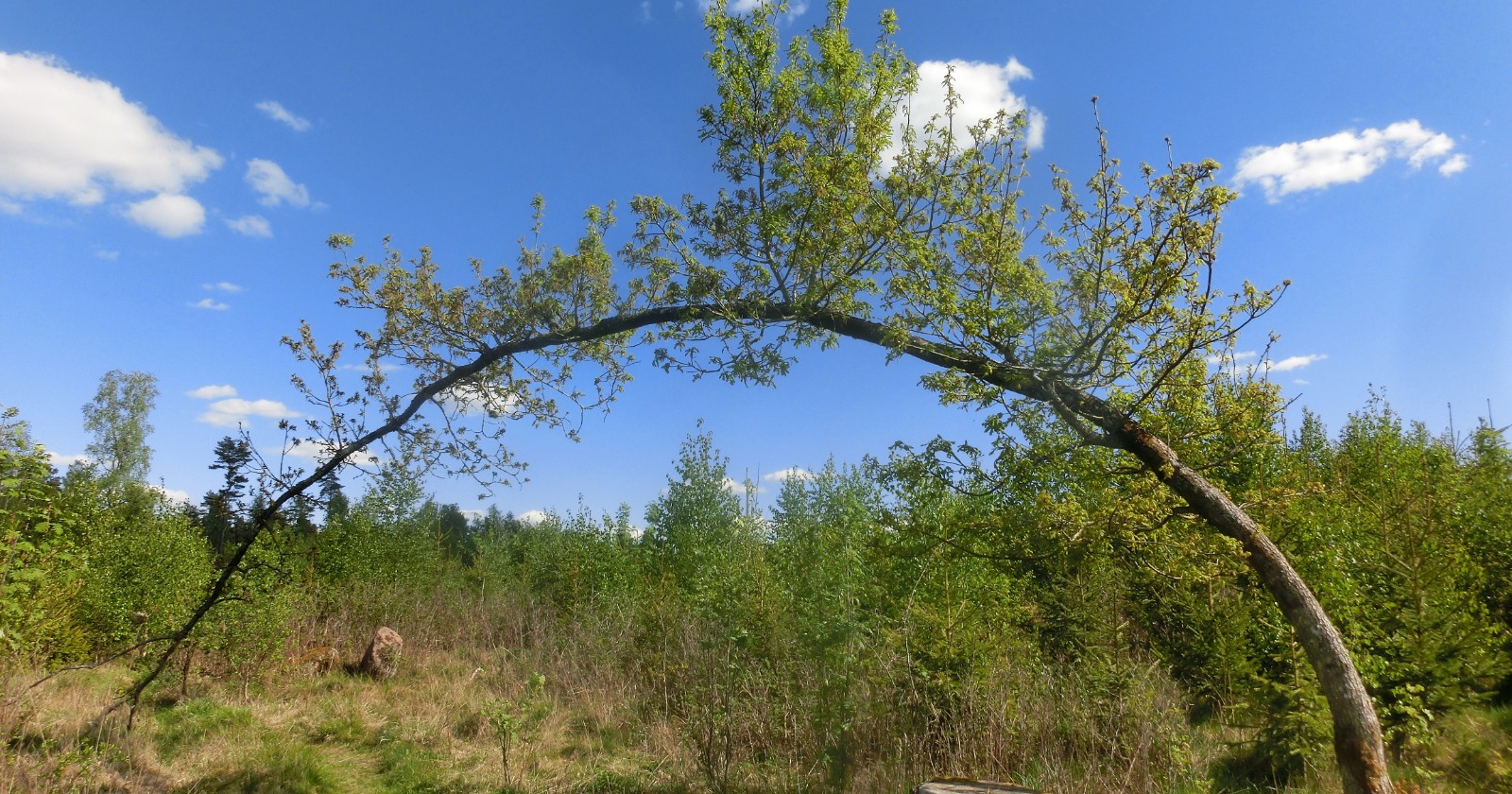
Proprioception is the sense that lets a person touch their nose with their eyes shut. It is the body reporting on its own shape.
Trees have a version of it. A study published in New Phytologist on 2 September follows ten young poplar stems. All ten were tipped onto their sides and allowed to bend back up; seven were then deprived of any usable information about which way was down. The wood each one laid down while that information was missing is the evidence, and it is dated.
A stem on its side
The plants were hybrid poplars, Populus tremula × Populus alba, clone INRA 717-1B4, raised by micropropagation and about 26 centimetres tall when the experiment began. The team is based mainly at PIAF, a joint laboratory of INRAE and Université Clermont Auvergne at Clermont-Ferrand, and one co-author ran the microfibril-angle measurements at the SILVATECH platform, an INRAE facility in Nancy.
Each stem was tilted to 90 degrees from vertical inside a spherical growth cabinet the team calls an isotropic light sphere, or, fitted with its built-in clinostat, an isotropic and agravitropic light sphere. It lights the plant evenly from every side, so there is no direction to grow towards. A camera fired every 30 minutes, day and night, synchronised to the clinostat so that every frame caught the stem in the same orientation.
Three control trees stayed like that for 21 days with no rotation, given nothing beyond the leaf trimming and the painted mark every plant in the experiment received. Seven experimental trees got the extra step. Once the painted mark 10 centimetres up the stem had risen to within 50 degrees of vertical, after 10 to 12 days, the clinostat began turning. It rotated the whole plant around a horizontal axis at two rotations a minute, roughly 2,880 rotations a day.
Plants read gravity through statocytes, cells holding dense starch grains that settle downward. Turn the plant continuously and the grains never settle, so graviperception is compensated away. Gravity is still there; the tree can no longer use it.
That is the whole trick, and it is also the first limit on the result. Seven saplings of one hybrid clone in a rotating cabinet is a narrow base, and the anatomical numbers below rest on five or six of them.
Curving up
For about five days a tilted stem simply sagged under its own weight. Then active bending took over and it curved upward, reaching a fairly even curvature along its length by about day 10.
The three control trees carried on from there without interruption. Their tips straightened while the bend concentrated near the base, settling into a steady shape: a tight curve at the bottom with a straighter section above it, at an average basal curvature of 0.14 per centimetre.
The seven experimental trees had followed the same path through the sag and the curve-up, and were still on it at day 11.
After the clinostat came on
Switching on the rotation stopped the upward movement and started the reverse. The basal 10 centimetres straightened out evenly over another 20 to 30 days, ending at an average curvature of 0.046 per centimetre across the six plants the paper reports at that point. That is close to straight, and still statistically distinguishable from perfectly straight, at P = 0.001.
The reversal did not begin the moment the gravity signal was compensated. The Discussion puts the delay between the clinostat switch and the peak of the bend at about two days, while the Results describe the same gap as a few days in one place and as roughly ten days in another. The paper does not reconcile these figures.
Either version is a lag, and the authors flag it as something their model fails to predict. The model expects an immediate switch from curving to straightening. Auxin transport alone cannot account for a delay that long, so the authors also point to the physical business of making wood. Cambial cell production takes about two days, and the gelatinous layer’s biomechanical action involves a viscoelastic component with a characteristic time of about 38 hours in earlier work. They present all of this as a refinement their results call for, since the same results support the model elsewhere.
The record in the rings
Woody dicots bend themselves using tension wood, a modified tissue whose fibres, in many angiosperm trees, develop a thick inner gelatinous layer of near-axially aligned cellulose. As that layer matures it is thought to generate a strong tensile stress along the fibre, and a crescent of it acts like a cable pulling one side of the trunk.
Cambium lays wood down in order, so a cross section is a chronology. Stain it with safranin and astra blue, and the tension wood shows up as a blue arc whose position in the ring says when it formed.
The sections told a two-part story. During the curving-up phase a blue arc formed on the upper side, and the extra wood there shifted the section’s geometric centre to 26.3 per cent of the section’s mean radius above the pith. After the clinostat came on, that arc stopped, a transient false ring appeared, and a second arc of blue wood began forming on the lower, convex side of the bend. By the end of the experiment the offset had reversed to 14.5 per cent below the pith.
Both arcs met every diagnostic the team applied for tension wood. The fibre-to-vessel ratio ran about three times higher than in the wood opposite, 63.6 against 22.9. The microfibril angle was statistically indistinguishable between them. The gelatinous layer on the lower side was the thicker of the two, at 2.70 micrometres against 1.97, which is the one measure that did separate them.
Tension wood has traditionally been described as the tissue that forms on the upper side of a leaning stem. In these trees it formed on whichever side the tree needed to pull on. The paper’s introduction says the result falsifies that textbook view; its abstract puts the same point more mildly, as revising it.
The alternative worth killing was mechanical. Active bending stores elastic energy in the stiff inner wood, and when the bending stimulus stops, that stored energy could unbend the stem all by itself, with nothing sensed and nothing decided. A spring-back of that kind requires no new tissue.
The sections show new tissue. Fresh gelatinous fibres were manufactured in the right place at the right time, in a sector that was outgrowing the face opposite it. Using the cambium positions dated to the clinostat switch and to the peak of the bend as time marks, the authors estimate that the sector making tension wood was growing three to five times faster in radius than the side opposite it.
The tree spent resources to straighten itself.
The model fit and its loose ends
Fitting a control-theory model of posture to the kinematics gave a proprioceptive sensitivity of 6.02 × 10⁻³ centimetres per degree-day. It also gave a dimensionless balance number of 2.17. The paper reports that as not significantly different from the 2.69 it derives from a study of the same poplar clone by an earlier study from an overlapping team, but with a 95 per cent confidence interval narrower by a factor of 18.
Two things in the paper’s own statistics do not hold together. It reports that the radial growth rates of the two stem segments “were not significantly different” while printing a P value of 0.003 beside them. It also supports a claim that growth rates held constant across the clinostat switch with a Shapiro test, which tests normality rather than comparing means. Neither is relied on here, and neither carries the main result.
The word that has travelled with the story is muscle. It comes from the INRAE press release that phys.org ran under a headline calling tension wood a muscle, so it is the institution’s press office speaking rather than the paper. Nothing in the mechanism the paper describes involves a motor protein contracting. There is a cell wall layer whose maturation is thought to generate the tensile stress that does the pulling.
Two limits remain on the reach of the finding. Whether the same self-sensing operates in the soft growing tip as well as the woody trunk was not resolved by these experiments. The authors argue that the strong similarity of tropic kinematics across growth zones strongly suggests the mechanism is general across growing tissues, and their expectation that it holds across flowering plants is likewise an inference from earlier kinematic similarity between poplar and oak.
The reference the tree was left with
The interesting part is what the poplar was steering by. With gravity unreadable, the only information left to it was the shape of its own trunk, and that turned out to be enough.
The work was funded in part by CNES, the French space agency.