

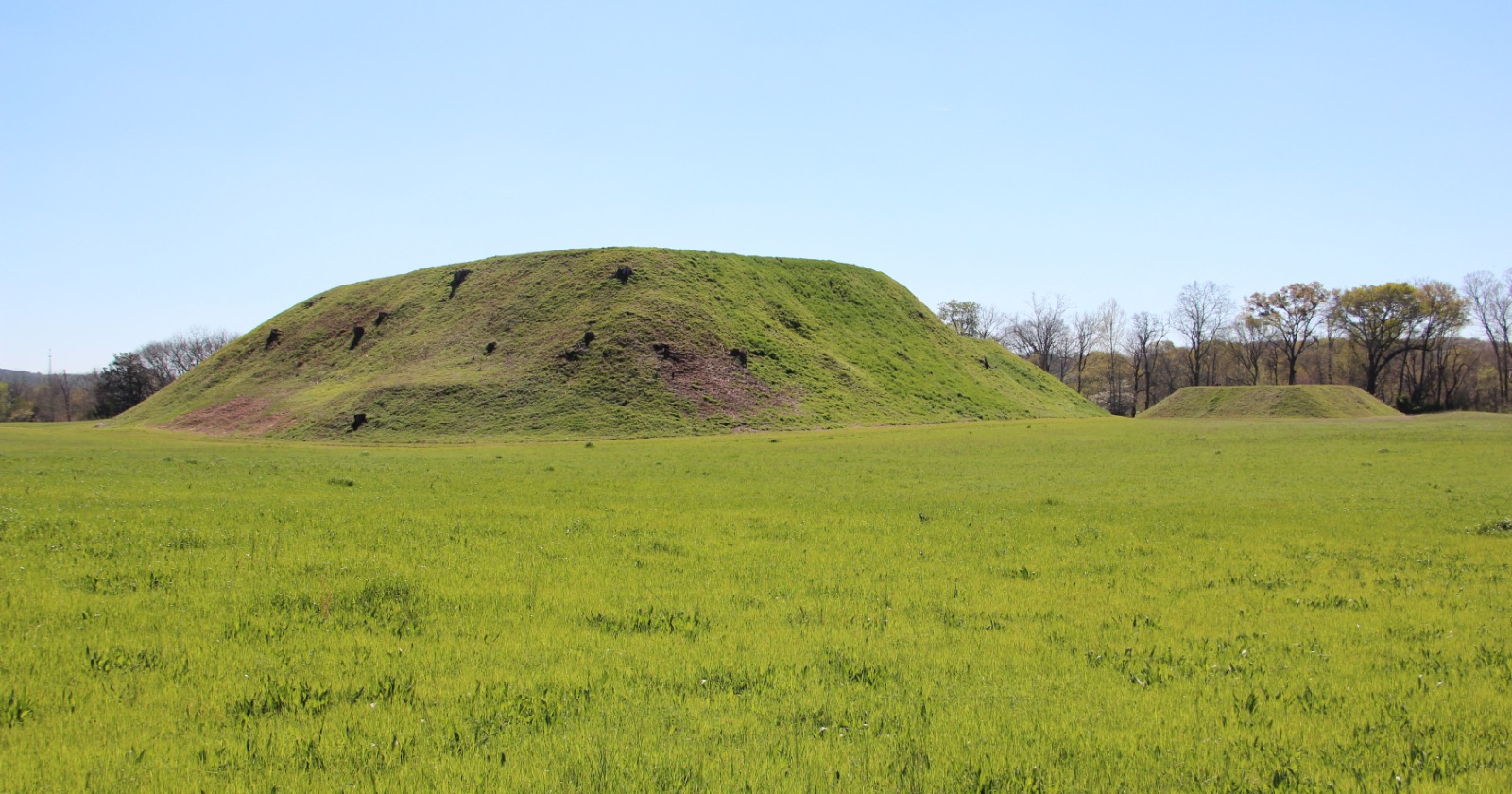
Fragments of ancient Theobroma cacao DNA have been identified in residues taken from the inside of two pottery sherds excavated at the Etowah site in northwest Georgia, from features dated to the eleventh and twelfth centuries CE. Adam King of the University of South Carolina and eight colleagues report the result in PLOS One, and describe it as the first evidence that cacao consumption was part of the Mississippian world, against a background the paper characterises as a lack of clear evidence rather than a lack of claims.
That world was substantial. Mississippian mound-building towns and cities spread across the eastern United States between roughly 1050 and 1600 CE, and Etowah was among the most important of them at its fourteenth-century peak.
Cacao, in the paper’s phrasing, evolved and is adapted only to tropical climates. Its presence in a pre-contact context in the modern United States therefore has to have come from contact with people in or near the cacao-growing regions of Central and South America. The authors add that for now, neither a direct connection to Mexico nor one to the American Southwest is supported by archaeological evidence.
A holly bush with chocolate’s chemistry
The Etowah sherds had already been examined once. In 2017 King and colleagues published an absorbed residue study of 31 sherds from the site, testing for four compounds associated with cacao: theobromine, theophylline, caffeine and paraxanthine. All four turned up in only three of the samples. Twenty-one of the 31 contained at least two, a count the new paper’s introduction rounds to “almost half” and its own later summary gives as 21 of 31.
The obvious reading of that would be chocolate. It failed on a detail.
The same study also tested yaupon holly, Ilex vomitoria, a shrub native to the Gulf and Atlantic coasts of the United States and the source of the drink early European observers called Black Drink. Contrary to what had been assumed, the yaupon samples contained theophylline as well as theobromine and caffeine. The compound treated as chocolate’s chemical fingerprint was not exclusive to chocolate.
So the 2017 team concluded that the commonly accepted biomarkers of caffeine, theobromine and theophylline cannot separate a residue left by cacao from one left by yaupon holly, and they chose the parsimonious answer: the locally available shrub. It was their separate finding that most of the sherds showed evidence of caffeinated drinks at all that came after accounting for modern contamination. The chemistry pointed to someone at Etowah drinking something caffeinated. It could not say what.
That is also what makes this paper’s claim to a first narrower than it sounds. Residues reported as cacao from Mississippian vessels in the Ohio and Mississippi valleys go back more than a decade, and this paper’s position, stated against those earlier studies by name, is that chemistry of that kind cannot separate cacao from yaupon holly. Clear evidence, in its words, is what has been lacking.
From raw reads to cacao-specific sequences
The three sherds that had produced all four alkaloids were taken forward for ancient DNA analysis. Their interior surfaces were abraded with clean sandpaper and the resulting powder, the burr, collected on clean paper.
Extraction and library preparation were carried out in a dedicated ancient-DNA facility at the Musée de l’Homme in Paris, under positive air pressure with daily ultraviolet irradiation, to keep modern cacao DNA out of the reaction. Sequencing produced 502.9 million usable paired sequences.
Two filters were then applied in turn. The first mapped the reads against the cacao reference genome and retained 6,360 of them, which the paper gives as 0.0012 per cent. The second ran those against the NCBI nucleotide collection and kept only the reads whose best match anywhere in that database was cacao itself.
Thirty-six sequences survived both filters across the three samples. Two of the sherds, labelled Sample 3 and Sample 25, accounted for 12 and 18 of them, and only those two cleared the threshold of at least five unique cacao-specific sequences that the same group had previously set for declaring cacao present in an archaeological residue. The third sherd yielded a small number of reads whose best match was cacao, but too few unique ones to pass. No selected sequence matched a wild relative first, and no cacao-specific sequence above the threshold appeared in the negative controls, on which basis the authors state as a hypothesis that contamination and wild relatives are ruled out.
The fragments behave like old DNA
The sherds passed through nearly six decades of washing, paper bags, shoeboxes and plastic bags before anyone sampled them in 2013. The paper says there are many points from recovery through analysis where modern chocolate could have been introduced, and argues that the DNA recovered from these residues, taken as a pool, carries the physical signature of age. Those checks were run on the reads that mapped to the cacao genome, not on the 36 cacao-specific sequences themselves.
Ancient DNA breaks into short pieces. Read-length distributions for the Etowah residues gave a mean fragment length of 84 base pairs.
As a second check, the team ran real-time PCR with three primer pairs targeting the same mitochondrial gene at increasing lengths: 100, 290 and 543 base pairs. Amplification fell away or failed entirely at 543 base pairs in the archaeological samples. Two modern cacao controls, Criollo and Amelonado, amplified the long and short fragments with similar intensity.
Age is not the only question the sherds raise, and the paper answers the second one two different ways. Its discussion states that despite the distances involved, “ancient DNA confirms the site’s inhabitants consumed cacao.” Its methods section is considerably narrower: “While we cannot be sure the pottery vessels we sampled actually held cacao, for our purposes the presence of ancient cacao DNA is the significant finding.”
The narrower version is the one the evidence supports, and the reason is in the archaeology. The sherds came from borrow pits packed with feasting debris: animal bone, broken pottery, organic materials. Ancient cacao DNA sitting on a sherd in that context could have reached the sherd after the vessel was discarded, which the authors say explicitly.
The analysis therefore establishes that ancient cacao DNA is present on Etowah pottery from features archaeologists date to the eleventh and twelfth centuries. That dating is inherited from the features, not measured on the DNA. No cacao seeds or other plant parts have been recovered from the site, and the sample is two vessels.
A preliminary answer on origin
Cacao is not genetically uniform. Eleven genetic groups are currently recognised in the species, and the team compared the ancient sequences against a reference panel of 76 modern accessions covering all eleven, plus five accessions from four wild relatives.
After discarding positions at fragment ends where post-mortem damage can mimic real variation, 20 usable single-nucleotide positions shared with the reference panel were available for Sample 3 and 18 for Sample 25. On those, Sample 3 sits closest to the Amelonado group and then Marañon; Sample 25 sits closest to Curaray and then Marañon. Cacao from those groups has been identified in Maya contexts in Belize and in Jama Coaque contexts in Ecuador.
Eighteen and twenty informative positions is a thin basis for an origin claim. The authors describe the ancestry work as preliminary results that must be confirmed by the identification of new specific cacao sequences and subsequent SNPs, and they point out that genetic groups which originated in South America were moved into Central America in the deep past, so a genetic match does not by itself pin down a geographical source.
Back at the borrow pits
The pits were dug for fill, to raise the first earthen platform mound at Etowah, and were filled again with the remains of feasting. Vernon James Knight’s reading of Mississippian mound building, which the authors follow, treats it as a communal rite of world renewal.
If cacao was consumed at Etowah, this is where it was consumed: at the start of the city’s history, in the middle of the work of making the place.
Cacao is argued to have reached the American Southwest by the same period, where residues at Chaco Canyon were reported alongside copper bells, cloisonné and scarlet macaws from tropical Central America. That argument rests on theobromine, bolstered by material evidence of sustained contact with tropical Mexico, and theobromine is one of the compounds this team’s 2017 work concluded cannot separate cacao from yaupon holly. Of connections between Etowah and Central America the paper says there is very little material evidence, and the links running west, to the Caddoan edge of the Mississippian world, amount to small amounts of turquoise, Southwestern pottery styles and obsidian.
King and colleagues suggest that the other Etowah sherds with partial alkaloid signatures may also reflect cacao, and that residues previously reported from Cahokia and the Ohio and Mississippi valleys deserve the same reconsideration. They flag that as a hypothesis for further archaeogenomic work.
The raw sequence reads are deposited and public. The sherds they came off went into the ground between Mounds A and B, in pits dug for fill and filled with a feast.